
TL;DR

Get home appliances delivered free with Prime
- Fast, free delivery on millions of items
- Prime Video, Amazon Music and more included
- Member-only deals all year
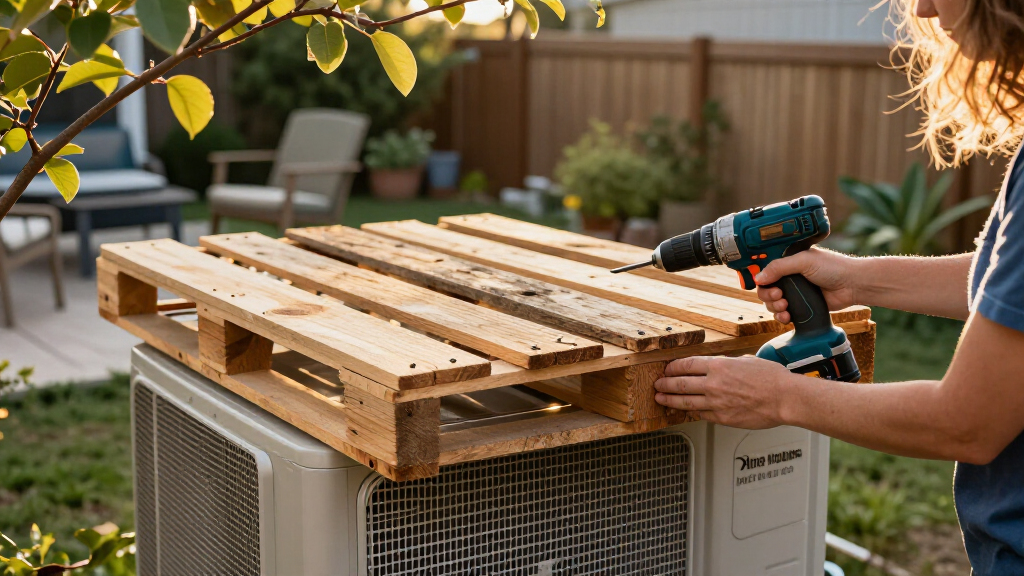
A Hunker report describes a Making Manzanita project that joins three pallet sections into a freestanding, three-sided screen for an outdoor air-conditioning unit. The design reuses wood, but the source advises leaving the top open, checking pallet condition and allowing room for airflow and service access.
A Making Manzanita DIY project uses three sections of reused wood pallets to form a freestanding, three-sided screen around an outdoor air-conditioning unit, according to a report by Hunker. The project offers homeowners a way to conceal the equipment with salvaged materials, while its open top and spacing from the unit are intended to preserve access and airflow.
The screen is assembled by cutting pallet sections to size and screwing them together in a U shape. The source says the pallets can remain mostly intact, with the horizontal slats forming the visible faces. A circular saw, tape measure, drill and screws are listed among the materials and tools. The article presents the structure as freestanding, without an anchor.
Hunker says measurements should be based on the specific equipment, with the screen made several inches larger and taller than the unit. It cites 12 inches of clearance on every side as a minimum for access during service, and says the screen can be moved because it is not fixed in place. The top should remain open to support airflow.
Possible finishing changes include exterior stain or paint, added boards at the corners, solar lights or finials, short blocks at the base, and planters attached to the outside. The report also suggests gravel or mulch around the screen. These are optional decorative ideas; the source does not provide test results on their effect on cooling performance.
A Reuse Project With Airflow Limits
The idea turns discarded lumber into a small outdoor screen and may appeal to homeowners seeking an alternative to a store-bought cover. Its practical value depends on the details around the equipment: an enclosure that is too close or blocks airflow could interfere with operation or make maintenance harder. The report’s open-top design and cited clearance guidance are central to using the concept responsibly.
There are also limits to what the source establishes. It describes a project and its construction approach, but does not report measured cooling efficiency, durability over time, or a verified total cost. Pallets may be free in some cases, but the article does not document material availability or expenses for an individual build.
Products Worth Considering

LEVOIT Vital 100S-P Smart Air Purifier with Washable Pre-Filter

Levoit Core 600S-P Smart Air Purifier for Large Rooms

Blueair Blue Pure 211i Max Air Purifier
As an affiliate, we earn on qualifying purchases.
How the Pallet Screen Is Built
The Hunker report attributes the design to Making Manzanita. It describes three pallet sections joined with screws, with the front and side panels forming a screen around the outdoor unit. Because the structure is not nailed down, the report says it can be moved aside for service work.
Hunker lists stores, warehouses, construction sites and Facebook Marketplace as possible places to find pallets, but availability varies. It advises avoiding pallets marked MB, which it says indicates treatment with methyl bromide, and inspecting used wood for structural problems. The report does not identify a particular pallet source or confirm that any given pallet is suitable.
“The project uses three pallet sections screwed together to create a three-sided screen.”
— Hunker, describing the Making Manzanita project
Performance and Build Costs Unreported
The supplied report does not give a measured airflow or cooling test, a long-term durability assessment, or a full project budget. It also does not specify the dimensions of the featured unit or provide a universal screen size; dimensions must be adapted to the equipment and its installation. The condition and treatment history of reclaimed pallets can vary, so the source’s general guidance cannot establish the suitability of a particular piece of wood.
Measure Before Cutting Pallets
For anyone adapting the idea, the next steps described in the report are to measure the unit and surrounding space, inspect the pallets, cut three sections to fit, and join them with screws. The finished screen should keep its top open and leave the clearance needed for airflow and service access. The source offers no scheduled follow-up or further reporting on the project.
Key Questions
How many pallets does the reported screen use?
The design uses three pallet sections joined into a U-shaped surround.
Does the screen cover the top of the AC unit?
No. Hunker says to leave the top open to allow airflow to the outdoor unit.
How much space should be left around the unit?
The report cites a minimum of 12 inches on every side for service access. Follow the equipment manufacturer’s instructions and applicable local requirements for the specific installation.
What should I check before using reclaimed pallets?
Inspect the wood for structural problems and avoid pallets marked MB, which the report associates with methyl bromide treatment.
Source: rss