For a balcony solar setup that can feed power into a home circuit, I would start with the Cosmoxstar 1200W Micro Inverter for its stated output and dual MPPT inputs, or the 800W Micro Inverter for a lower-output alternative with app monitoring. If your priority is the panel rather than the grid connection, the Renogy ShadowFlux 400W two-panel set is the more shade-aware panel pick. Those options do different jobs: the inverter listings do not include solar panels, while the Renogy panel kits do not include a grid-tie inverter.

Get home appliances delivered free with Prime
- Fast, free delivery on millions of items
- Prime Video, Amazon Music and more included
- Member-only deals all year
That distinction drives my ranking. These five products are not equivalent, complete balcony kits. They span grid-tie inverters, standalone panels intended for battery systems, and a small lighting kit. I rank them by how closely their stated features fit a balcony use case, while calling out missing components, electrical compatibility, and unclear specifications. Before buying, check your local rules for balcony generation and confirm that the inverter, panels, connection method, and household electrical system are compatible.
Complete the kit


Key Takeaways
- Cosmoxstar 1200W is the most capable listed inverter option, but it requires compatible panels and a 110V grid connection.
- The 800W micro inverter adds dual MPPT and Wi-Fi monitoring, though its listing conflicts between 800W and 1200W output figures.
- Renogy ShadowFlux is the panel choice for balconies with intermittent shade; it still needs a suitable inverter or charge controller and battery setup.
- Renogy’s standard 400W N-Type kit suits compact off-grid and battery projects better than a ready-to-plug-in balcony system.
- IOENC’s 15W kit is for lights and small-device charging, not meaningful household power generation.
| Cosmoxstar 1200W Solar Micro Inverter with Dual MPPT and WiFi Monitoring |  | Best Inverter for Higher-Output Balcony Setups | Stated power output: 1200W | MPPT: Dual | Conversion efficiency: Up to 96% stated | VIEW LATEST PRICE | See Our Full Breakdown |
| Renogy ShadowFlux 400W N-Type Solar Panel, 2-Pack |  | Best Panels for Partly Shaded Balconies | Total panel power: 400W | Panel configuration: 2 × 200W | Cell type: N-Type, 16BB | VIEW LATEST PRICE | See Our Full Breakdown |
| Renogy 400W N-Type Solar Panel Kit (2x 200W), 16BB High-Efficiency for RV, Van, and Off-Grid Systems |  | Best Panel Set for Compact Battery-Based Systems | Total power: 400W | Panel configuration: 2 × 200W | Cell type: N-Type monocrystalline | VIEW LATEST PRICE | See Our Full Breakdown |
| 800W Micro Inverter with Dual MPPT, WiFi App Control, IP67 Waterproof and Plug‑and‑Play Design |  | Best Inverter for Monitoring and a Lower-Output Build | Advertised output: 800W in title and description; 1200W in specifications | Conversion efficiency: 96% stated | MPPT: Dual | VIEW LATEST PRICE | See Our Full Breakdown |
| IOENC 15W Solar Panel Kit with 4 LED Bulbs |  | Best for Balcony Lighting and Small Devices | Panel power: 15W | Battery: 12V, 4Ah rechargeable | Bulbs: 4 SMD LED bulbs, over 100 lumens each | VIEW LATEST PRICE | See Our Full Breakdown |
| balcony solar panel kit | Output voltage | Dimensions |
|---|---|---|
| Cosmoxstar 1200W Solar Micro I | 110V | — |
| Renogy ShadowFlux 400W N-Type | 24V DC | 49.7 × 30.1 × 1.2 inches per panel |
| Renogy 400W N-Type Solar Panel | 24V DC | 49.7 × 30.1 × 1.2 inches per panel |
| 800W Micro Inverter with Dual | 110V listed | 7.7 × 1.65 × 8.94 inches |
| IOENC 15W Solar Panel Kit with | — | — |
More Details on Our Top Picks
Cosmoxstar 1200W Solar Micro Inverter with Dual MPPT and WiFi Monitoring
The Cosmoxstar 1200W earns the first position because it has the clearest stated high-output role among these options and includes dual MPPT tracking. Separate MPPT channels can help the inverter manage two panel inputs under different conditions, which is useful when a balcony has uneven sunlight or panels face slightly different directions. Its 16–60V DC input range, IP67 enclosure, and included 16.4-foot AC cable also make the feature set relevant to an outdoor installation.
This is still an inverter only, not a full kit: buyers need compatible panels, and the listing specifies a 110V grid connection. That makes it a stronger fit for someone assembling a grid-tied system than for a renter seeking a self-contained panel-and-battery package. Compared with the 800W inverter, the Cosmoxstar has a more straightforward 1200W output claim, though both share dual MPPT, Wi-Fi monitoring, and an IP67 rating. Its listed two-year warranty is a modest reassurance, not a substitute for checking the installation and support terms.
I would put this ahead of the panel-only Renogy products for a buyer who already has suitable panels and wants a grid-connected inverter. I would not rank it as a complete balcony kit, because no panels are included and the 110V requirement narrows compatibility. The stated 1200W output also should not be taken as a promise of that much generation: panel capacity, sunlight, system limits, and local rules all affect usable output.
Pros:- Stated 1200W output with dual MPPT inputs
- Wi-Fi app monitoring and a 16.4-foot AC cable
- IP67 enclosure for outdoor exposure
- 16–60V DC input range and a listed two-year warranty
Cons:- Panels are not included, so the product is not a complete kit
- Requires a 110V grid connection
- Real output depends on compatible panel capacity and installation conditions
Best for: A buyer building a grid-tied balcony system who already has compatible panels and a 110V connection.
Not ideal for: Anyone who wants a complete panel-and-inverter package, a battery-first off-grid system, or a unit confirmed for a different grid voltage.
- Stated power output:1200W
- MPPT:Dual
- Conversion efficiency:Up to 96% stated
- DC input range:16–60V
- Output voltage:110V
- AC cable:16.4 ft
- Warranty:2 years
Our verdict“I rank the Cosmoxstar first for its stated inverter capacity and balcony-relevant features, provided you already have compatible panels and a suitable 110V connection.”
Renogy ShadowFlux 400W N-Type Solar Panel, 2-Pack
Balcony railings, nearby buildings, and overhangs can cast shifting shadows across a panel. Renogy’s ShadowFlux 400W two-pack is the most specifically shade-oriented panel choice here: its stated ShadowFlux design aims to maintain generation in partial shade and reduce hot-spot risks. A pair of 200W N-Type panels also offers a useful 400W array in two pieces rather than one larger panel, giving buyers more flexibility to arrange the mounting footprint.
The panels carry a stated 25% cell efficiency and IP67-or-higher protection, but neither figure turns them into a complete balcony system. The listing gives a 24V DC output and solar connectors; a buyer still needs to match them to an inverter for grid use or a charge controller and battery for an off-grid setup. Compared with Renogy’s standard 400W N-Type set, ShadowFlux’s point of difference is its partial-shade design, not a larger array or a different stated efficiency.
The main drawback is uncertainty in the warranty wording: the supplied details mention five years for materials and craftsmanship and a 25-year output warranty with an 80% output statement. I would verify the exact warranty document before relying on those terms. This pick makes the most sense where shade is a recurring problem and the buyer can supply the other system components. For a clear, unobstructed balcony, the standard Renogy panels may be just as relevant, while an inverter product may be a better first purchase for someone who already owns panels.
Pros:- ShadowFlux design is aimed at partial-shade generation and hot-spot risk
- Two 200W N-Type panels provide a flexible 400W array
- 25% stated cell efficiency
- IP67-or-higher stated weather protection
Cons:- No inverter, charge controller, or battery is listed as included
- Warranty terms are described unclearly
- 24V output requires careful matching with the rest of the system
Best for: A buyer with partial shade who wants two efficient panels to pair with a compatible inverter or battery system.
Not ideal for: Anyone expecting a complete plug-in balcony kit, or a buyer who wants fully clear warranty details before purchasing.
- Total panel power:400W
- Panel configuration:2 × 200W
- Cell type:N-Type, 16BB
- Stated efficiency:25%
- Output voltage:24V DC
- Protection:IP67 or higher stated
- Dimensions:49.7 × 30.1 × 1.2 inches per panel
- Warranty information:5 years materials and craftsmanship; 25-year output warranty stated
Our verdict“I would choose ShadowFlux over the standard Renogy panels when shifting balcony shade is the main problem, but only after confirming the warranty and system compatibility.”
Renogy 400W N-Type Solar Panel Kit (2x 200W), 16BB High-Efficiency for RV, Van, and Off-Grid Systems
This Renogy kit is a capable 400W panel set for buyers who want two compact 200W panels and plan to build around a battery system. Its N-Type cells, 16BB construction, stated 25% efficiency, and IP67 rating provide a solid specification mix for a tight space exposed to weather. The panels’ stated high-temperature performance is relevant on a sunny balcony, where mounted modules can run hot and available installation area may be limited.
Despite the word “kit” in its title, the supplied description identifies the two solar panels, not a complete balcony package with an inverter, mounting hardware, or battery. Its 24V DC output is a key matching detail: a 12V battery setup may need a charge controller suited to the panel voltage, and direct connection is not appropriate. Compared with ShadowFlux, this standard Renogy set does not emphasize partial-shade performance, so I would favor ShadowFlux for a balcony with recurring shadows and this one for a straightforward compact off-grid panel array.
The claimed 25-year guarantee that panels retain 80% output is appealing on paper, but the buyer still needs to plan for wiring, mounting, charge control, and the intended energy use. This option sits behind ShadowFlux in my balcony ranking because the latter addresses one common balcony constraint more directly. It remains a sensible pick for someone who values Renogy’s stated efficiency and durability features and is comfortable sourcing the rest of the system separately.
Pros:- Two 200W panels provide a compact 400W array
- N-Type 16BB cells with 25% stated efficiency
- IP67 rating and stated high-temperature performance
- 25-year 80% output guarantee stated
Cons:- Panels alone do not complete a balcony system
- 24V output may require careful charge-controller or voltage matching for 12V batteries
- High-efficiency N-Type panels may cost more than simpler alternatives
Best for: A buyer building a compact 12V or 24V battery-based system who wants two weather-rated N-Type panels.
Not ideal for: Someone looking for a ready-to-connect grid-tie balcony package or a panel specifically described as shade-optimized.
- Total power:400W
- Panel configuration:2 × 200W
- Cell type:N-Type monocrystalline
- Cell technology:16BB
- Stated efficiency:25%
- Output voltage:24V DC
- Dimensions:49.7 × 30.1 × 1.2 inches per panel
- Warranty:25-year 80% output guarantee stated
Our verdict“I recommend this Renogy set for compact battery projects, while balcony buyers seeking shade handling or a ready grid connection should look elsewhere in this lineup.”
800W Micro Inverter with Dual MPPT, WiFi App Control, IP67 Waterproof and Plug‑and‑Play Design
This micro inverter is the lineup’s most monitoring-focused choice: it lists Wi-Fi app control, dual MPPT, IP67 protection, and a 16.4-foot AC cable. Those features can simplify checking system status and placing the inverter near a balcony installation. Its stated 96% conversion efficiency and plug-and-play description are attractive on paper, but buyers should read “plug-and-play” as a product claim, not proof that the unit can be connected to any household outlet without checking local rules and electrical compatibility.
The critical issue is the listing’s conflicting power figures. The product name and description say 800W, while its specifications list 1200W output and wattage. That makes a direct comparison with the Cosmoxstar 1200W model difficult; I place it below Cosmoxstar because the latter has a consistent stated output in the supplied details. Both offer dual MPPT, Wi-Fi, and IP67 protection, so this option only becomes preferable if the manufacturer confirms the exact output and it matches the buyer’s intended system.
Like the Cosmoxstar, this is an inverter rather than a full kit and it does not include panels. Its listed 60V maximum DC input also limits which panel arrangements are suitable. I would shortlist it for an existing solar-panel owner who values app monitoring and wants a compact unit, but I would not buy based on the headline wattage alone. Confirm the model’s rated AC output, approved panel configuration, grid requirements, and installation instructions first.
Pros:- Dual MPPT and stated 96% conversion efficiency
- Wi-Fi app monitoring and control
- IP67 protection and compact dimensions
- Includes a 16.4-foot AC cable
Cons:- Listing conflicts between 800W and 1200W output figures
- Panels are not included
- Maximum DC input voltage is listed as 60V, limiting panel configurations
Best for: A buyer who already has compatible panels and wants Wi-Fi monitoring, dual MPPT, and a compact outdoor-rated inverter.
Not ideal for: Anyone who needs a clearly specified output rating or a complete panel-and-inverter balcony kit.
- Advertised output:800W in title and description; 1200W in specifications
- Conversion efficiency:96% stated
- MPPT:Dual
- Maximum DC input:60V
- Output voltage:110V listed
- AC cable:16.4 ft
- Dimensions:7.7 × 1.65 × 8.94 inches
Our verdict“I would consider this inverter only after the seller or manufacturer confirms its actual output rating and compatible panel limits.”
IOENC 15W Solar Panel Kit with 4 LED Bulbs
The IOENC kit is the outlier in this roundup, but it has a clear job: provide basic lighting and small-device charging, rather than generate substantial power for home use. It includes a 15W panel, a 12V 4Ah battery, four LED bulbs, a wall charger, USB ports, and a 12V DC output. Each bulb has its own switch and two brightness modes, which gives a small household or outdoor space more control than a bare panel-and-battery setup.
Compared with the Renogy 400W panel sets, its generation capacity is far lower; it is not a substitute for an inverter-based balcony installation. Its advantage is that the core lighting components are bundled, so a buyer can use it as a small standalone lighting system without assembling a larger solar architecture. The listed runtime of up to 32 hours per bulb depends on a full charge and the stated operating conditions, and should not be read as a guarantee under every use pattern.
The 15W panel and 4Ah battery limit what it can support, and the supplied details give inconsistent weight information between the product description and specifications. I would choose it for emergency lighting, a shed, or a balcony area where modest illumination and USB charging are enough. Anyone hoping to offset regular household consumption should skip it and compare the higher-capacity panel and inverter options instead.
Pros:- Includes panel, rechargeable battery, four bulbs, and a wall charger
- Two USB ports and a 12V DC output
- Bulbs have independent switches and two brightness modes
- IP65-rated panel
Cons:- 15W panel and 4Ah battery are limited to lights and small devices
- Listed product weight differs between supplied details
- Does not include a grid-tie inverter for household generation
Best for: A buyer who wants a self-contained solar lighting kit for a balcony, shed, or small emergency setup.
Not ideal for: Anyone expecting to power appliances, meaningfully reduce household electricity use, or build a grid-tied balcony array.
- Panel power:15W
- Battery:12V, 4Ah rechargeable
- Bulbs:4 SMD LED bulbs, over 100 lumens each
- Brightness modes:100% and 50%
- Maximum runtime:Up to 32 hours per bulb after a full charge, as stated
- Charging and output:2 USB ports; 12V DC output
- Panel protection:IP65
- Weight:3.6 lb listed; supplied description has a conflicting weight
Our verdict“I recommend the IOENC only for lighting and small-device needs; its bundled convenience cannot make up for its limited capacity as a household solar system.”
How We Picked
I ranked these products against the needs people usually mean when they search for balcony solar panel kits: limited mounting space, changing sun and shade, outdoor exposure, straightforward system matching, and a practical route for using the electricity. The supplied products do not all include the same parts, so I do not treat a panel set, an inverter, and a battery lighting kit as interchangeable complete systems.
My ranking gives more weight to a product’s direct usefulness for balcony generation than to headline wattage alone. I look at stated power, MPPT features, weather protection, panel efficiency, and whether the listing makes the required system components clear. I also account for caveats: an inverter without panels is an incomplete purchase, and panels without the right inverter or charge controller are not a plug-in home-power system.
I have not independently verified the manufacturers’ claims. I treat listed efficiency, output, runtime, protection ratings, and warranty terms as product information rather than guaranteed real-world results. In particular, the 800W inverter’s description and specifications conflict on output, and the ShadowFlux warranty wording is not fully clear. Buyers should confirm the exact model documentation and local electrical requirements before installation.
Factors to Consider When Choosing Best Balcony Solar Panel Kits
Balcony solar shopping starts with the system you are trying to build, not the largest wattage printed on a listing. I would first separate grid-tied generation from battery-based power and standalone lighting, then match the components to the balcony’s space, sun exposure, electrical setup, and local requirements.Decide whether you need a full system or one component
A panel turns sunlight into DC electricity; it does not automatically provide usable household AC power. The Renogy products in this roundup are panel sets, while the Cosmoxstar and 800W listings are micro inverters. The IOENC is a small lighting system with its own battery. Check the included-items list before buying: a product titled “kit” may still omit mounting pieces, a charge controller, a battery, or an inverter.
For a grid-connected balcony array, you need compatible panels and a suitable inverter, plus a connection method permitted where you live. For stored off-grid power, you need a compatible charge controller and battery, with capacity matched to the devices you intend to run. A lighting kit can be simpler, but it is not a substitute for either system.
Match voltage, input limits, and panel configuration
Compare the panels’ voltage and current with the inverter or charge controller’s permitted input range. The Renogy panel sets list 24V DC output, while the 800W inverter lists a maximum DC input of 60V. Those figures do not by themselves establish a compatible connection: the series or parallel arrangement changes the electrical values, and equipment limits must be respected.
The Cosmoxstar lists a 16–60V input range and a 22V start voltage. Ask whether your specific panel arrangement will start and operate within those limits under expected conditions. Never infer that two parts are compatible simply because their headline wattages look similar. Verify the manufacturer’s wiring guidance and use equipment intended for the chosen configuration.
Measure the balcony and think about shade
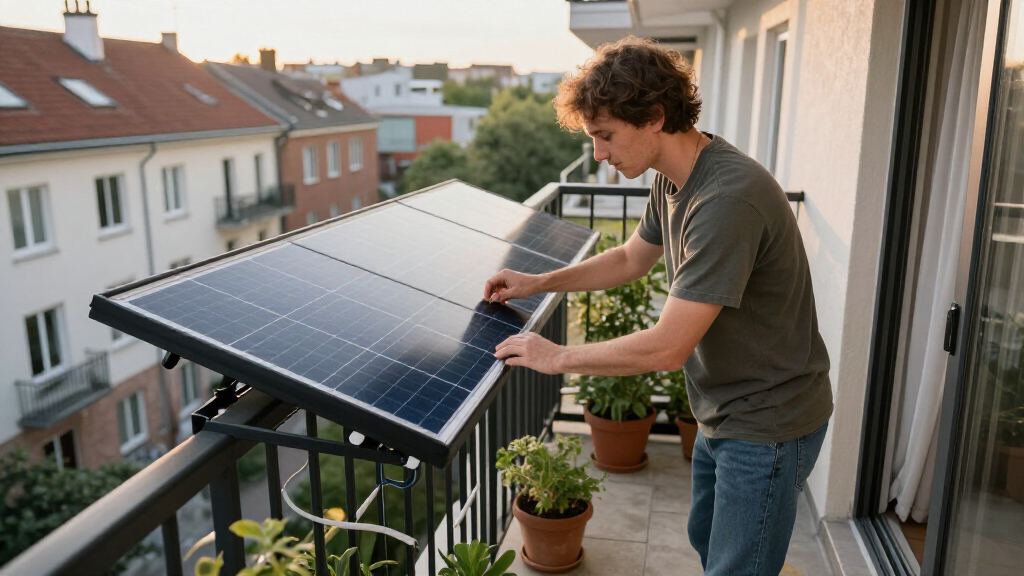
Use the panel’s actual dimensions, not just its wattage, to plan the available area. Each Renogy panel is listed at about 49.7 × 30.1 inches, so a pair needs enough space for both panels, their mounting approach, and safe access. Check that railings, doors, building rules, and wind exposure do not make the proposed placement unsuitable.
Balconies often receive uneven or changing sunlight. If railing bars or nearby structures cast recurring shadows, ShadowFlux is the only panel product here described as designed for partial-shade performance. Dual MPPT on an inverter can also help manage separate inputs, but it does not remove shade or guarantee a set level of output. A clear, unshaded placement can make a standard panel set the simpler choice.
Treat wattage as a limit, not a daily-energy promise
Panel wattage describes rated power under specified conditions; it does not tell you how much electricity the system will make over a typical day. Sun hours, orientation, temperature, shade, inverter losses, and panel positioning all affect production. The stated 1200W inverter output is not a forecast of 1200 watts of continuous solar generation, especially when the connected panel capacity is lower.
Start with the devices you want to run and their energy use over time. Lighting and phone charging may fit a small battery kit, while household loads need a larger, carefully matched system. Avoid treating the IOENC’s claimed bulb runtime as evidence that it can operate appliances: its 15W panel and 4Ah battery define a much smaller use case.
Check outdoor installation and local electrical rules
IP ratings describe protection against specified ingress conditions; they do not certify a complete installation. The IP67 inverter listings and Renogy panel ratings may be relevant to outdoor exposure, but connectors, cables, mounts, and the wall connection also need suitable protection. Secure mounting matters on an exposed balcony, where wind can put force on panels and brackets.
Rules for connecting generation to a home circuit differ by location, building, lease, and electrical setup. Check with the property owner or building manager where applicable, and follow local code and the equipment manufacturer’s instructions. Use a qualified electrician when required, particularly for grid-tied equipment. A “plug-and-play” label does not override electrical or building requirements.
Resolve listing inconsistencies before purchase
Some details in these listings need confirmation. The 800W inverter’s title and description state 800W, but its supplied specifications list 1200W. ShadowFlux’s warranty terms combine a five-year materials-and-craftsmanship statement with a 25-year output warranty, while the IOENC details disagree about weight. Treat these as questions to settle, not minor wording issues.
Ask for the exact model documentation, rated AC output, supported panel configuration, warranty text, and included accessories. This check is especially useful when comparing the two inverter products: the Cosmoxstar has a consistent 1200W claim in the supplied information, whereas the other model’s power rating is not clear. I would base a system design on the model documentation, not a conflicting sales-page figure.
Frequently Asked Questions
Are these five products complete balcony solar kits?
No. The Cosmoxstar and 800W products are micro inverters, and the supplied details do not include panels. The two Renogy products are panel sets that still need compatible system components such as an inverter for grid use or a charge controller and battery for off-grid use. IOENC is a small lighting kit with a panel and battery, but it is not a household grid-tie system. Confirm every included component before ordering.
Which option makes the most sense for a shaded balcony?
The Renogy ShadowFlux 400W set is the clearest match because its description specifically says its design aims to maintain generation in partial shade and reduce hot-spot risks. Its performance will still depend on the shade pattern, panel placement, and system configuration. If shade is heavy or persistent, compare the proposed setup with the manufacturer’s guidance rather than assuming the panel can overcome a poor location.
Can I connect either inverter directly to my household outlet?
The supplied listings describe grid-tie micro inverters and refer to a 110V connection, but that alone does not confirm that a particular outlet connection is allowed or safe in your location. Local electrical rules, utility requirements, inverter certification, and the product’s installation instructions matter. Confirm the exact model requirements and ask a qualified electrician or local authority when needed; do not rely on “plug-and-play” wording as permission to connect it.
What is the main difference between the two Renogy panel sets?
Both sets are described as two 200W N-Type panels with 25% stated efficiency and 24V output. ShadowFlux adds a stated partial-shade design goal, making it the more targeted choice for balconies with shifting shadows. The standard Renogy set is positioned for compact RV, van, and off-grid systems. Neither listing, based on the supplied details, provides a complete grid-connected balcony setup, and ShadowFlux’s warranty wording deserves confirmation.
Is the IOENC kit suitable for powering household appliances?
It is not the right choice for ordinary household appliance use. Its 15W panel and 12V 4Ah battery are aimed at the included LED bulbs and small-device charging through USB or the 12V DC output. The described runtime applies to the bulbs under stated conditions and does not indicate capacity for appliances. Choose an appropriately designed higher-capacity system if you want to support larger electrical loads.
Conclusion
My pick depends on what you are actually trying to build. For a higher-output grid-tie inverter, I would start with the Cosmoxstar 1200W, provided its 110V requirement and your panels are a match. For a balcony with changing shade, I would choose Renogy ShadowFlux as the panel set, after confirming warranty terms and adding the required system components. The standard Renogy 400W N-Type kit fits compact battery-based projects better, while the 800W inverter is worth considering only after its conflicting output rating is resolved.
If your goal is simply balcony lighting and USB charging, the IOENC 15W kit is the most self-contained choice, but it is not household solar generation. For every option, I would verify compatibility, included parts, mounting suitability, and local electrical rules before buying. That check matters more than a headline wattage when the products in this roundup serve such different roles.
Fall yard work Picks
leaf blowers
As an affiliate, we earn on qualifying purchases.