
TL;DR

Get home appliances delivered free with Prime
- Fast, free delivery on millions of items
- Prime Video, Amazon Music and more included
- Member-only deals all year
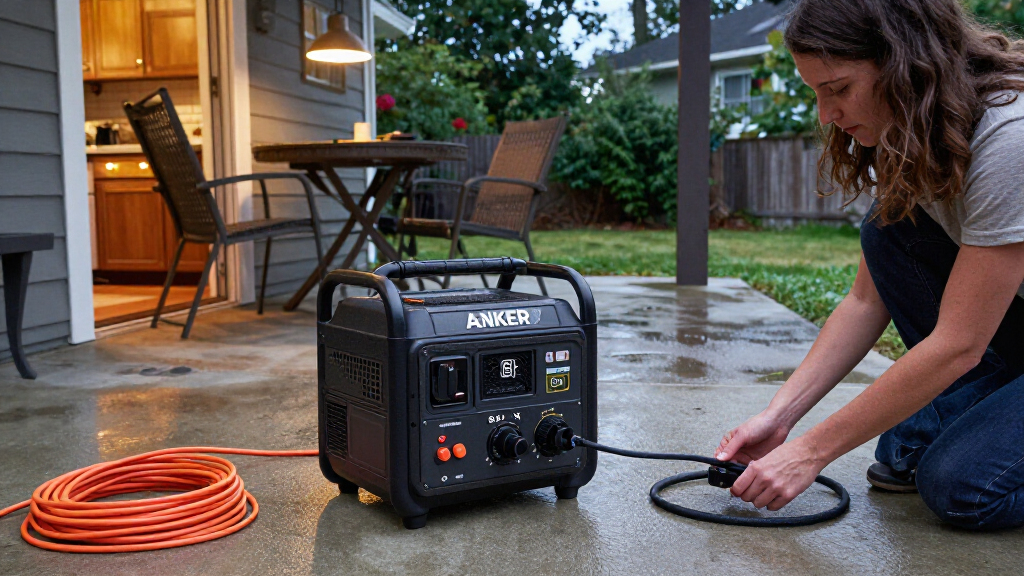
A Family Handyman reviewer tested the Anker Solix Smart Generator 5500 for just over a month, using gasoline and propane and connecting it to an Anker Solix E10 home battery system. The reviewer reported simple setup and reliable app controls, but did not test natural-gas operation or a long-duration outage.
Family Handyman reviewer Paul Rankin reports that he tested Anker’s Solix Smart Generator 5500 for just over a month at his Florida home, running it on gasoline and propane and connecting it to a Solix E10 home battery system. He found setup and app-based operation straightforward, while noting that the unit is noisy and that a complete battery backup system adds substantial cost.
The 224cc, four-stroke generator can run on gasoline, propane or natural gas. Anker lists up to 4,500 watts of DC output on gasoline or propane, and up to 4,000 watts on natural gas. Its rated AC output is up to 3,600 watts on all three fuels, through a TT-30R outlet and a 5-20R outlet. Rankin tested gasoline and propane but said he had not yet tested natural gas.
Rankin said initial setup took about 20 minutes, including connecting the startup battery and adding engine oil. During his tests, he used the physical controls and the Anker app to start the generator; he also noted a manual pull start. He reported no starting problems, overloads, connection failures or app glitches during the month of use. His longest continuous test lasted about two hours.
When connected to an E10, the generator can send DC power directly to the battery system, avoiding an AC-to-DC conversion for charging. Rankin observed output of around 4.5 kilowatts during DC charging, in line with Anker’s advertised maximum. In his setup, the batteries powered household loads while the generator charged them; the generator was not directly supplying every appliance.
Where the Generator Fits at Home
The review describes one way a generator can support a home backup system: batteries supply household power, while a generator and rooftop solar recharge them when needed. That arrangement may matter during an extended outage, including at night or when solar production is insufficient. The reported test shows the generator working with one Anker battery setup, but it does not establish how it would perform in every home or through a prolonged outage.
Cost is a major factor in the example. Rankin says the battery equipment in his system cost about $14,000, with professional installation adding approximately $4,500. Those figures cover his E10 configuration and installation, not the price of every buyer’s system. The review describes the generator as useful on its own, too, but its direct DC charging connection is specifically relevant to compatible Anker equipment.
A Florida Backup Power Test
Rankin explains that he lives in Florida, where hurricanes and severe storms can cause outages lasting hours or days. His home already had rooftop solar and an Anker Solix E10 system with two E10 power modules and three battery expansion modules. Electricians Arcenio Garcia of Firstline Electric & Energy and Oswin Fernandez of Future Electric Solutions installed the system.
In the described setup, solar replenishes the batteries when conditions allow, and the generator provides another charging source. Rankin tested the generator with gasoline and propane, app and manual controls, and Eco and higher-output modes. The review’s findings reflect this home and its equipment; they are not a controlled comparison with other generators.
““The biggest surprise was how easy Anker made practically everything about using a gas-powered generator.””
— Paul Rankin, Family Handyman reviewer
Limits of the Reported Testing
The review does not report a natural-gas test. Rankin said using that fuel would require a professionally installed connection to his home’s gas supply, which he planned to add later. His longest continuous run was about two hours, so the report does not show how the generator performs over days of operation or during an actual extended outage.
The account also does not provide a full fuel-consumption comparison, measured noise levels, or the generator’s purchase price. Rankin describes the unit as noisy and the full backup arrangement as costly, but the supplied material does not quantify those points or compare them with other systems.
Natural-Gas Testing Still Ahead
Rankin said he planned to add a professionally installed natural-gas connection and test the generator on that fuel. The supplied report does not give a date for that work or results from any later testing. Buyers weighing the system can use the review’s gasoline, propane and E10 observations as one household’s experience, while checking current pricing, installation requirements and compatibility for their own setup.
Key Questions
Which fuels did the reviewer test?
Rankin tested gasoline and propane. He had not tested natural gas at the time of the report.
Did the generator power the whole house directly?
In Rankin’s test, the generator charged the E10 battery system, and the batteries supplied household loads. The generator was not directly powering every appliance.
How long did the reported testing last?
Rankin tested the generator for just over a month, but his longest continuous run was about two hours. The report does not describe a multi-day outage test.
What did the E10 equipment and installation cost?
Rankin reported about $14,000 for battery equipment and approximately $4,500 for professional installation in his own setup. Those amounts do not state the generator’s price.
Source: rss
NFL season / tailgating Picks
team gear
As an affiliate, we earn on qualifying purchases.