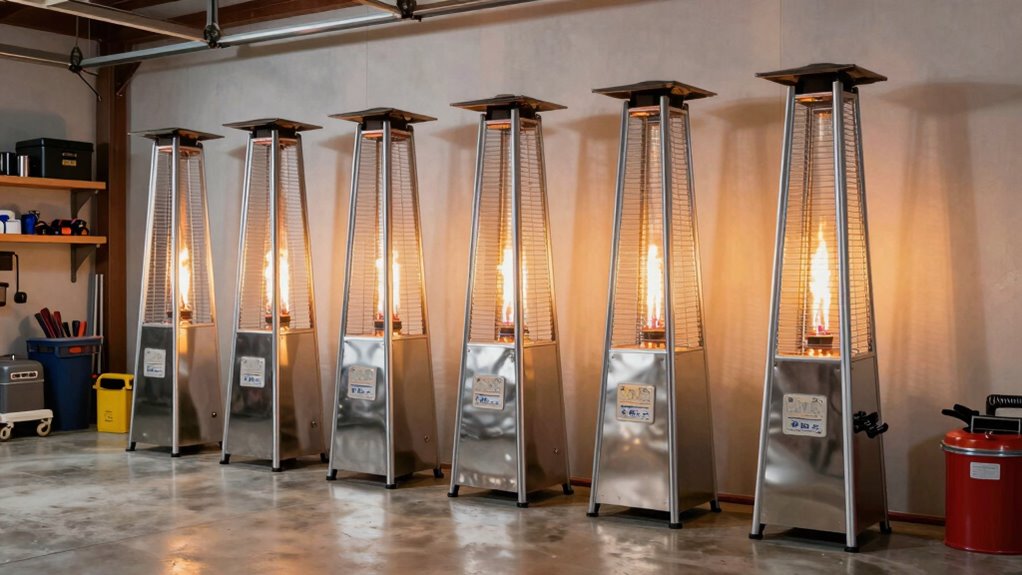

For most garages, I’d start with the Mr. Heater Big Maxx 50,000 BTU: its ceiling-mounted unit-heater design suits a dedicated workspace better than a portable jobsite heater. The Remington 60,000 BTU is a stronger fit when you need directed heat and can accept its forced-air setup, while the ThermoMate 18,000 BTU radiant heater favors targeted warmth without heating the whole room as quickly. The main tradeoff is between broad, fast air heating and quieter, localized radiant warmth, with venting, installation, and fuel capacity shaping the choice. I ranked these options by how well their design and output match common garage needs, along with usability and installation demands. Read on for the full breakdown and guidance on choosing a heater that fits your space.

Get home appliances delivered free with Prime
- Fast, free delivery on millions of items
- Prime Video, Amazon Music and more included
- Member-only deals all year
Complete the kit


Key Takeaways
- The Big Maxx 50,000 BTU is my best overall pick for a dedicated garage because its unit-heater format is better suited to a fixed workspace than portable forced-air models.
- Forced-air heat dominates the high-output options: Remington and VEVOR offer portable 60,000 BTU designs, while Mr. Heater’s 80,000 and 125,000 BTU units suit larger or more demanding spaces.
- Radiant models serve a different need: ThermoMate, SANAUVULCAN, Jocoevol, and GASLAND focus on warmth near the heater, so they can suit spot heating better than warming an entire garage.
- Installation can outweigh output: the Comfort Glow direct-vent wall heater and Big Maxx involve a more fixed setup, while portable heaters offer easier placement but require attention to safe clearances and fuel.
- The 125,000 BTU Mr. Heater is a specialty choice, not an automatic upgrade; buyers should match capacity to the space and heat loss rather than choosing the largest output.
| Remington LP Forced Air Propane Heater, 60,000 BTU |  | Best for Fast, Broad Garage Heat | Fuel: Liquid propane | Heat output: 60,000 BTU | Coverage: Up to 1,500 sq. ft. | VIEW ON AMAZON | See Our Full Breakdown |
| ThermoMate 18,000 BTU Propane Radiant Heater |  | Best for Quiet, Adjustable Radiant Heat | Fuel: Propane | Heat settings: 6,000, 12,000, or 18,000 BTU | Coverage: Up to 450 sq. ft. | VIEW ON AMAZON | See Our Full Breakdown |
| SANAUVULCAN 18,000 BTU Portable Propane Radiant Heater |  | Best Compact Radiant Pick | Fuel: Propane | Heat settings: 6,000, 12,000, or 18,000 BTU | Coverage: Up to 450 sq. ft. | VIEW ON AMAZON | See Our Full Breakdown |
| Comfort Glow 11,000 BTU Direct Vent Liquid Propane Gas Wall Heater, Medium, Gray |  | Best for Permanent Indoor Installation | Fuel: Liquid propane | Heat output: 11,000 BTU | Coverage: Up to 350 sq. ft. | VIEW ON AMAZON | See Our Full Breakdown |
| Jocoevol Propane Heater Outdoor 18,000 BTU Portable Tank Heater, Cordless |  | Best for Outdoor Garage Work | Fuel and power: Propane; cordless | Heat settings: 6,000, 12,000, or 18,000 BTU | Coverage: Up to 450 sq. ft. | VIEW ON AMAZON | See Our Full Breakdown |
| Mr. Heater Big Maxx 50,000 BTU Forced-Air Unit Heater |  | Best for Permanent Mid-Size Garages | Heat output: 50,000 BTU | Heating coverage: Up to 1,667 sq ft | Fuel: Natural gas | VIEW ON AMAZON | See Our Full Breakdown |
| Mr. Heater 80,000 BTU Forced-Air Unit Heater |  | Best for Large Permanent Workshops | Heat output: 80,000 BTU | Heating coverage: Up to 2,667 sq ft | Fuel: Natural gas | VIEW ON AMAZON | See Our Full Breakdown |
| Mr. Heater 80,000 BTU Portable Propane Convection Heater |  | Best for Large Off-Grid Work Areas | Heat output: 30,000–80,000 BTU per hour | Heating coverage: Up to 2,000 sq ft | Fuel: Propane | VIEW ON AMAZON | See Our Full Breakdown |
| VEVOR 60,000 BTU Forced-Air Propane Heater |  | Best for Portable Forced-Air Heat | Heat output: 60,000 BTU | Heating coverage: Up to 1,400 sq ft | Fuel: Propane | VIEW ON AMAZON | See Our Full Breakdown |
| GASLAND 18,000 BTU Propane Heater, Indoor/Outdoor, 450 Sq. Ft., MHA18W |  | Best Compact Radiant Pick | Model: MHA18W | Heat output: 18,000 BTU | Heating coverage: Up to 450 sq ft | VIEW ON AMAZON | See Our Full Breakdown |
| Mr. Heater 125,000 BTU Forced-Air Unit Heater (Propane or Natural Gas) |  | Best for Extra-Large Garages | BTU output: 125,000 BTU | Fuel type: Propane or natural gas | Heating coverage: Up to 2,000 square feet | VIEW ON AMAZON | See Our Full Breakdown |
| propane garage heater | Fuel | Heat output | Heating method | Heating coverage |
|---|---|---|---|---|
| Remington LP Forced Air Propan | Liquid propane | 60,000 BTU | — | — |
| ThermoMate 18,000 BTU Propane | Propane | — | Radiant | — |
| SANAUVULCAN 18,000 BTU Portabl | Propane | — | Radiant | — |
| Comfort Glow 11,000 BTU Direct | Liquid propane | 11,000 BTU | — | — |
| Jocoevol Propane Heater Outdoo | — | — | Radiant | — |
| Mr. Heater Big Maxx 50,000 BTU | Natural gas | 50,000 BTU | Forced air | Up to 1,667 sq ft |
| Mr. Heater 80,000 BTU Forced-A | Natural gas | 80,000 BTU | Forced air | Up to 2,667 sq ft |
| Mr. Heater 80,000 BTU Portable | Propane | 30,000–80,000 BTU per hour | Convection | Up to 2,000 sq ft |
| VEVOR 60,000 BTU Forced-Air Pr | Propane | 60,000 BTU | — | Up to 1,400 sq ft |
| GASLAND 18,000 BTU Propane Hea | Propane | 18,000 BTU | Radiant | Up to 450 sq ft |
| Mr. Heater 125,000 BTU Forced- | — | — | — | Up to 2,000 square feet |
More Details on Our Top Picks
Remington LP Forced Air Propane Heater, 60,000 BTU
The Remington LP Forced Air is the strongest fit here for someone who needs to warm a larger garage or workshop quickly. Its 60,000 BTU output and stated coverage of up to 1,500 square feet give it a substantial reach advantage over the 18,000 BTU ThermoMate, which is better suited to smaller areas and closer-range radiant warmth. At 11 pounds, this heater is also easy to move between work zones, and variable heat settings let you adjust output as conditions change. Electronic ignition and several listed shutoffs add practical safeguards. The tradeoff is that forced air can be less comfortable for people who want quiet, localized heat, and the propane tank is sold separately. Choose it for an open, ventilated workspace; skip it if you need a fixed indoor heater or already know you prefer radiant heat.
Pros:- 60,000 BTU output with stated coverage up to 1,500 square feet
- Light 11-pound design is easy to reposition
- Variable heat settings and adjustable height
- Includes a 10-foot hose and regulator
Cons:- Propane tank is required and not included
- Forced-air heating may be noisy or drafty compared with radiant models
- Not a direct-vent installation for enclosed indoor rooms
Best for: Owners of larger, well-ventilated garages or workshops who want a portable heater with more output than the 18,000 BTU cabinet models
Not ideal for: People heating a small enclosed room or seeking quiet, fixed indoor heat; it requires ventilation and a separate propane tank
- Fuel:Liquid propane
- Heat output:60,000 BTU
- Coverage:Up to 1,500 sq. ft.
- Weight:11 lb.
- Ignition:Electronic
- Hose:10 ft.; hose and regulator included
- Tank:20 lb. propane tank required; not included
- Safety features:Thermocouple, high-temperature limit shut-off, flame-out fuel cut-off
Our verdict“Pick the Remington for portable, high-output heat in a large ventilated garage, and choose a lower-output radiant heater for a smaller, quieter work area.”
ThermoMate 18,000 BTU Propane Radiant Heater
The ThermoMate suits a smaller garage where quiet, adjustable radiant warmth matters more than fast whole-room heating. Its three settings, from 6,000 to 18,000 BTU, let you use a lower output during milder weather, while the listed runtime of up to 69 hours on low with a 20-pound tank can reduce tank changes during extended use. Five locking casters make it easier to move and secure than a fixed wall heater such as the Comfort Glow. Compared with the portable Remington forced-air model, the ThermoMate offers lower output and a smaller stated coverage area, but its radiant approach may better suit a stationary workbench. It is CSA certified and lists ODS and tip-over protection. It still needs ventilation, and it is not suitable for tightly enclosed spaces.
Pros:- Three heat settings from 6,000 to 18,000 BTU
- Radiant heat offers a quiet alternative to forced-air models
- Five locking casters aid movement and positioning
- ODS and tip-over protection; CSA certified
Cons:- Stated coverage is limited to 450 square feet
- Requires a propane tank, which is not listed as included
- Must not be used in tightly enclosed spaces
Best for: Garage hobbyists working in a ventilated area up to 450 square feet who want quiet radiant heat and the option to run at low output
Not ideal for: Owners of large garages needing fast whole-space heating, or anyone planning to use a propane heater in a tightly enclosed room
- Fuel:Propane
- Heat settings:6,000, 12,000, or 18,000 BTU
- Coverage:Up to 450 sq. ft.
- Heating method:Radiant
- Form and mounting:Freestanding cabinet
- Noise:Up to 32 dB
- Mobility:Five locking casters
- Low-setting runtime:Up to 69 hours on a 20 lb. tank at 6,000 BTU
- Safety and certification:ODS and tip-over protection; CSA certified
Our verdict“Choose the ThermoMate for quiet, movable radiant heat in a ventilated small garage, rather than the Remington when you need broader, higher-output heating.”
SANAUVULCAN 18,000 BTU Portable Propane Radiant Heater
The SANAUVULCAN is a compact alternative for garage users who want radiant heat with a rolling cabinet that is easy to reposition. It shares the ThermoMate’s three output levels and stated 450-square-foot coverage, but its product data lists a lower noise ceiling of 30 dB or less and gives dimensions of 10 × 15 × 22 inches. That makes it a reasonable choice when floor space and quieter operation matter. Piezoelectric ignition avoids a separate electric ignition supply, while tip-over and low-oxygen shutoffs are listed safety features. The tradeoff is that the data does not specify an included tank, and the heater must be used in a well-ventilated area. Compared with the higher-output Remington forced-air heater, it is a smaller-area, gentler radiant option rather than a solution for heating a large garage quickly.
Pros:- Three settings from 6,000 to 18,000 BTU
- Listed noise level is 30 dB or lower
- Compact 10 × 15 × 22-inch dimensions with casters and side handles
- Piezo ignition plus tip-over and low-oxygen shutoffs
Cons:- Requires a propane supply and well-ventilated use
- 450-square-foot stated coverage is modest for larger garages
- Product data does not specify a propane tank as included
Best for: Garage users with limited floor space who want a compact, low-noise radiant heater for a ventilated area up to 450 square feet
Not ideal for: People who need to heat a large garage quickly, or buyers who need a heater for an enclosed space
- Fuel:Propane
- Heat settings:6,000, 12,000, or 18,000 BTU
- Coverage:Up to 450 sq. ft.
- Heating method:Radiant
- Dimensions:10 × 15 × 22 in.
- Weight:8.48 kg
- Ignition:Piezoelectric
- Noise:30 dB or lower
- Safety and mobility:Tip-over and low-oxygen shutoffs; five casters, two locking
Our verdict“Pick the SANAUVULCAN when compact dimensions and quiet radiant heat matter more than the wider reach of the Remington forced-air heater.”
Comfort Glow 11,000 BTU Direct Vent Liquid Propane Gas Wall Heater, Medium, Gray
For a garage where the priority is fixed, room-style heating, the Comfort Glow direct-vent wall heater has a different role from the portable models in this lineup. Its sealed burn system and direct vent route combustion through a wall, while the adjustable thermostat helps maintain a chosen temperature without relying on electricity. Compared with the ThermoMate or SANAUVULCAN, it avoids a rolling floor cabinet and is specified for indoor spaces, but installation requires a compatible wall and vent opening. Its 11,000 BTU output and stated 350-square-foot capacity also make it a smaller-space choice than the Remington’s 60,000 BTU forced-air output. The vent kit is included, yet buyers still need a 100-pound minimum propane tank and a two-stage low-pressure regulator. Choose it for a suitable permanent installation, not occasional portability.
Pros:- Direct-vent sealed burn design for indoor installation
- Operates without electricity
- Adjustable thermostatic control and electronic ignition
- Professional vent kit included
Cons:- Requires a minimum 100 lb. propane tank and a two-stage low-pressure regulator
- Wall thickness compatibility is limited to 4.5–10 inches
- 11,000 BTU output and 350-square-foot stated capacity limit it to smaller spaces
Best for: Owners of a small garage or workspace who can install a direct-vent wall heater and want fixed, electricity-free propane heat
Not ideal for: Renters, frequent movers, or owners of large garages; installation needs a compatible wall, venting, a large propane tank, and the specified regulator
- Fuel:Liquid propane
- Heat output:11,000 BTU
- Coverage:Up to 350 sq. ft.
- Vent type:Direct vent
- Dimensions:20 in. H × 17 in. W × 7 in. D
- Ignition and control:Electronic ignition; adjustable thermostat
- Propane supply:Minimum 100 lb. tank; two-stage low-pressure regulator required
- Wall compatibility:4.5–10 in. thick
- Burner and safety:430 stainless steel burner; sealed burn system and safety pilot
Our verdict“Choose the Comfort Glow for a compatible permanent installation in a smaller garage, rather than a portable heater when you need to move heat between work areas.”
Jocoevol Propane Heater Outdoor 18,000 BTU Portable Tank Heater, Cordless
The Jocoevol portable cabinet heater is the clearest choice here for work that happens in an open or well-ventilated garage area. Its product data labels it for outdoor use, so that designation should guide buyers who might otherwise assume that a garage recommendation means it belongs in an enclosed room. Three settings up to 18,000 BTU and five casters make it flexible to position, while low-oxygen, tip-over, and flameout protection are listed safeguards. Compared with the ThermoMate, it has a similar output range and coverage, with a lower stated noise level of below 30 dB; unlike the fixed Comfort Glow, it needs no wall installation. The 450-square-foot coverage is modest, and the 20-pound cylinder is not included. Choose it for ventilated, intermittent use, not primary heat for a large enclosed garage.
Pros:- Three heat settings up to 18,000 BTU
- Below 30 dB stated noise level
- Five casters, including two with brakes, aid positioning
- Lists low-oxygen, tip-over, and flameout protection
Cons:- Outdoor-use designation makes it unsuitable as an enclosed-room heater
- 20 lb. propane cylinder is not included
- Stated coverage is limited to 450 square feet
Best for: People working in open-sided garages, patios, or other well-ventilated areas who want movable radiant heat without an electrical cord
Not ideal for: Anyone seeking primary heat for an enclosed garage or a large workshop; it is listed for outdoor use and covers up to 450 square feet
- Fuel and power:Propane; cordless
- Heat settings:6,000, 12,000, or 18,000 BTU
- Coverage:Up to 450 sq. ft.
- Heating method:Radiant
- Usage designation:Outdoor
- Tank compatibility:Standard 20 lb. propane cylinder; not included
- Dimensions and weight:13.7 in. D × 18 in. W × 23 in. H; 18 lb.
- Noise:Below 30 dB
- Safety and mobility:Low-oxygen, tip-over, and flameout protection; five casters, two with brakes
Our verdict“Choose the Jocoevol for quiet, cordless radiant warmth in an open or well-ventilated work area, and look to a direct-vent model for fixed indoor heating.”
Mr. Heater Big Maxx 50,000 BTU Forced-Air Unit Heater
I’d choose the Big Maxx 50,000 BTU for a garage that needs steady, ceiling-mounted heat and already has a natural gas hookup. Its 1,667-square-foot coverage suits a substantial workshop without stepping up to the larger Mr. Heater 80,000 BTU unit, which is better matched to bigger spaces and has a stated 10-foot minimum ceiling height. Forced air helps circulate warmth around the room, while the choice of vertical or horizontal venting gives installers some flexibility.
The tradeoff is a more involved, fixed installation: this heater needs 120-volt power, gas, a separately purchased thermostat, and at least 8 feet of clearance below. I’d skip it for a renter’s garage or a space without a suitable vent route; the portable VEVOR 60,000 BTU propane heater is easier to relocate, though it has lower listed coverage.
Pros:- Rated to heat spaces up to 1,667 square feet
- Ceiling mounting keeps floor and workbench space open
- Supports vertical or horizontal venting
- Includes angle brackets for installation
Cons:- Requires both a natural gas hookup and 120-volt AC power
- Thermostat is sold separately
- Needs at least 8 feet of clearance below the heater
Best for: Owners of mid-size garages or workshops with natural gas, power, and room for a permanent ceiling installation
Not ideal for: Renters, off-grid users, or anyone without the required overhead clearance, gas hookup, and venting options
- Heat output:50,000 BTU
- Heating coverage:Up to 1,667 sq ft
- Fuel:Natural gas
- Heating method:Forced air
- Mounting:Ceiling mount
- Power requirement:120-volt AC
- Thermostat compatibility:Standard 24-volt or Wi-Fi-enabled thermostats, sold separately
- Vent options:Vertical or horizontal
Our verdict“Choose the Big Maxx for permanent natural-gas heat in a mid-size garage when its installation and clearance needs fit your space.”
Mr. Heater 80,000 BTU Forced-Air Unit Heater
For a large, permanently heated garage, this 80,000 BTU natural-gas unit offers more reach than the Big Maxx 50,000 BTU, with stated coverage up to 2,667 square feet. Its high-velocity fan moves heat through a bigger work area, and vertical or horizontal venting can help accommodate different layouts. The flame sensor and high-temperature shut-off add safety features, while the listed heat exchanger warranty is longer than the parts and burner warranty.
That extra capacity brings stricter space requirements: the product data calls for a 10-foot minimum ceiling height and 8 feet of clearance from the heater base to the floor. It also needs AC power, gas, code-compliant installation, and a separately purchased thermostat. Compared with the portable Mr. Heater 80,000 BTU propane convection heater, this is a permanent natural-gas solution, not a heater to take between job sites.
Pros:- Rated for spaces up to 2,667 square feet
- Vertical or horizontal venting supports different installation layouts
- Includes high-temperature shut-off and flame sensor
- Listed 10-year warranty against heat exchanger defects
Cons:- Requires a minimum 10-foot ceiling and 8 feet of clearance below the heater
- Thermostat is sold separately
- Installation must meet local codes and restrictions
Best for: Owners of large workshops or barns with natural gas, a high ceiling, and plans for permanent installation
Not ideal for: People with low ceilings, no gas line, or a need for portable heat without fixed venting
- Heat output:80,000 BTU
- Heating coverage:Up to 2,667 sq ft
- Fuel:Natural gas
- Heating method:Forced air
- Mounting:Ceiling mount
- Voltage:120 volts
- Amperage:2.3 A
- Thermostat compatibility:Standard 24V or Wi-Fi-enabled thermostats, sold separately
- Warranty:3 years on parts and burners; 10 years on heat exchanger defects
Our verdict“Pick this unit for a large, high-ceiling workspace with natural gas and room for a code-compliant permanent installation.”
Mr. Heater 80,000 BTU Portable Propane Convection Heater
This portable propane convection heater is the lineup’s high-output choice for a large work area without an electrical supply. It provides 30,000 to 80,000 BTU per hour, covers up to 2,000 square feet, and can run for up to 14 hours on a 100-pound propane tank. That makes it more useful for job sites or ventilated garages where power is unavailable than either ceiling-mounted Mr. Heater natural-gas unit, which needs AC power and a fixed installation.
Portability has a fuel and air-quality cost: the longer runtime depends on a large 100-pound tank, and the heater needs adequate ventilation. Its convection approach also differs from the VEVOR 60,000 BTU forced-air model, which directs heat with a fan and is rated for a smaller area. I’d skip this for compact garages or enclosed household rooms where ventilation is limited.
Pros:- Variable output from 30,000 to 80,000 BTU per hour
- Rated to heat spaces up to 2,000 square feet
- Operates without electricity
- Includes a 10-foot hose, regulator, and P.O.L. tank connection
Cons:- Extended runtime requires a bulky 100-pound propane tank
- Requires adequate ventilation and is unsuitable for household indoor use without it
- Less suited to tight spaces than smaller portable options such as the GASLAND MHA18W
Best for: Tradespeople and owners of large, ventilated work areas who need high-output propane heat without electricity
Not ideal for: People who need a compact heater, lack space for a 100-pound tank, or want to heat an enclosed household room
- Heat output:30,000–80,000 BTU per hour
- Heating coverage:Up to 2,000 sq ft
- Fuel:Propane
- Heating method:Convection
- Runtime:Up to 14 hours on a 100 lb propane tank
- Electricity required:No
- Hose length:10 ft
- Assembly:Fully assembled, ready to use
Our verdict“Choose it for large, ventilated work areas where portable propane heat and operation without electricity matter more than tank size.”
VEVOR 60,000 BTU Forced-Air Propane Heater
The VEVOR 60,000 BTU forced-air heater suits buyers who need directed propane heat they can move between a garage, workshop, or outdoor work area. It weighs 13.7 pounds, has an ergonomic handle, and offers electronic ignition plus overheat and flameout protection. Against the 80,000 BTU Mr. Heater convection model, it gives up output and listed coverage but takes a smaller 20-pound tank and is easier to carry; compared with the GASLAND MHA18W, it is the higher-output choice for a larger area.
The stated coverage is up to 1,400 square feet, and runtime is listed at 7–11 hours. You’ll need to supply the propane tank, and the listed 30–45 °F temperature range is unusually low for a heater, so I’d verify what that setting describes before relying on it for precise temperature control. This is a portable workspace heater, not a fixed ceiling unit like the Big Maxx.
Pros:- Portable 13.7-pound design with ergonomic handle
- Rated for up to 1,400 square feet
- Electronic ignition with overheat and flameout protection
- Adjustable heating angle from 30° to 45°
Cons:- Requires a separate 20-pound propane tank
- Listed 30–45 °F temperature range is unusually low and may need clarification
- Its 7–11 hour runtime is shorter than the listed maximum for the 100-pound-tank Mr. Heater convection model
Best for: People who need portable, fan-driven propane heat for a medium-to-large garage or work area and can provide a 20-pound tank
Not ideal for: Buyers seeking permanent ceiling heat, the longest runtime, or clearly specified thermostat settings
- Heat output:60,000 BTU
- Heating coverage:Up to 1,400 sq ft
- Fuel:Propane
- Tank compatibility:20 lb propane tank
- Runtime:7–11 hours
- Heating angle:Adjustable from 30° to 45°
- Ignition:Electronic
- Weight:13.7 lb
Our verdict“Pick the VEVOR when you want portable forced-air warmth for a sizable work area and can work around its tank and temperature-setting limitations.”
GASLAND 18,000 BTU Propane Heater, Indoor/Outdoor, 450 Sq. Ft., MHA18W
The GASLAND MHA18W is the compact, lower-output option here: its radiant heat covers up to 450 square feet, making it a better fit for a one-car garage work zone or a patio than for heating a large barn. Three heat modes let you adjust the warmth, and rolling wheels with an integrated handle make it easier to reposition than the heavier ceiling-mounted Big Maxx. It also operates without electricity, which can be useful during a power outage.
Its 20-pound propane cylinder is separate, and the product data calls for proper ventilation in indoor or enclosed-area use. Compared with the VEVOR 60,000 BTU forced-air heater, the GASLAND trades broad coverage for a cabinet-style radiant format and mobility. I’d skip it if you need whole-garage heat; its stated coverage is a fraction of the portable Mr. Heater convection model’s.
Pros:- Three heat modes: high, medium, and low
- Operates without electricity
- Rolling wheels and integrated handle aid repositioning
- Includes tip-over and low-oxygen shut-off features
Cons:- Coverage is limited to about 450 square feet
- Requires a separate 20-pound propane cylinder
- Needs proper ventilation for indoor or enclosed-area use
Best for: Garage users who want portable radiant warmth for a small work area, with three heat modes and no electrical connection
Not ideal for: Owners of large garages who need broad, whole-room coverage or anyone unable to provide proper ventilation
- Model:MHA18W
- Heat output:18,000 BTU
- Heating coverage:Up to 450 sq ft
- Fuel:Propane
- Heating method:Radiant
- Heating modes:High, medium, and low
- Cylinder requirement:20 lb propane cylinder
- Safety features:Tip-over protection and low-oxygen shut-off
- Certification:CSA certified
Our verdict“Choose the MHA18W for movable radiant heat in a small garage zone, and look to a higher-output model for whole-garage coverage.”
Mr. Heater 125,000 BTU Forced-Air Unit Heater (Propane or Natural Gas)
The 125,000 BTU output and stated coverage of up to 2,000 square feet set this unit apart from the Mr. Heater Big Maxx 50,000 BTU and 80,000 BTU models: it is aimed at a much larger heating load, not a typical small garage. Its propane or natural gas operation gives buyers a choice of fuel, and the included propane conversion kit supports using liquid propane. Electronic ignition simplifies startup, while the powered exhaust moves combustion exhaust out of the unit. That power comes with real setup demands: the space needs adequate ventilation, and a natural gas hookup may call for professional installation. I would choose this model for a large workspace where its capacity is useful; for a smaller garage, the lower-output Big Maxx models are a more proportionate fit.
Pros:- 125,000 BTU output suits a larger heating load than the lineup’s 50,000 and 80,000 BTU Big Maxx models.
- Runs on propane or natural gas, giving buyers a choice of fuel.
- Included liquid propane conversion kit supports propane operation.
- Electronic ignition makes startup straightforward.
Cons:- Natural gas hookup may require professional installation.
- Powered exhaust requires adequate ventilation.
- Its high output may be excessive for smaller garages.
Best for: Owners of large garages or workshops near the stated 2,000-square-foot coverage who want a high-output unit with propane and natural gas options.
Not ideal for: People heating a compact or modestly sized garage, or buyers who need a simple portable heater without installation and ventilation considerations.
- BTU output:125,000 BTU
- Fuel type:Propane or natural gas
- Heating coverage:Up to 2,000 square feet
- Ignition:Electronic
- Exhaust:Powered
- Propane conversion:Liquid propane conversion kit included
- ASIN:B0746MRZZR
Our verdict“Choose this unit for a large garage that can use its 125,000 BTU capacity and accommodate the installation and ventilation requirements.”

How We Picked
I compared the 11 heaters by how their heat delivery, output, and installation style fit a garage. Forced-air models can move heat across a workspace quickly, while radiant designs concentrate warmth around people and nearby surfaces; direct-vent and unit-heater formats make more sense for buyers planning a fixed installation. I also weighed portability, fuel and power needs, and how much setup each type implies. Because the product list spans very different uses, I ranked models by fit for common garage jobs rather than treating BTU output as a quality score.
The Big Maxx 50,000 BTU leads as a balanced fixed garage option, while portable forced-air heaters rank well for flexible, broad heating. Radiant picks rank higher for localized warmth and simpler placement, but lower for heating an entire room. The 125,000 BTU model is reserved for large or high-heat-loss spaces, where its extra capacity can be useful. I considered the tradeoffs among all 11; the ranking reflects product type and stated specifications, not hands-on testing.
| propane garage heater | Fuel | Heating method | Heating coverage |
|---|---|---|---|
| Remington LP Forced Air Propan | Liquid propane | — | — |
| ThermoMate 18,000 BTU Propane | Propane | Radiant | — |
| SANAUVULCAN 18,000 BTU Portabl | Propane | Radiant | — |
| Comfort Glow 11,000 BTU Direct | Liquid propane | — | — |
| Jocoevol Propane Heater Outdoo | — | Radiant | — |
| Mr. Heater Big Maxx 50,000 BTU | Natural gas | Forced air | Up to 1,667 sq ft |
| Mr. Heater 80,000 BTU Forced-A | Natural gas | Forced air | Up to 2,667 sq ft |
| Mr. Heater 80,000 BTU Portable | Propane | Convection | Up to 2,000 sq ft |
| VEVOR 60,000 BTU Forced-Air Pr | Propane | — | Up to 1,400 sq ft |
| GASLAND 18,000 BTU Propane Hea | Propane | Radiant | Up to 450 sq ft |
| Mr. Heater 125,000 BTU Forced- | — | — | Up to 2,000 square feet |
Factors to Consider When Choosing Propane Garage Heater
Before choosing a propane garage heater, I’d work backward from the space, how you use it, and what installation it can support. A larger BTU figure alone won’t tell you whether a heater will feel comfortable at a workbench or warm the whole garage evenly.
Match heat delivery to the way you work
Forced-air heaters warm and circulate garage air, which can help when you need a broader area to become usable. Radiant heaters warm nearby people and objects more directly, so they can make sense if you spend most of your time at one bench. That focused warmth may feel useful before the entire garage air has warmed, but it won’t distribute heat evenly through a large space. Think about whether you move around the garage or stay in one spot. Choosing by work pattern can prevent paying for output that warms the wrong area.
Size for the building, not just the floor area
Garage ceiling height, insulation, air leakage, door use, and local winter conditions all affect heating demand. Two garages with the same floor area may need different capacities if one has an insulated ceiling and the other has a drafty overhead door. A heater that is too small may run without making the space comfortable, while excess capacity can mean a harsher heat cycle than your workspace needs. Look for manufacturer sizing guidance and use the heater’s listed coverage only as a starting point. If the garage has unusually high ceilings or poor insulation, account for those conditions before settling on a model.
Plan venting and installation before buying
Portable and fixed heaters come with different placement and installation requirements. A direct-vent wall heater needs a suitable wall location and vent path, while a unit heater may call for ceiling mounting, gas connections, electrical power, and clearances. Portable models still need stable placement and the clearances specified by their manuals. Check local rules and the manufacturer’s instructions before installation, especially for a permanently connected appliance. Treat installation constraints as part of the buying decision, since they can rule out a heater before output becomes relevant.
Check how the heater gets fuel and power
Propane heaters differ in how they connect to fuel and whether they need electricity for ignition or a fan. A cordless radiant model can be convenient where outlets are scarce, while a forced-air heater may depend on power for its blower. Consider whether you’ll use a portable cylinder or a fixed propane supply, and how often you’re willing to handle refills. Cold weather and long sessions can make fuel logistics more noticeable than they seem during purchase. Confirm the exact fuel and power requirements for the model and setup you plan to use.
Account for airflow, clearances, and garage contents
A garage often contains vehicles, tools, paint, fuel, and other materials that affect where a heater can safely operate. Follow the product manual for required clearance from walls, ceilings, stored items, and people. Ventilation and combustion requirements vary by heater type, so don’t assume that a model marketed for indoor use is suitable for every enclosed garage or every operating condition. Keep the intended placement clear of door swings and work paths as well. A location that preserves safe spacing may be more important than the most convenient spot for directing heat.
Pay more for the setup you need
Extra output is useful when a garage is large, poorly insulated, or needs faster whole-room heating, but it is not a benefit by itself. A fixed unit heater can justify a more involved installation if you use the garage often and want a dedicated heating setup. For occasional work near a bench, a simpler radiant heater may be a better match even though it cannot warm the room in the same way. Compare the installation, fuel arrangement, and operating routine along with the heater’s capacity. The best value is the option whose format fits your use, not necessarily the one with the most features or BTUs.
Frequently Asked Questions
Is a 60,000 BTU portable heater too much for a one-car garage?
It depends on the garage’s insulation, ceiling height, air leakage, and how quickly you want it to warm. A 60,000 BTU forced-air heater may be more capacity than a well-insulated small garage needs, while a drafty space can lose heat quickly. Higher output does not fix poor placement or heat loss through an open door. Compare the manufacturer’s sizing guidance with your actual space and use pattern. If you mainly need warmth at one workbench, a lower-output radiant heater may suit the task better.
Should I choose a forced-air heater or a radiant heater for a workshop garage?
Choose based on whether you need warm air across the room or warmth concentrated where you work. Forced-air models such as the Remington and VEVOR can move heat around a broader space, but their fans and airflow are part of the experience. Radiant options like the ThermoMate or SANAUVULCAN focus heat near the heater and can suit a fixed work area. If you regularly move between benches or need the whole garage air warmed, forced air is the more natural starting point. For one stationary task area, radiant heat may avoid heating more space than you use.
Can I use a propane garage heater in a closed garage?
Suitability depends on the exact heater, its installation, and the instructions and rules that apply where you live. Check whether the model requires venting or ventilation and follow its clearances and operating directions. A direct-vent design has a different installation approach from a portable heater, so category labels alone are not enough to decide. Never assume that an indoor-use claim makes every enclosed-garage setup appropriate. If requirements are unclear, consult the manufacturer or a qualified installer before operating it in that space.
Is a ceiling-mounted unit heater worth the installation effort?
It can make sense if you use the garage regularly and want a dedicated heater kept out of the way of floor-level work. The Big Maxx’s unit-heater format is more aligned with that use than portable models, but installation planning and utility connections matter. A portable forced-air heater is easier to reposition for occasional use, while a radiant heater may cover a small work zone with less room-wide heating. Consider how often you heat the garage and whether a permanent setup fits its layout. If you only need occasional spot warmth, the installation effort may not pay off.
When should I choose the 125,000 BTU model over the 80,000 BTU model?
Consider the 125,000 BTU unit only when the garage’s size, heat loss, or heating task calls for more capacity than an 80,000 BTU option can provide. Large doors, high ceilings, weak insulation, and frequent door openings can increase demand, but BTU figures should be matched to manufacturer guidance for the space. A larger heater can also impose greater installation and fuel-supply demands. For a smaller or better-insulated garage, the 80,000 BTU model may be a more fitting scale. Compare the units against your building conditions instead of treating the higher number as a universal upgrade.
Conclusion
For a dedicated garage workspace, I’d choose the Mr. Heater Big Maxx 50,000 BTU as best overall because its fixed unit-heater format fits regular use. The Remington 60,000 BTU is my best value pick for buyers who want portable, directed forced-air heat, while the Big Maxx is also the best premium-style choice for someone ready to plan a permanent installation. Beginners who want a simpler entry into localized warmth should compare the ThermoMate 18,000 BTU radiant heater with other portable radiant options, keeping their coverage limits in mind. For a large or high-heat-loss garage, the Mr. Heater 125,000 BTU is the specific-capacity choice; for a fixed work zone, a radiant model may be the better fit. Match the heater to your garage’s conditions and installation options before deciding.
Halloween Picks
halloween
As an affiliate, we earn on qualifying purchases.