Choosing the right air filtration system for workshop environments requires balancing raw airflow capacity against noise levels and maintenance costs. The ALORAIR Purecare 780IG stands out as the best overall pick for medium-sized shops due to its efficient two-stage filtration and ionizer technology that captures fine dust without excessive noise. For those prioritizing maximum coverage in larger spaces, the Abestorm DecDust 1350IG offers superior 360-degree suction, while the WEN 3410 remains the go-to choice for budget-conscious beginners needing reliable basic protection. Most buyers struggle with deciding between high CFM ratings for speed and lower decibel levels for comfort, as well as choosing between hanging units and portable scrubbers. Continue reading to see how these models stack up against specific workshop needs and spatial constraints.

Get home appliances delivered free with Prime
- Fast, free delivery on millions of items
- Prime Video, Amazon Music and more included
- Member-only deals all year
Complete the kit



Key Takeaways
- Hanging units dominate for fixed workshops due to ceiling clearance, while portable negative air scrubbers are superior for construction sites or multi-room projects.
- Ionizer technology consistently reduces fine particulate matter better than standard HEPA-only systems in enclosed shop environments.
- Remote control functionality is a critical usability feature for hanging units, as reaching high-mounted controls during active work is impractical.
- Filter replacement costs vary widely; some systems use proprietary cartridges that are significantly more expensive than generic HEPA replacements.
- CFM ratings above 1000 are often overkill for standard two-car garages, leading to unnecessary energy consumption and noise without proportional air quality gains.
| ALORAIR Purecare 780IG 2-Stage Woodworking Air Filtration System with Ionizer and Remote |  | Best for Small Workshops | Airflow: 580/780 CFM | Filter Class: MERV-11 | Noise Level: Below 50 dBA | VIEW ON AMAZON | See Our Full Breakdown |
| Abestorm DecDust 1350IG 360-Degree Air Filtration System with Ionizer |  | Best High-Capacity Value | Airflow: 1050–1350 CFM | Coverage Area: Up to 1700 sq ft | Noise Level: 60–69 dBA | VIEW ON AMAZON | See Our Full Breakdown |
| DEWALT DWXAF101 Air Filtration System for Woodworking |  | Best for Fine Dust Capture | Filtration: Two-stage: Washable pre-filter + H11 HEPA | Particle Capture: >95% of 0.3 micron particles | Noise Level: 64 dB | VIEW ON AMAZON | See Our Full Breakdown |
| Abestorm 1080 CFM Intake Air Filtration System with Remote Control |  | Best Balanced Performance | Airflow: 780-1080 CFM | Coverage Area: Up to 1100 sq.ft. | Noise Level: <60dBA | VIEW ON AMAZON | See Our Full Breakdown |
| Purisystems PuriCare 1100IG Air Filtration System with Ionizer and RF Remote |  | Best for Portable Use | Airflow: 650/850/1100 CFM | Weight: 33 pounds | Noise Level: 66 dB | VIEW ON AMAZON | See Our Full Breakdown |
| POWERTEC AF4001E 3-Speed Remote-Controlled Workshop Air Filtration System |  | Best for Fine Dust Precision | Max Airflow: 400 CFM | Filter Efficiency: 1-micron inner, 5-micron outer | Speeds: 3 | VIEW ON AMAZON | See Our Full Breakdown |
| ABESTORM DecDust 1350IG Hanging Air Filtration System with Ionizer |  | Best High-Volume Coverage | Max Airflow: 1350 CFM | Filter Type: MERV-11 (Reusable) | Coverage Area: Up to 1700 sq ft | VIEW ON AMAZON | See Our Full Breakdown |
| ALORAIR Purecare 1350IG 360-Degree Air Filtration System |  | Best for Large Shop Odor Control | Max Airflow: 1350 CFM | Filter Class: MERV-11 | Coverage Area: Up to 1700 sq ft | VIEW ON AMAZON | See Our Full Breakdown |
| ALORAIR Purecare 1080IG Hanging Air Filtration System with Ionizer and Remote |  | Best Mid-Size Shop Balance | Max Airflow: 1080 CFM | Filter Efficiency: MERV-11 | Coverage Area: Up to 1100 sq ft | VIEW ON AMAZON | See Our Full Breakdown |
| 550 CFM Stackable Negative Air Scrubber with 3-Stage HEPA, Carbon, and MERV-10 Filtration | 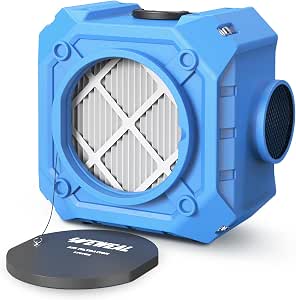 | Best for Portable & Hazardous Dust | Max Airflow: 550 CFM | Filtration Stages: 3 (MERV-10, Carbon, HEPA) | HEPA Efficiency: 99.97% at 0.3 microns | VIEW ON AMAZON | See Our Full Breakdown |
| ALORAIR PureCare 1050 Hanging Air Filtration System |  | Best for Small Shop Flexibility | Airflow: 850 / 1,050 CFM | Coverage: Up to 800 sq. ft. | Filter Type: MERV 13 (90% capture of 3–10 μm) | VIEW ON AMAZON | See Our Full Breakdown |
| ALORAIR Purecare 1350 360-Degree Air Filtration System |  | Best High-Coverage Value | Airflow: 1,050 / 1,350 CFM | Coverage: Up to 1,700 sq. ft. | Filter Efficiency: MERV 11 (85% of 1 µm) | VIEW ON AMAZON | See Our Full Breakdown |
| WEN 3410 3-Speed Remote-Controlled Air Filtration System | 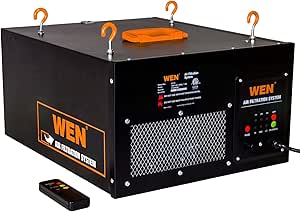 | Best Proven Entry-Level Choice | Airflow: 300 / 350 / 400 CFM | Coverage: Up to 400 sq. ft. | Filtration: 5-micron pre-filter + 1-micron filter | VIEW ON AMAZON | See Our Full Breakdown |
| PURISYSTEMS PuriCare 500IG Air Filtration System |  | Best for Odor and Ionization | Airflow: 350 / 450 / 500 CFM | Coverage: Up to 500 sq. ft. | Filtration: 3-Stage, 1-micron retention | VIEW ON AMAZON | See Our Full Breakdown |
| RIKON 62-450 Three-Speed Remote-Controlled Air Filtration System |  | Best for Ease of Maintenance | Airflow: 250 / 350 / 450 CFM | Coverage: Up to 400 sq. ft. | Construction: 20-gauge Steel | VIEW ON AMAZON | See Our Full Breakdown |
| air filtration system for workshop | Noise Level | Weight | Airflow |
|---|---|---|---|
| ALORAIR Purecare 780IG 2-Stage | Below 50 dBA | — | 580/780 CFM |
| Abestorm DecDust 1350IG 360-De | 60–69 dBA | 27 lbs | 1050–1350 CFM |
| DEWALT DWXAF101 Air Filtration | 64 dB | 20.9 pounds | — |
| Abestorm 1080 CFM Intake Air F | <60dBA | — | 780-1080 CFM |
| Purisystems PuriCare 1100IG Ai | 66 dB | 33 pounds | 650/850/1100 CFM |
| POWERTEC AF4001E 3-Speed Remot | 62-69 dB | — | — |
| ABESTORM DecDust 1350IG Hangin | — | 27 lbs | — |
| ALORAIR Purecare 1350IG 360-De | — | — | — |
| ALORAIR Purecare 1080IG Hangin | — | 22 lbs | — |
| 550 CFM Stackable Negative Air | — | 39 lbs | — |
| ALORAIR PureCare 1050 Hanging | Under 58 dBA | 17.4 lbs | 850 / 1,050 CFM |
| ALORAIR Purecare 1350 360-Degr | 60–69 dB | 27 lbs | 1,050 / 1,350 CFM |
| WEN 3410 3-Speed Remote-Contro | 50–60 dB | 31 lbs | 300 / 350 / 400 CFM |
| PURISYSTEMS PuriCare 500IG Air | 61 dB | 25.5 lbs | 350 / 450 / 500 CFM |
| RIKON 62-450 Three-Speed Remot | — | — | 250 / 350 / 450 CFM |
More Details on Our Top Picks
ALORAIR Purecare 780IG 2-Stage Woodworking Air Filtration System with Ionizer and Remote
This unit stands out for its compact footprint and versatility, offering a choice between ceiling mounting or bench-top placement. While the ALORAIR Purecare 780IG delivers up to 780 CFM of airflow, it is significantly smaller than the Abestorm 1080 CFM model, making it ideal for spaces under 800 square feet. The inclusion of a built-in ionizer helps settle fine dust particles that standard MERV-11 filters might miss, a feature absent in basic models like the WEN 3410. However, the reported coverage area varies drastically between marketing materials and technical data, which creates uncertainty for larger shops. It runs quietly at under 50 dBA, allowing for conversation while working, but the inconsistent specs mean buyers should treat the higher coverage claims with caution.Pros:- Flexible mounting options allow for ceiling or bench-top use
- Quiet operation under 50 dBA preserves workshop conversation
- Built-in ionizer assists in settling fine airborne dust
Cons:- Conflicting coverage data (100 vs. 800 sq. ft.) creates uncertainty
- Lower maximum airflow compared to larger industrial units
Best for: Hobbyists with workshops under 800 sq. ft. who need a quiet, flexible unit that can sit on a bench if ceiling mounting isn’t possible.
Not ideal for: Owners of large professional shops needing verified high-capacity airflow, due to conflicting coverage specifications.
- Airflow:580/780 CFM
- Filter Class:MERV-11
- Noise Level:Below 50 dBA
- Wattage:62 W
- Dimensions:18.35 × 18.35 × 8.82 in.
- Controls:IR remote; 1–9 hour timer
Our verdict“Choose this if you need a quiet, flexible filter for a small shop and can tolerate some ambiguity regarding its maximum effective range.”
Abestorm DecDust 1350IG 360-Degree Air Filtration System with Ionizer
The Abestorm DecDust 1350IG is a powerhouse designed for larger spaces, boasting up to 1350 CFM of airflow. This is nearly double the maximum output of the ALORAIR 780IG, making it far better suited for open-concept garages or busy woodworking shops up to 1700 sq. ft. It includes a built-in ionizer and comes with four replaceable MERV-11 filters, reducing the immediate need for spare purchases unlike some competitors. The tradeoff is noise and maintenance; at 60–69 dBA, it is noticeably louder than the quieter ALORAIR models. Additionally, the filters require replacement every 2–4 months, a frequent interval that adds to long-term operational costs compared to units with longer-lasting filters.Pros:- High airflow capacity up to 1350 CFM for large areas
- Includes four replaceable filters and mounting hardware
- Versatile installation: ceiling, wall, or workbench
Cons:- Higher noise level (60–69 dBA) may disrupt conversation
- Short filter replacement interval (every 2–4 months)
Best for: Owners of large workshops (up to 1700 sq. ft.) who prioritize maximum airflow over silence and want included spare filters.
Not ideal for: Quiet-focused environments or users who dislike frequent filter changes, as the 2–4 month replacement cycle is demanding.
- Airflow:1050–1350 CFM
- Coverage Area:Up to 1700 sq ft
- Noise Level:60–69 dBA
- Weight:27 lbs
- Filter Replacement:Every 2–4 months
- Controls:Touch panel and remote
Our verdict“This is the go-to choice for large shops needing raw power and included spares, provided you can handle the noise and frequent filter swaps.”
DEWALT DWXAF101 Air Filtration System for Woodworking
Unlike the MERV-11 filters found in most competitors like the Abestorm 1350IG, the DEWALT DWXAF101 utilizes an H11 HEPA filter paired with a washable cotton pre-filter. This two-stage system captures over 95% of particles as small as 0.3 microns, making it superior for handling fine sanding dust and allergens that standard filters miss. The washable pre-filter significantly lowers recurring costs, as you only need to replace the primary HEPA element when indicated by the built-in sensor. However, this unit is strictly ceiling-mounted, lacking the bench-top flexibility of the ALORAIR 780IG. At 64 dB, it is also louder than the quieter ALORAIR options, which may be a consideration for noise-sensitive users.Pros:- H11 HEPA filtration captures 95%+ of 0.3-micron particles
- Washable cotton pre-filter reduces recurring supply costs
- Built-in filter replacement indicator prevents guesswork
Cons:- Strictly ceiling-mounted; no bench-top option available
- Moderate noise level of 64 dB
Best for: Woodworkers focused on health and air quality who need to capture fine sanding dust and want a low-maintenance washable pre-filter.
Not ideal for: Users who cannot mount equipment to the ceiling or who require a quieter operating environment.
- Filtration:Two-stage: Washable pre-filter + H11 HEPA
- Particle Capture:>95% of 0.3 micron particles
- Noise Level:64 dB
- Warranty:3 years
- Weight:20.9 pounds
- Mounting:Ceiling-mounted only
Our verdict“Ideal for those prioritizing breathable air quality and fine dust capture over mounting flexibility or silence.”
Abestorm 1080 CFM Intake Air Filtration System with Remote Control
This Abestorm model strikes a middle ground between the compact ALORAIR 780IG and the massive DecDust 1350IG. With 1080 CFM of airflow, it handles medium-to-large workshops effectively without the extreme noise or high filter consumption of its larger sibling. The 270° intake design maximizes dust collection efficiency, pulling air from three sides rather than just the bottom. While it lacks an ionizer, its quiet operation under 60 dBA makes it suitable for shared workspaces. The tradeoff is ongoing maintenance, as filters require replacement every 4–6 months. It is a solid, no-nonsense option that avoids the coverage ambiguity of the ALORAIR 780IG while remaining more affordable than high-end HEPA systems.Pros:- Efficient 270° intake design captures dust from multiple angles
- Quiet operation under 60 dBA suits shared spaces
- Balanced airflow (1080 CFM) for medium-large shops
Cons:- No built-in ionizer for fine particle settling
- Filters require replacement every 4–6 months
Best for: Medium-sized workshop owners who want strong, quiet airflow without the complexity of ionizers or frequent filter changes.
Not ideal for: Users requiring ionizer technology or those with very small spaces where a smaller unit would suffice.
- Airflow:780-1080 CFM
- Coverage Area:Up to 1100 sq.ft.
- Noise Level:<60dBA
- Intake Design:270° three-sided
- Filter Replacement:Every 4-6 months
- Dimensions:19.4″L x 19.4″W x 9.6″H
Our verdict“A reliable, quiet choice for medium workshops that balances power and maintenance needs effectively.”
Purisystems PuriCare 1100IG Air Filtration System with Ionizer and RF Remote
The Purisystems PuriCare 1100IG is unique in this lineup for its portability, featuring carrying handles and rubber feet that allow it to sit on a bench or be moved easily between zones. While it matches the Abestorm 1080 CFM model in airflow, it offers three speed settings compared to the dual-speed options on most competitors. The inclusion of an RF remote with a 26-foot range provides greater convenience than IR remotes found on the ALORAIR units. However, it is the heaviest at 33 pounds and operates at 66 dB, which is on the louder side. The reusable filters are a cost-saving feature, but the lack of a specific particle efficiency rating below 1 micron puts it a step behind the HEPA-rated DEWALT in fine dust capture.Pros:- Portable design with handles and rubber feet for bench use
- Three airflow speeds offer more control than dual-speed models
- RF remote works through obstacles unlike IR remotes
Cons:- Heaviest unit in this group at 33 pounds
- Loud operation at 66 dB
Best for: Users who need to move their air filter between different workstations or areas and prefer three-speed control.
Not ideal for: Those needing the highest possible fine-dust filtration efficiency or a lightweight unit for frequent lifting.
- Airflow:650/850/1100 CFM
- Weight:33 pounds
- Noise Level:66 dB
- Remote Range:Up to 26 feet
- Timer:1–12 hours
- Filtration:Two reusable filters (MERV-10/12)
Our verdict“Perfect for flexible workshop layouts where portability and multi-speed control are more important than ultra-quiet operation.”
POWERTEC AF4001E 3-Speed Remote-Controlled Workshop Air Filtration System
This unit stands out for its 1-micron inner filter, offering finer particulate capture than the standard MERV-11 filters found in the ALORAIR Purecare 1350IG. While it lacks the 360-degree intake of larger competitors, its 400 CFM maximum airflow is sufficient for dedicated tool stations rather than whole-shop circulation. The RF remote and timer add convenience, allowing users to start cleaning after leaving the room. However, the disposable outer filter creates ongoing supply costs that reusable options avoid. It is a focused solution for those prioritizing air quality near specific machines over broad coverage.Pros:- Captures particles down to 1 micron for cleaner air near tools
- RF remote and automatic timer offer hands-free operation
- Three speed settings allow noise and airflow adjustment
Cons:- Lower CFM output compared to high-volume shop units
- Requires purchasing disposable outer filters regularly
- Ceiling mounting is mandatory for proper function
Best for: Woodworkers who need high-efficiency filtration at specific workstations rather than whole-room circulation.
Not ideal for: Users with large, open garages who need to move air across 1,000+ square feet.
- Max Airflow:400 CFM
- Filter Efficiency:1-micron inner, 5-micron outer
- Speeds:3
- Noise Level:62-69 dB
- Control:RF Remote with Timer
- Motor Power:1/6 HP
Our verdict“Choose this for superior fine-dust capture at individual workstations rather than general shop ventilation.”
ABESTORM DecDust 1350IG Hanging Air Filtration System with Ionizer
With a peak output of 1350 CFM, this model moves significantly more air than the POWERTEC AF4001E, making it better suited for large, open workshops. The 360-degree intake pulls dust from all directions, reducing blind spots common in single-inlet systems. It includes four reusable MERV-11 filters, which lowers long-term operating costs compared to disposable alternatives. The built-in ionizer helps settle airborne particles faster. However, the noise range up to 69 dBA can be intrusive in quiet environments, and filter replacement every few months requires maintenance attention.Pros:- High airflow up to 1350 CFM for large spaces
- 360-degree intake captures dust from all angles
- Includes four reusable filters to reduce waste
- Ionizer assists in settling fine particulate matter
Cons:- Can reach 69 dBA at high speed
- Filters require replacement every 2-4 months
- Larger footprint may not fit tight ceilings
Best for: Owners of large garages or professional shops needing rapid air turnover across wide areas.
Not ideal for: Small hobbyists who prefer silent operation or have limited ceiling mounting options.
- Max Airflow:1350 CFM
- Filter Type:MERV-11 (Reusable)
- Coverage Area:Up to 1700 sq ft
- Intake Design:360-Degree
- Controls:Touch Panel & Remote
- Weight:27 lbs
Our verdict“Ideal for maximizing air turnover in large workshops where speed matters more than noise.”
ALORAIR Purecare 1350IG 360-Degree Air Filtration System
This unit mirrors the airflow capacity of the ABESTORM DecDust 1350IG but distinguishes itself with a two-speed vortex fan designed to enhance circulation patterns. The MERV-11 filter is effective for standard wood dust, while the ionizer targets lingering odors from finishes or glues. It covers up to 1700 sq ft, making it a strong contender for big shops. A significant drawback is its shipping restriction to California, which limits accessibility. Additionally, the 69 dB noise level at high speed may require hearing protection during prolonged use, unlike quieter, lower-CFM alternatives.Pros:- High 1350 CFM airflow for rapid cleaning
- Ionizer helps neutralize workshop odors
- Two-speed operation balances power and noise
- Includes remote control and timer functions
Cons:- Not available for shipping to California
- Reaches 69 dB at maximum speed
- Plastic housing may feel less durable than metal
Best for: Large workshop owners who need to manage both dust and chemical odors effectively.
Not ideal for: Residents in California or users who prioritize silent operation during work.
- Max Airflow:1350 CFM
- Filter Class:MERV-11
- Coverage Area:Up to 1700 sq ft
- Fan Speeds:2
- Timer:1-9 Hours
- Dimensions:20.5 x 20.5 x 9.8 in
Our verdict“A powerful choice for large spaces where odor removal is as important as dust capture.”
ALORAIR Purecare 1080IG Hanging Air Filtration System with Ionizer and Remote
Offering 1080 CFM, this model provides a middle ground between the high-volume ABESTORM DecDust 1350IG and smaller units. Its 270-degree intake is slightly less comprehensive than full 360-degree systems but still covers most standard garage layouts effectively. The 22 lb weight makes it easier to install or relocate than heavier competitors. It includes an ionizer and remote for convenience. Like its larger sibling, it cannot ship to California. The 1100 sq ft coverage is ideal for typical two-car garages, avoiding the overkill of higher-CFM units.Pros:- Lighter 22 lb frame simplifies installation
- Balanced 1080 CFM airflow for medium shops
- Ionizer aids in particle settling and odor control
- Compact 19.4-inch footprint fits lower ceilings
Cons:- Not available for shipping to California
- 270-degree intake has minor blind spots
- Filter replacement costs accumulate over time
Best for: Homeowners with standard two-car garages seeking balanced power without excessive noise.
Not ideal for: Those in California or users needing coverage beyond 1100 square feet.
- Max Airflow:1080 CFM
- Filter Efficiency:MERV-11
- Coverage Area:Up to 1100 sq ft
- Intake Design:270-Degree
- Weight:22 lbs
- Timer:1-9 Hours
Our verdict“A well-rounded option for average-sized workshops needing reliable dust and odor management.”
550 CFM Stackable Negative Air Scrubber with 3-Stage HEPA, Carbon, and MERV-10 Filtration
Unlike the ceiling-mounted ALORAIR Purecare 1350IG, this portable scrubber can be moved to the source of contamination, such as a sanding station. Its HEPA filtration captures 99.97% of particles down to 0.3 microns, far exceeding the MERV-11 standard of hanging units. The carbon layer adds odor and VOC protection, making it suitable for painting or chemical work. While the 550 CFM output is lower, its negative pressure capability is superior for containment. The rotomolded body is rugged but heavy at 39 lbs, and stacking multiple units is required for large areas.Pros:- True HEPA filtration captures microscopic particles
- Portable design allows targeted dust control
- Carbon filter neutralizes odors and VOCs
- Stackable design allows scalable airflow
Cons:- Heavy 39 lb unit is cumbersome to move frequently
- Lower 550 CFM airflow requires multiple units for large shops
- Higher initial cost for premium HEPA technology
Best for: Contractors or DIYers working with hazardous dusts, mold, or fumes requiring portable containment.
Not ideal for: Users seeking permanent, hands-free whole-shop cleaning without moving equipment.
- Max Airflow:550 CFM
- Filtration Stages:3 (MERV-10, Carbon, HEPA)
- HEPA Efficiency:99.97% at 0.3 microns
- Weight:39 lbs
- Body Material:Rotomolded LLDPE
- Connectivity:Dual GFCI Outlets
Our verdict“The definitive choice for mobile, high-efficiency filtration in hazardous or contained work zones.”
ALORAIR PureCare 1050 Hanging Air Filtration System
This unit stands out for its compact footprint and built-in power outlet, a feature rarely seen in this class. While the MERV 13 filter offers superior fine-particle capture compared to the MERV 11 units like the ALORAIR 1350, its coverage tops out at 800 sq. ft. The two-speed motor allows for quieter operation during light tasks, though the maximum noise level of 58 dBA is noticeable in quiet environments. It is lighter and easier to mount than the bulkier WEN 3410, making it ideal for renters or small garage setups where permanent installation is difficult. However, the conflicting dimension data in the listing requires careful measurement before purchasing to ensure it fits your ceiling space.
Pros:- MERV 13 filtration captures finer dust than MERV 11 competitors
- Integrated power socket adds utility to the mounting location
- Lightweight design simplifies ceiling installation
- Timer function prevents energy waste after shutdown
Cons:- Maximum noise level of 58 dBA may be disruptive in quiet rooms
- Conflicting product dimensions listed in specifications
- Limited to 800 sq. ft. coverage, unsuitable for large shops
Best for: Woodworkers in small garages (under 800 sq. ft.) who need a compact, hanging unit with a handy power socket for nearby tools.
Not ideal for: Large workshop owners who need high-volume air exchange or those sensitive to noise in tight spaces.
- Airflow:850 / 1,050 CFM
- Coverage:Up to 800 sq. ft.
- Filter Type:MERV 13 (90% capture of 3–10 μm)
- Noise Level:Under 58 dBA
- Weight:17.4 lbs
- Extra Features:Power socket, 1-2 hour timer
- Power Source:AC
Our verdict“Choose this if you need high-efficiency filtration in a small space and value the convenience of an integrated power outlet.”
ALORAIR Purecare 1350 360-Degree Air Filtration System
With 1,350 CFM airflow and a 360-degree intake design, this model clears the air in spaces up to 1,700 sq. ft., significantly outperforming the WEN 3410 in raw volume. The iron construction provides durability, though it adds weight compared to the lighter ALORAIR 1050. While the MERV 11 filter is less efficient at trapping sub-micron particles than the MERV 13 in the 1050 model, it handles larger wood dust effectively. The infrared remote and long timer range (up to 9 hours) offer convenience, but the unit is not shippable to California, limiting its availability. It represents a solid middle ground for medium-to-large shops that need powerful circulation without the premium price of industrial HEPA units.
Pros:- High airflow rate of 1,350 CFM for rapid air turnover
- 360-degree intake maximizes dust capture from all directions
- Durable iron construction withstands workshop environments
- Flexible mounting options for ceiling or bench use
Cons:- Not available for shipping to California
- Noise levels can reach 69 dB on high setting
- MERV 11 filter is less effective for ultra-fine particles
Best for: Owners of medium-to-large workshops (up to 1,700 sq. ft.) who prioritize high airflow volume and durability.
Not ideal for: Buyers in California due to shipping restrictions, or those requiring HEPA-level filtration for fine silica dust.
- Airflow:1,050 / 1,350 CFM
- Coverage:Up to 1,700 sq. ft.
- Filter Efficiency:MERV 11 (85% of 1 µm)
- Noise Level:60–69 dB
- Weight:27 lbs
- Controls:Infrared Remote, 1-9 hr Timer
- Mounting:Ceiling or Workbench
Our verdict“A powerful, durable choice for large shops needing high-volume dust collection, provided you are outside California.”
WEN 3410 3-Speed Remote-Controlled Air Filtration System
The WEN 3410 is a staple for hobbyists, offering a three-speed motor and a 1-micron filter that captures finer dust than many MERV-rated competitors. Its RF remote works from 26 feet without line-of-sight, a distinct advantage over the infrared remotes found on the ALORAIR 1350. However, its 400 sq. ft. coverage is significantly lower than the ALORAIR models, making it unsuitable for large open garages. The unit is heavy at 31 lbs, making ceiling mounting a two-person job. It lacks the built-in ionizer or power socket features of newer models, but its two-year warranty and proven reliability make it a safe bet for beginners who want straightforward, no-frills dust control.
Pros:- 1-micron filter captures fine sawdust effectively
- RF remote operates without direct line of sight
- Three speed settings allow for noise and power management
- Backed by a solid two-year manufacturer warranty
Cons:- Heavy at 31 lbs, making installation difficult for one person
- Limited coverage area of 400 sq. ft.
- Lacks advanced features like ionizers or extra power sockets
Best for: Hobbyists and beginners in small workshops (under 400 sq. ft.) who want a reliable, warranty-backed system.
Not ideal for: Users with large shops or those who need to move the unit frequently due to its 31 lb weight.
- Airflow:300 / 350 / 400 CFM
- Coverage:Up to 400 sq. ft.
- Filtration:5-micron pre-filter + 1-micron filter
- Noise Level:50–60 dB
- Weight:31 lbs
- Remote Range:Up to 26 ft (RF)
- Warranty:2 Years
Our verdict“A dependable, entry-level workhorse for small shops that prioritizes filter quality over smart features.”
PURISYSTEMS PuriCare 500IG Air Filtration System
This unit differentiates itself with a built-in ionizer, which helps settle fine dust and neutralize odors—a feature absent in the basic WEN 3410. The three-stage reusable filter system reduces long-term maintenance costs, though it may not capture particles as efficiently as a dedicated MERV 13 system like the ALORAIR 1050. With 500 CFM airflow, it is better suited for smaller rooms (up to 500 sq. ft.) than the high-power ALORAIR 1350. The RF remote offers convenience, but the unit is restricted in California. It is a strong contender for those who finish projects with stains or solvents and want the added benefit of ionization, though the 61 dB noise level is on the louder side for a small shop.
Pros:- Integrated ionizer helps settle fine dust and reduce odors
- Reusable three-stage filters lower ongoing replacement costs
- RF remote provides convenient operation from a distance
- Compact design fits well in smaller garages
Cons:- Not available for shipping to California
- 61 dB noise level is noticeable in quiet environments
- Lower airflow (500 CFM) compared to high-end models
Best for: Woodworkers who use stains, finishes, or glues and want an ionizer to help manage fumes and fine dust.
Not ideal for: California residents, or users needing maximum CFM for large, open-plan workshops.
- Airflow:350 / 450 / 500 CFM
- Coverage:Up to 500 sq. ft.
- Filtration:3-Stage, 1-micron retention
- Ionizer:Up to 15M negative ions/sec
- Noise Level:61 dB
- Weight:25.5 lbs
- Remote Range:Up to 26 ft
Our verdict“Ideal for small shops where odor control and ionization are as important as raw dust capture.”
RIKON 62-450 Three-Speed Remote-Controlled Air Filtration System
The RIKON 62-450 prioritizes user-friendly design with quick-release latches that make filter changes significantly faster than the screw-based systems on the WEN 3410. Its 20-gauge steel cabinet feels robust and durable, though it lacks the advanced filtration specs of the MERV 13 ALORAIR 1050. The carry handle is a thoughtful addition for portability, allowing users to move it between rooms more easily than the heavier WEN model. However, its 400 sq. ft. coverage limits it to small shops, and it lacks the timer or ionizer features found in the ALORAIR and PURISYSTEMS units. It is a straightforward, no-nonsense option for those who value simplicity and easy maintenance over smart features.
Pros:- Quick-release latches simplify filter replacement
- Top carry handle enhances portability
- Durable 20-gauge steel construction
- Three speed settings for variable air control
Cons:- Limited coverage area of 400 sq. ft.
- Lacks timer or ionizer features found in competitors
- Basic filtration compared to MERV 13 or 1-micron HEPA options
Best for: Users who change filters frequently and prioritize quick access and portability in a small workshop.
Not ideal for: Those who need timers, ionizers, or coverage for rooms larger than 400 sq. ft.
- Airflow:250 / 350 / 450 CFM
- Coverage:Up to 400 sq. ft.
- Construction:20-gauge Steel
- Filter Access:Quick-release latches
- Portability:Top carry handle
- Controls:Remote-controlled
Our verdict“A solid, easy-to-maintain choice for small shops where convenience and durability are key.”

How We Picked
I evaluated these fifteen systems by analyzing their airflow efficiency relative to noise output, a common pain point in enclosed workshop spaces. My ranking logic prioritizes units that deliver effective particulate capture without requiring users to wear hearing protection during operation. I also weighted ease of filter maintenance heavily, as many systems fail in real-world usage because owners neglect dirty filters due to difficult access panels.
Comparison points included filtration stages (HEPA vs. carbon vs. ionizer), control interfaces (remote vs. manual), and physical footprint. Products were ranked higher if they offered versatile mounting options or clearer indicators for filter life. I excluded models with ambiguous CFM ratings or those lacking replaceable filter components, ensuring every recommendation represents a sustainable long-term solution for air quality management.
Factors to Consider When Choosing Air Filtration System For Workshop
Understanding the technical specifications behind air filtration is the only way to avoid buying a unit that is either too weak for your dust load or too loud for daily use. This guide breaks down the critical factors that differentiate a basic dust collector from a high-end air quality system.
Airflow Capacity and Room Volume
Many buyers mistakenly assume that higher CFM (Cubic Feet per Minute) is always better, but this leads to inefficient energy use and unnecessary noise. You need to calculate your workshop’s volume (length x width x height) and aim for a system that can cycle the entire volume of air 4 to 6 times per hour. Standard two-car garages typically require 500-800 CFM, while larger professional shops may need 1000+ CFM. Over-sizing a unit creates turbulent air currents that can actually resettle fine dust rather than capturing it, defeating the purpose of the filtration system.
Noise Levels and Decibel Ratings
Manufacturers often omit decibel ratings, forcing buyers to guess how loud a unit will be in practice. A unit operating at 70 decibels is comparable to a vacuum cleaner and will make conversation difficult, whereas units under 60 decibels allow for normal speech. If you work in a detached garage, noise might be irrelevant, but for attached garages or shared spaces, prioritize models with insulated housings or variable speed motors. The WEN 3410 and similar budget models often run louder at high speeds, so consider running them at lower settings for longer durations to maintain a quieter environment.
Filter Technology: HEPA, Carbon, and Ionizers
Basic HEPA filters capture large dust particles but often miss volatile organic compounds (VOCs) from finishes and adhesives. Systems with activated carbon layers or ionizers provide a broader spectrum of purification, addressing both particulate matter and chemical fumes. However, ionizers can produce trace amounts of ozone, which is harmful in unventilated spaces, so ensure the unit complies with strict ozone safety standards. For woodworkers using heavy finishes, a multi-stage system with carbon is a better investment than a standard HEPA-only unit, despite the higher upfront cost.
Maintenance and Filter Replacement Costs
The sticker price of an air filtration system is only half the battle; ongoing maintenance costs determine its true value. Some proprietary filters are expensive and difficult to source, leading to neglected maintenance and reduced performance. Look for systems that use standardized filter sizes or offer washable pre-filters to extend the life of the main HEPA cartridge. Checking the estimated lifespan of filters before purchasing prevents surprise expenses, as some high-capacity units require replacements every three months under heavy use, significantly impacting long-term ownership costs.
Mounting Options and Spatial Constraints
Hanging units save floor space but require sturdy ceiling joists and adequate headroom, which can be problematic in low-ceiling basements or finished garages. Portable negative air scrubbers offer flexibility but occupy valuable floor space and may obstruct movement around workbenches. 360-degree intake models are generally more efficient in open layouts because they capture dust from all directions, whereas front-facing units are better suited for placement against walls. Assess your ceiling height and structural integrity before committing to a hanging system to avoid installation headaches.
Frequently Asked Questions
Do I need an air filtration system if I already have a dust collector?
Yes, because dust collectors and air filtration systems serve different functions. A dust collector captures large chips and heavy dust at the source of the tool, while an air filtration system cleans the ambient air of fine, suspended particulates that escape the collector. Fine dust from sanding and cutting can remain airborne for hours, causing respiratory issues even if your primary tools are connected to a shop vac. Using both systems together provides the most complete protection for your lungs and equipment.
How often should I replace the filters in my workshop air filter?
Replacement frequency depends entirely on usage intensity and the type of dust generated. In a heavy-use woodworking shop, HEPA filters may need replacement every 3 to 6 months, whereas light hobbyist use might extend this to a year. Most modern units feature a filter life indicator, but these are often estimates based on runtime rather than actual clogging. A practical rule of thumb is to replace filters when airflow visibly drops or when the unit starts to smell musty, indicating saturation.
Are ionizers in air filtration systems safe for enclosed workshops?
Modern ionizers are generally safe if they comply with strict ozone emission standards (typically below 0.05 ppm). However, older or cheaper models may produce higher levels of ozone, which can irritate lungs and eyes in poorly ventilated spaces. If you choose a unit with an ionizer, ensure it is UL-listed for ozone safety and consider running it in conjunction with ventilation if you work with chemical finishes. For most wood dust applications, a high-quality HEPA filter is sufficient without the added complexity of an ionizer.
Can I leave my air filtration system running all day?
Yes, most systems are designed for continuous operation, but you should monitor energy consumption and noise levels. Running a unit at high speed all day will significantly increase electricity costs and wear on the motor bearings. It is more efficient to run the system at high speed during active dust-generating tasks and then switch to a low setting for continuous maintenance cycles. This strategy maximizes filtration efficiency when it matters most while minimizing operational costs during idle periods.
What is the difference between CFM and CADR in air filters?
CFM (Cubic Feet per Minute) measures the total volume of air moved by the fan, regardless of how clean it is after passing through the filter. CADR (Clean Air Delivery Rate) measures the volume of filtered air delivered by the unit, accounting for filter efficiency. A unit with high CFM but poor filtration will circulate dirty air, while a unit with lower CFM but high CADR effectively cleans the air. For workshops, CADR is the more meaningful metric because it reflects actual cleaning performance rather than just fan power.
Conclusion
Selecting the right air filtration system for workshop spaces depends heavily on your specific environment and usage patterns. For the best overall balance of performance and features, the ALORAIR Purecare 780IG remains the top recommendation due to its ionizer and remote control convenience. If you are a beginner or working with a tight budget, the WEN 3410 provides reliable basic filtration without breaking the bank. For large professional shops requiring maximum coverage, the Abestorm DecDust 1350IG offers the necessary airflow volume, though you should be prepared for higher noise levels. Those needing portability or handling chemical fumes should look toward the 550 CFM Stackable Negative Air Scrubber for its multi-stage carbon filtration and flexible placement options. Ultimately, match the CFM rating to your room size and prioritize ease of filter maintenance to ensure the system remains effective over time.