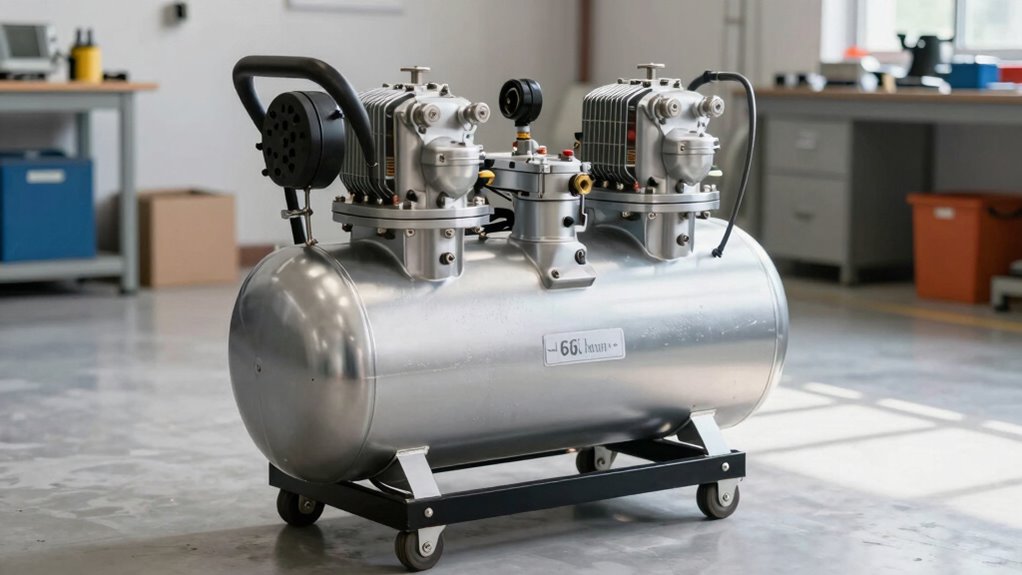
A 60-gallon two-stage air compressor can support demanding shop tools, but airflow, power requirements, and pump design vary across this lineup. My best overall pick is the Ingersoll Rand 2340L5-V, a 5 HP two-stage model that balances workshop capability with a more manageable motor size than the 7.5 HP Ingersoll Rand 2475N7.5. The Campbell Hausfeld 175 PSI and VEVOR 5 HP heavy-duty model offer alternatives for buyers weighing pressure and stated airflow. The main tradeoffs are oil-free convenience versus serviceable pump design, and higher output versus electrical demands. Read on for the full breakdown and guidance on matching a compressor to your tools.

Get home appliances delivered free with Prime
- Fast, free delivery on millions of items
- Prime Video, Amazon Music and more included
- Member-only deals all year
Complete the kit


Key Takeaways
The Ingersoll Rand 2340L5-V is the most balanced choice in this group: its 5 HP two-stage design sits between the smaller 3 HP options and the 7.5 HP premium model.
The Ingersoll Rand 2475N7.5 is the lineup’s high-power choice, but its 7.5 HP motor calls for buyers to check electrical capacity before choosing it.
The VEVOR oil-free model is listed at 10 SCFM at 90 PSI, while the VEVOR 5 HP heavy-duty model is listed at 12 SCFM at 90 PSI; that gap may matter more than tank size for air-hungry tools.
Several models reach 175 PSI, while the VEVOR oil-free and heavy-duty listings specify 125 PSI and 145 PSI maximum, respectively. Match pressure to tool requirements instead of assuming every 60-gallon compressor performs alike.
The roundup includes both explicitly two-stage models and listings that do not specify pump stage. Buyers who need sustained high-pressure operation should verify pump configuration and delivered airflow before treating tank capacity as a performance guarantee.
| DEWALT 60-Gallon Vertical Electric Stationary Air Compressor |  | Best for Flexible Installation | Tank capacity: 60 gallons | Motor power: 3.7 HP | Maximum pressure: 175 PSI | VIEW ON AMAZON | See Our Full Breakdown |
| Campbell Hausfeld 60-Gallon Two-Stage Air Compressor, 175 PSI, 230V |  | Best for Specified Two-Stage Workshop Use | Pump: Oil-lubricated, two-stage cast iron | Maximum pressure: 175 PSI | Air delivery: 7.6 SCFM at 90 PSI; 6.9 SCFM at 175 PSI | VIEW ON AMAZON | See Our Full Breakdown |
| Ingersoll Rand 2340L5-V 5 HP Two-Stage Air Compressor |  | Best for Continuous-Duty Work | Horsepower: 5 HP | Type: Two-stage | Voltage: 230 V | VIEW ON AMAZON | See Our Full Breakdown |
| VEVOR 60-Gallon Oil-Free Air Compressor, 4 HP, 10 SCFM at 90 PSI, 125 PSI Max, 230V |  | Best Oil-Free Option | Tank capacity: 60 gallons | Motor power: 4 HP | Air delivery: 10 SCFM at 90 PSI | VIEW ON AMAZON | See Our Full Breakdown |
| Ingersoll Rand 2475N7.5 7.5 HP Two-Stage Air Compressor |  | Best for Higher-Capacity Shop Demands | Horsepower: 7.5 HP | Compressor type: Two-stage | Maximum operating pressure: 175 psig | VIEW ON AMAZON | See Our Full Breakdown |
| VEVOR 60-Gallon Heavy-Duty Air Compressor, 5 HP, 12 SCFM at 90 PSI, 145 PSI Max, 230V |  | Best for Two-Tool Workshop Use | Tank capacity: 60 gallons | Motor power: 5 HP | Airflow: 12 SCFM at 90 PSI | VIEW ON AMAZON | See Our Full Breakdown |
| 60-Gallon 175 PSI Two-Stage Stationary Electric Air Compressor |  | Best for High Airflow | Tank capacity: 60 gallons | Maximum pressure: 175 PSI | Motor power: 5 HP | VIEW ON AMAZON | See Our Full Breakdown |
| VEVOR 60-Gallon Heavy-Duty Air Compressor, 3.7 HP, 230V |  | Best for Space-Conscious Shops | Tank capacity: 60 gallons | Motor power: 3.7 HP | Airflow: 8 SCFM at 90 PSI | VIEW ON AMAZON | See Our Full Breakdown |
| 3 HP Air Compressor with 60-Gallon Tank |  | Best for 110V Garage Setups | Tank capacity: 60 gallons | Motor power: 3 HP | Voltage: 110 V | VIEW ON AMAZON | See Our Full Breakdown |
| gallon two stage air compressor | Tank capacity | Motor power | Maximum pressure | Voltage |
|---|---|---|---|---|
| DEWALT 60-Gallon Vertical Elec | 60 gallons | 3.7 HP | 175 PSI | 208V or 230V |
| Campbell Hausfeld 60-Gallon Tw | 60 gallons | — | 175 PSI | 230V; requires dedicated 230/240V supply |
| Ingersoll Rand 2340L5-V 5 HP T | 60 gallons | — | — | 230 V |
| VEVOR 60-Gallon Oil-Free Air C | 60 gallons | 4 HP | 125 PSI | — |
| Ingersoll Rand 2475N7.5 7.5 HP | — | — | — | — |
| VEVOR 60-Gallon Heavy-Duty Air | 60 gallons | 5 HP | 145 PSI | — |
| 60-Gallon 175 PSI Two-Stage St | 60 gallons | 5 HP | 175 PSI | 230 V AC |
| VEVOR 60-Gallon Heavy-Duty Air | 60 gallons | 3.7 HP | 155 PSI | — |
| 3 HP Air Compressor with 60-Ga | 60 gallons | 3 HP | — | 110 V |
More Details on Our Top Picks
DEWALT 60-Gallon Vertical Electric Stationary Air Compressor
The DEWALT 60-Gallon suits a workshop that needs high pressure and wants some choice in electrical setup. Its 175 PSI maximum and 11.5 CFM at 90 PSI give it stronger listed airflow than the Campbell Hausfeld 60-Gallon Two-Stage, which supplies 7.6 SCFM at 90 PSI. That difference can matter when running air-hungry tools, though delivered airflow and tool requirements should be checked before buying. The motor accepts 208V or 230V, offering more installation flexibility than the Campbell Hausfeld’s 230V-only motor. Both are stationary, oil-lubricated machines, so neither is a fit for a mobile setup and both need routine oil-system care. I would shortlist this DEWALT for buyers who can verify their power supply and value its stated airflow; the supplied description does not specify its pump stages.
Pros:- 11.5 CFM at 90 PSI is higher than the listed airflow for the Campbell Hausfeld model
- 175 PSI maximum pressure supports demanding pneumatic applications
- 208V or 230V motor compatibility gives more wiring options
- ASME-certified tank
Cons:- Stationary vertical design is not suited to work that moves between locations
- Oil-lubricated system requires routine maintenance
- Description does not identify the pump as two-stage
Best for: Workshop owners seeking a stationary 60-gallon compressor with 175 PSI output, listed 11.5 CFM at 90 PSI, and 208V or 230V motor compatibility.
Not ideal for: Buyers who need a portable compressor, want an oil-free system, or require a confirmed two-stage pump specification.
- Tank capacity:60 gallons
- Motor power:3.7 HP
- Maximum pressure:175 PSI
- Airflow:11.5 CFM at 90 PSI
- Voltage:208V or 230V
- Lubrication:Oil-lubricated
- Tank certification:ASME
- Configuration:Vertical, stationary
Our verdict“Choose the DEWALT if you want its comparatively high listed airflow and flexible voltage compatibility in a stationary 60-gallon setup.”
Campbell Hausfeld 60-Gallon Two-Stage Air Compressor, 175 PSI, 230V
The Campbell Hausfeld is a clear fit for buyers who want a documented two-stage cast-iron pump and a 60-gallon ASME tank for a fixed workshop. Its stated delivery is 7.6 SCFM at 90 PSI and 6.9 SCFM at 175 PSI, giving a useful high-pressure figure the DEWALT 60-Gallon Vertical Electric does not list. The tradeoff is airflow: the DEWALT is rated at 11.5 CFM at 90 PSI, so it has the stronger stated figure for tools with substantial air demand. Campbell Hausfeld’s 230V-only motor also calls for a dedicated supply, whereas the DEWALT supports 208V or 230V. Its 23-by-23-inch footprint is a concrete planning detail, but this remains a stationary, oil-lubricated machine that needs maintenance.
Pros:- Specified oil-lubricated, two-stage cast-iron pump
- Delivers 6.9 SCFM at 175 PSI as well as 7.6 SCFM at 90 PSI
- Vertical 60-gallon ASME tank supports a fixed workshop installation
- 23-by-23-inch footprint helps with space planning
Cons:- Requires a dedicated 230/240V supply
- Its stated 90 PSI airflow is lower than the DEWALT 60-Gallon Vertical Electric’s 11.5 CFM rating
- Stationary, oil-lubricated design limits mobility and requires upkeep
Best for: DIY workshop owners and tradespeople with a dedicated 230/240V circuit who want stated two-stage construction for sanding, painting, grinding, nailing, or inflation.
Not ideal for: Buyers with only 120V power, those needing high airflow beyond its stated 7.6 SCFM at 90 PSI, or anyone who needs a portable or oil-free compressor.
- Pump:Oil-lubricated, two-stage cast iron
- Maximum pressure:175 PSI
- Air delivery:7.6 SCFM at 90 PSI; 6.9 SCFM at 175 PSI
- Tank capacity:60 gallons
- Tank type:Vertical ASME
- Motor:3.7 running HP induction motor
- Voltage:230V; requires dedicated 230/240V supply
- Footprint:23 x 23 inches
Our verdict“Pick the Campbell Hausfeld when specified two-stage construction and high-pressure airflow matter more than the DEWALT’s higher listed 90 PSI airflow or broader voltage compatibility.”
Ingersoll Rand 2340L5-V 5 HP Two-Stage Air Compressor
For a shop that runs its compressor for long stretches, the Ingersoll Rand 2340L5-V stands apart with its stated 100% continuous-duty cycle and 5 HP two-stage design. That makes it a stronger fit for sustained workloads than the Campbell Hausfeld 60-Gallon Two-Stage, whose description lists workshop tasks and pump life but does not specify a continuous-duty cycle. The Ingersoll Rand’s cast-iron construction and service-oriented components are aimed at long-term operation, with individually cast cylinders, an overhung crankshaft, and a one-piece connecting rod. However, the supplied specs give no airflow or maximum-pressure figures, so I cannot compare its delivery directly with the DEWALT’s 11.5 CFM at 90 PSI or the Campbell Hausfeld’s stated pressure figures. Confirm those numbers against your tools before choosing it.
Pros:- Specified 100% continuous-duty cycle
- 5 HP two-stage design
- Cast-iron construction
- Service-friendly components include individually cast cylinders and a one-piece connecting rod
Cons:- Supplied product data does not state airflow or maximum pressure
- Requires 230V single-phase power
- 60-gallon vertical tank and stationary configuration are not intended for portable use
Best for: Workshop operators with single-phase 230V power who need a 60-gallon compressor specified for continuous-duty operation and value serviceable cast-iron construction.
Not ideal for: Buyers who need published airflow or maximum-pressure figures to match tools, or who require a portable compressor.
- Horsepower:5 HP
- Type:Two-stage
- Voltage:230 V
- Phase:Single phase
- Frequency:60 Hz
- Tank capacity:60 gallons
- Tank orientation:Vertical
- Duty cycle:100% continuous duty
- Construction:Cast iron
Our verdict“Choose the Ingersoll Rand 2340L5-V for a fixed shop prioritizing stated continuous-duty capability, after confirming its airflow and pressure suit your tools.”
VEVOR 60-Gallon Oil-Free Air Compressor, 4 HP, 10 SCFM at 90 PSI, 125 PSI Max, 230V
The VEVOR’s main distinction is its oil-free pump, which avoids the oil-system upkeep required by the DEWALT 60-Gallon Vertical Electric and Campbell Hausfeld 60-Gallon Two-Stage. Its listed 10 SCFM at 90 PSI and dual outlets make it suited to a shop that wants to connect two air tools, provided the combined demand stays within the compressor’s capacity. The tradeoff is pressure: its 125 PSI maximum is well below the 175 PSI listed for those two alternatives, so buyers needing more pressure should look elsewhere. This listing also describes a single-phase 4 HP unit, not a two-stage compressor, so it does not match the roundup’s two-stage promise as closely. A 230V supply is required, and the unit ships without a plug, adding an electrical setup task.
Pros:- Oil-free pump avoids oil changes
- 10 SCFM at 90 PSI is a stated airflow figure for tool matching
- Dual outlets allow connection of two air tools
- 60-gallon carbon-steel tank has a powder-coated finish
Cons:- 125 PSI maximum is lower than the 175 PSI listed for the DEWALT and Campbell Hausfeld alternatives
- Product data does not specify a two-stage pump
- No plug is included and 230V power is required
Best for: Workshop buyers who prioritize avoiding oil changes and want dual outlets for lighter simultaneous tool use within the compressor’s stated air capacity.
Not ideal for: Buyers who specifically need a two-stage pump, require pressure above 125 PSI, or want a plug-in-ready compressor.
- Tank capacity:60 gallons
- Motor power:4 HP
- Air delivery:10 SCFM at 90 PSI
- Maximum pressure:125 PSI
- Pump type:Oil-free
- Tank material:3 mm thick carbon steel
- Outlets:Dual air outlets
- Voltage and phase:230V, single-phase
- Plug:No plug included
Our verdict“Pick this VEVOR if oil-free operation and dual outlets matter more than two-stage construction or pressure above 125 PSI.”
Ingersoll Rand 2475N7.5 7.5 HP Two-Stage Air Compressor
The Ingersoll Rand 2475N7.5 is the step-up choice for buyers whose work calls for a larger receiver and sustained operation: it pairs a 7.5 HP two-stage compressor with an 80-gallon ASME tank and a stated 100% duty cycle. Compared with the Ingersoll Rand 2340L5-V, it has 2.5 more horsepower and 20 more gallons of tank capacity, though the 2340L5-V is the one in this lineup explicitly listed with a 60-gallon tank. More stored air can help buffer demand, but the supplied data gives no CFM figure, so horsepower and tank size alone do not establish tool compatibility. The cast-iron pump is designed for more than 15,000 hours, and synthetic lubricant has a stated 2,000-hour service interval. Buyers should factor in routine service and the required start-up kit for the extended pump warranty.
Pros:- 80-gallon ASME receiver tank exceeds the 60-gallon capacity of the Ingersoll Rand 2340L5-V
- 7.5 HP two-stage design with a stated 100% continuous-duty cycle
- Cast-iron construction with designed pump life over 15,000 hours
- Synthetic lubricant has a stated 2,000-hour service interval
Cons:- 80-gallon tank does not match a strict 60-gallon size requirement
- Supplied product data does not state airflow for checking against tool demand
- Regular maintenance is required, and the extended pump warranty requires a start-up kit
Best for: Production-oriented shops with space and suitable electrical service that need a larger receiver and a compressor specified for continuous-duty operation.
Not ideal for: Buyers who require exactly a 60-gallon tank, need published CFM to verify tool demand, or want to avoid scheduled lubricant service and start-up kit requirements.
- Horsepower:7.5 HP
- Compressor type:Two-stage
- Maximum operating pressure:175 psig
- Receiver tank capacity:80 gallons
- Duty cycle:100% continuous duty
- Construction:Cast iron
- Lubricant:All Season Select synthetic
- Lubricant service interval:2,000 hours
- Designed pump life:Over 15,000 hours
Our verdict“Choose the 2475N7.5 if your shop can use its larger 80-gallon receiver and higher horsepower, and you can confirm airflow and service requirements before purchase.”
VEVOR 60-Gallon Heavy-Duty Air Compressor, 5 HP, 12 SCFM at 90 PSI, 145 PSI Max, 230V
The 5 HP motor, 12 SCFM at 90 PSI, and dual outlets make this VEVOR a fit for shops that want to run two air tools from one stationary compressor. Its airflow is below the 15.3 CFM offered by the 60-Gallon 175 PSI Two-Stage Stationary Electric Air Compressor, but the dual outlets suit a shop where tools are used in turns or have moderate air demands. The 60-gallon tank gives a useful reserve for longer tasks, while the oil-level window makes routine checks easier. Its 145 PSI ceiling is lower than that model’s 175 PSI, so buyers prioritizing pressure headroom should compare them closely. This pick also requires 230V wiring, and the missing plug and oil-lubricated pump add setup and maintenance work.
Pros:- 12 SCFM at 90 PSI supports a range of workshop air tools
- Dual outlets allow two tools to connect at once
- Oil-level viewing window makes routine monitoring easier
- Powder-coated carbon steel tank is designed to resist corrosion
Cons:- 145 PSI maximum is below the 175 PSI offered by some alternatives
- Requires 230V power and does not include a plug
- Oil-lubricated pump requires ongoing oil checks
Best for: Workshop owners with 230V power who want a 60-gallon tank and two outlets for moderate-duty tools
Not ideal for: Buyers needing higher airflow or 175 PSI pressure headroom, or those without 230V wiring and the ability to fit a plug
- Tank capacity:60 gallons
- Motor power:5 HP
- Airflow:12 SCFM at 90 PSI
- Maximum pressure:145 PSI
- Power supply:230V, 60Hz, single-phase
- Pump type:Belt-driven, oil-lubricated
- Air outlets:Dual
- Plug:Not included
Our verdict“Choose this VEVOR if you want dual outlets and moderate workshop airflow, and can accommodate its 230V setup and oil maintenance.”
60-Gallon 175 PSI Two-Stage Stationary Electric Air Compressor
This model leads the four on stated airflow, with 15.3 CFM and a 175 PSI maximum. That extra capacity gives demanding shop tools more breathing room than the 12 SCFM VEVOR 5 HP model, while its two-stage design aligns more directly with buyers seeking a compressor for sustained professional work. The cooling-focused pump, fins, and cast-iron flywheel are intended to support longer run times, and thermal overload protection adds a safeguard for the 5 HP motor. The tradeoff is a fixed installation: at 40 x 31 x 80 inches, it needs a dedicated spot and 230V power. Compared with the VEVOR 3.7 HP model, it offers substantially more stated airflow, but buyers should be prepared for a large stationary unit rather than a flexible shop compressor.
Pros:- 15.3 CFM airflow is the highest stated among these four products
- 175 PSI maximum provides more pressure headroom than the VEVOR 5 HP model
- Thermal overload protection helps protect the 5 HP motor
- Cooling-oriented pump and flywheel design is intended for longer run times
Cons:- Large 40 x 31 x 80-inch footprint requires dedicated floor space
- Stationary design limits portability
- Requires 230V AC power
Best for: Professional garage and workshop operators who use air tools heavily and have space for a stationary 230V compressor
Not ideal for: Small shops, mobile users, or buyers whose wiring cannot support a 230V unit
- Tank capacity:60 gallons
- Maximum pressure:175 PSI
- Motor power:5 HP
- Airflow:15.3 CFM
- Voltage:230 V AC
- Noise level:65 dB
- Dimensions:40 x 31 x 80 in
- Type:Two-stage stationary electric
Our verdict“Pick this compressor for demanding, sustained shop use if its 230V requirement and large stationary footprint fit your workspace.”
VEVOR 60-Gallon Heavy-Duty Air Compressor, 3.7 HP, 230V
At 24 x 20.9 x 55.5 inches, this VEVOR has a smaller listed footprint than the 60-Gallon 175 PSI Two-Stage Stationary Electric Air Compressor, which makes it easier to place in a crowded workshop. Its 60-gallon tank and dual outlets still provide useful storage and connection options, but the 3.7 HP motor delivers only 8 SCFM at 90 PSI. That is a clear step down from the 12 SCFM VEVOR 5 HP model, so it suits lighter or intermittent tool use better than air-hungry work. The 155 PSI maximum exceeds that 5 HP VEVOR’s 145 PSI, though pressure alone does not make up for the lower airflow. Buyers also need to plan for 230V wiring, a separate plug, oil checks, and its stated 85 dB noise level.
Pros:- Smaller listed dimensions than the 175 PSI stationary alternative
- 60-gallon tank provides stored air for intermittent tasks
- Dual outlets allow two tools to connect
- 155 PSI maximum is higher than the VEVOR 5 HP model’s 145 PSI
Cons:- 8 SCFM at 90 PSI is lower than the 12 SCFM VEVOR 5 HP model
- 85 dB noise level may be disruptive in a shared workspace
- Requires 230V power, excludes the plug, and needs oil monitoring
Best for: Owners of space-limited workshops who need a 60-gallon tank for intermittent air-tool use
Not ideal for: Users running multiple high-demand tools or working near others who need a quieter compressor
- Tank capacity:60 gallons
- Motor power:3.7 HP
- Airflow:8 SCFM at 90 PSI
- Maximum pressure:155 PSI
- Power supply:230V, 60Hz, single-phase
- Noise level:85 dB
- Weight:192.7 lbs
- Dimensions:24 x 20.9 x 55.5 in
- Pump type:Belt-driven, oil-lubricated
Our verdict“Choose this VEVOR if compact listed dimensions matter more than high airflow and you mainly use air tools intermittently.”
3 HP Air Compressor with 60-Gallon Tank
This is the only option in this group with a listed 110V single-phase motor, giving it a practical advantage for buyers who cannot provide the 230V supply required by both VEVOR models and the 175 PSI two-stage compressor. Its 60-gallon tank offers substantial storage, but the 6.3 CFM at 90 PSI makes it the lowest-airflow choice here with a stated 90 PSI figure. The 3 HP, single-stage V-twin setup also differs from the two-stage focus of the roundup: it may suit lighter garage tasks, but it is a weaker match for buyers seeking sustained output for demanding shop tools. Compared with the VEVOR 3.7 HP, it trades lower stated 90 PSI delivery for 110V power compatibility. The available data does not list maximum pressure or other installation details.
Pros:- 110V single-phase motor suits garages without 230V power
- 60-gallon tank stores air for intermittent tasks
- Provides 8.6 CFM at 40 PSI for lower-pressure applications
Cons:- 6.3 CFM at 90 PSI is lower than the listed output of both VEVOR models
- Single-stage design is a less direct fit for a two-stage compressor roundup
- Product data does not state maximum pressure
Best for: Home garage users who need a 60-gallon tank and have 110V power but cannot install a 230V circuit
Not ideal for: Professional users or anyone running air-hungry tools for long stretches who needs higher airflow and a two-stage pump
- Tank capacity:60 gallons
- Motor power:3 HP
- Voltage:110 V
- Phase:Single phase
- Compressor type:V-twin, single-stage
- Air delivery at 40 PSI:8.6 CFM
- Air delivery at 90 PSI:6.3 CFM
Our verdict“Consider this model for lighter garage work when 110V compatibility matters more than high airflow or two-stage performance.”

How We Picked
I compared the nine listings on details that shape real workshop fit: stated motor power, airflow where provided, maximum pressure, pump stage, oil-free or oil-lubricated design where specified, and the likely electrical demands of the motor. I gave more weight to clear, buyer-relevant specifications than to tank size alone, since a 60-gallon tank cannot compensate for a compressor that falls short of a tool’s airflow needs.
The ranking favors models with a clear use case and enough published information to judge that fit. The Ingersoll Rand 2340L5-V leads as a balanced 5 HP two-stage option; the 2475N7.5 earns the premium role for buyers needing a larger motor, while the VEVOR 5 HP heavy-duty listing stands out for its stated 12 SCFM at 90 PSI. Models with sparse descriptions rank lower because buyers have less information to compare stage, output, or maintenance needs. I treat listing specifications as stated and recommend confirming them with the seller or manufacturer before purchase.
Factors to Consider When Choosing 60 Gallon Two Stage Air Compressor
Tank size is only one part of choosing a stationary compressor. I would start with the tools and work pattern the compressor must support, then check the shop’s electrical supply, installation space, and tolerance for routine pump service.
Match Delivered Airflow to Your Tools
Write down the airflow demand of the tools you expect to run, especially those used continuously, such as sanders or spray equipment. Compare that demand with the compressor’s delivered SCFM at the pressure your tool requires; a figure measured at 90 PSI may not describe output at a higher pressure. For tools used in bursts, the tank can cover short peaks while the pump catches up, but that buffer fades during long sessions. A common mistake is selecting by horsepower or tank capacity without checking airflow. If several tools may run at once, add their demands and allow headroom rather than sizing to the smallest tool. When a listing omits SCFM, ask for the figure before buying.
Check Pressure at the Tool, Not Just the Compressor
Maximum tank pressure and usable pressure at a tool are different things: regulators, hoses, fittings, and filters all affect what reaches the work. Check the tool maker’s pressure range and compare it with the compressor’s stated maximum, leaving room for pressure loss. A model with a higher maximum can offer flexibility, but it does not automatically deliver more air at the pressure your tool uses. Avoid raising regulator settings to compensate for a compressor that cannot keep up with airflow demand. For a mixed shop, plan for the highest-pressure tool and confirm that the other tools can operate at their required settings. Ask whether published airflow is measured at a pressure that matches your intended use.
Plan for the Motor and Electrical Supply
Stationary compressors can draw substantial current at startup, so confirm voltage, phase, breaker, wiring, and motor requirements with the nameplate and a qualified electrician. A 230V label alone does not tell you whether the circuit can handle the motor’s starting load. Higher-horsepower models may suit heavier workloads, but they can be a poor fit if the shop’s electrical service is limited. Consider where the circuit will run and whether the compressor needs a dedicated supply. Buyers often settle on a model first and discover the installation needs afterward. Check the electrical requirements before ordering and include any wiring work in the project plan.
Choose Pump Design Around Maintenance and Duty
Oil-free pumps reduce routine oil checks and avoid oil entering the compressed-air stream from the pump, which can appeal to users seeking simpler upkeep. Oil-lubricated designs typically require regular oil checks and changes, and the service schedule should come from the manufacturer. Pump stage also matters: two-stage compression is designed for higher-pressure operation, but it does not remove the need to compare airflow and duty limits. Ask about replacement parts, service intervals, and whether the pump is intended for the hours you expect to run. Do not infer maintenance needs from horsepower or tank size. Choose the upkeep pattern you can follow consistently.
Measure the Installation Space and Air System
A vertical 60-gallon tank saves floor area compared with many horizontal layouts, but the compressor still needs room for airflow, service access, and safe drainage. Measure doorways, ceiling height, and the path from delivery to its final location before choosing a unit. Plan for vibration isolation, a drain you can reach, and piping or hose rated for the pressure. If the compressor will sit near occupied work areas, check the published noise information and consider placement. A tank is not a substitute for properly sized distribution lines or point-of-use regulators. Planning these details early can prevent a capable compressor from becoming awkward to install or use.
Pay More for Capacity You Will Actually Use
A larger motor or higher-pressure rating makes sense when tools demand sustained airflow or the shop expects long operating sessions. For occasional inflation and intermittent tool use, that extra capacity may add electrical and installation demands without improving the work. Set a budget around the complete setup: compressor, electrical work, air treatment, piping, and maintenance supplies. Compare warranty terms and service access as well as headline specifications. If your future plans may add air-hungry equipment, buying some headroom can be sensible, but verify the circuit and duty rating first. A compressor that fits today’s tools and can be serviced locally may be a better shop asset than one chosen solely for the largest motor.
Frequently Asked Questions
Is a 60-gallon tank enough to run an air sander or paint sprayer?
Tank capacity alone cannot answer that; the compressor must keep up with the tool’s sustained SCFM demand at its working pressure. A 60-gallon tank can cushion short bursts, but it will not prevent pressure from falling if the pump’s output stays below demand. Check the tool’s airflow requirement and compare it with the compressor’s delivered SCFM at a relevant pressure. The VEVOR listings in this roundup state 10 and 12 SCFM at 90 PSI, but other listings provide no comparable airflow figure here. For continuous sanding or spraying, verify output and duty rating with the manufacturer before choosing.
Should I choose an oil-free compressor to avoid maintenance?
Oil-free construction can remove pump oil checks and changes from the routine, which is useful when simplicity is a priority. It does not mean the compressor needs no maintenance: drains, filters, cooling airflow, and other service items still need attention. Oil-lubricated pumps require more regular care, but some buyers prefer a serviceable design for ongoing shop use. Compare the maker’s maintenance schedule, parts availability, and duty guidance rather than relying on the label alone. In this lineup, the VEVOR oil-free model is the clearly identified oil-free option.
Can I install a 5 HP or 7.5 HP compressor on a standard 230V outlet?
Do not assume that voltage compatibility means the existing outlet and circuit are suitable. Motor phase, full-load current, startup draw, breaker, wire gauge, and local electrical rules all affect whether an installation is appropriate. The 7.5 HP Ingersoll Rand may place greater demands on a circuit than a smaller motor, while exact requirements depend on the model’s nameplate. Check the manufacturer’s wiring instructions and have a qualified electrician assess the shop supply. Confirm this before purchase so installation needs do not dictate an unexpected change of model.
Does a two-stage compressor always deliver more air than a single-stage model?
No. Two-stage describes how the pump compresses air, not a guarantee of higher SCFM than every single-stage compressor. Air delivery depends on the pump, motor, operating pressure, and how the manufacturer measures output. Two-stage designs are often selected for higher-pressure work, but buyers still need to compare SCFM at the pressure their tools use. In this roundup, several listings identify a two-stage design, while others do not provide enough information to confirm it. Ask for the pump specification and airflow data when either is missing.
What should I verify when a 60-gallon listing leaves out key specifications?
Ask for the delivered SCFM at your tool’s working pressure, maximum pressure, pump stage, motor voltage and phase, and duty rating. Request the model or SKU so you can compare the listing with the manufacturer’s documentation. Confirm whether the pump is oil-free or oil-lubricated, along with service intervals and warranty coverage. Check the tank’s required clearances and installation instructions, since those details affect whether it fits your shop. If the seller cannot provide the information, treat the uncertainty as a real drawback and compare against listings with clearer specifications.
Conclusion
For most buyers seeking a shop compressor with a clear two-stage, 5 HP specification, I recommend the Ingersoll Rand 2340L5-V as best overall. The VEVOR 5 HP heavy-duty model is my value-oriented pick for buyers whose tools fit its stated 12 SCFM at 90 PSI and 145 PSI maximum, while the Ingersoll Rand 2475N7.5 suits a premium, higher-power setup with electrical capacity to match. Beginners who want fewer pump oil tasks can look at the VEVOR oil-free model, though its stated airflow and 125 PSI maximum make tool matching especially important. For buyers focused on 175 PSI, compare the Campbell Hausfeld and the generic 175 PSI listing, and confirm airflow and pump details before deciding. Choose by tool demand and installation fit first; the biggest tank or motor is not automatically the best fit for your shop.
Halloween Picks
halloween
As an affiliate, we earn on qualifying purchases.