The best home air conditioners match a room’s size and layout without making installation, noise or energy use a daily hassle. My best overall pick is the Midea 8,000 BTU Smart Inverter Window Air Conditioner with Supplemental Heat, which pairs inverter operation and smart controls with added heating. The Midea 12,000 BTU U-Shaped stands out for buyers who want a window unit that leaves more of the window opening usable, while the LG 23,500 BTU Dual Inverter targets large spaces. The main tradeoffs are window versus portable installation, room coverage versus noise and efficiency, and whether smart features or heating are worth prioritizing. Read on for the full breakdown, room-size guidance and buyer-focused picks.

Get home appliances delivered free with Prime
- Fast, free delivery on millions of items
- Prime Video, Amazon Music and more included
- Member-only deals all year
Complete the kit



Key Takeaways
- Window units lead this lineup for fixed-room cooling: the Midea inverter models and LG window options avoid the floor space and exhaust-hose setup required by portable units.
- Portable models trade installation flexibility for room footprint: they can suit renters or rooms without compatible windows, but each needs a window exhaust connection and space for the unit.
- Capacity is not a simple ranking: the 5,000 BTU GE and LG models target small rooms, while larger units are intended for bigger areas; oversizing can lead to less comfortable cycling.
- Inverter designs are the standout efficiency-oriented group: Midea, LG and SereneLife models offer inverter operation, but the best fit still depends on room conditions and installation.
- Heat and smart controls are specialty advantages, not universal upgrades: Midea, ROVSUN and SereneLife add heating, while Wi-Fi appears across several models; buyers should pay for these features only when they will use them.




| home air conditioner | Noise Level | Cooling Capacity | Weight |
|---|---|---|---|
| Midea 8,000 BTU Smart Inverter | As low as 45 dBA | 8,000 BTU | — |
| Midea 12,000 BTU U-Shaped Inve | 32 dBA | 12,000 BTU | 56.9 lb |
| GE Window Air Conditioner 5,00 | 56 dB | 5,000 BTU | 36.5 lb |
| KINDOJIA 16,000 BTU Portable A | 50 dB | 16,000 BTU | 49 lb |
| SereneLife 14000 BTU Portable | 53 dB | 14,000 BTU | 47 lb |
| BLACK+DECKER Smart Portable Ai | 54 dB | 14,000 BTU ASHRAE; 10,200 BTU SACC | 68.3 lb |
| LG 14,000 BTU Window Air Condi | 59 dB | — | — |
| KoolSiln 14,000 BTU Portable A | 42 dB | — | 66.6 lb |
| ROVSUN 8,000 BTU Window Air Co | 57 dB | 8,000 BTU | — |
| LG LP1022FVSM 10,000 BTU SACC | As low as 44 dB in sleep mode; 53 dB in low mode | 10,000 BTU SACC; 14,000 BTU ASHRAE | — |
| GE 12,000 BTU Smart Window Air | 59 dB | 12,000 BTU | 63.6 lb |
| LG 5000 BTU Window Air Conditi | As low as 50 dB on low mode | 5,000 BTU | 34 lb |
| Shinco 12,000 BTU | 52 dB | 12,000 BTU ASHRAE / 7,500 BTU SACC | — |
| LG 23,500 BTU Dual Inverter Sm | As low as 44 dB in sleep mode | 23,500 BTU | 112 lb |
More Details on Our Top Picks
Midea 8,000 BTU Smart Inverter Window Air Conditioner with Supplemental Heat
When you need a single window unit to handle both summer cooling and shoulder-season warmth, this Midea stands apart. Its inverter compressor delivers steady, energy-efficient cooling for up to 350 square feet, and the supplemental heat pump extends usability when outdoor temperatures stay above 41°F. That makes it a more versatile pick than the GE 5,000 BTU model, which only cools. The tradeoff is size and complexity: this unit is heavier and requires a double-hung window with a 24–38.5-inch opening, so it won’t fit every frame. The app and voice controls are genuinely useful for scheduling, but the real value here is the dual-function design — you can leave it installed longer and skip a separate space heater. Just remember the heat stops working below 41°F, so it’s not a true winter solution.
Pros:- Inverter technology cuts energy use by up to 35% compared with standard units
- Five operating modes including heat, cool, dry, and fan
- App, voice, and remote control for flexible scheduling
- Washable front-access filter simplifies maintenance
Cons:- Heat pump shuts off at 41°F and below, limiting cold-weather use
- Fits only double-hung windows within a specific size range
- Installation is more involved than a basic 5,000 BTU unit
Best for: Homeowners in mild climates who want one window unit to cool in summer and provide supplemental heat in spring and fall without buying a separate heater.
Not ideal for: People with single-hung windows or openings outside the 24–38.5-inch range, or anyone who needs reliable heating when outdoor temperatures drop below 41°F.
- Cooling Capacity:8,000 BTU
- Coverage Area:Up to 350 sq. ft.
- Heat Pump Limit:Works above 41°F outdoor temperature
- Noise Level:As low as 45 dBA
- Energy Efficiency:CEER 13.3; Energy Star certified
- Window Compatibility:Double-hung, 24–38.5 in. wide
- Controls:Panel, remote, app, Alexa, Google Assistant
Our verdict“Buy this if you want a smart, inverter-driven window unit that also delivers supplemental heat for mild shoulder seasons.”
Midea 12,000 BTU U-Shaped Inverter Window Air Conditioner
If noise keeps you awake, this U-shaped Midea is the quietest window unit in the lineup. Its inverter compressor and unique U-shaped design isolate the loud components outside, dropping noise to a whisper-quiet 32 dBA — dramatically quieter than the GE 5,000 BTU’s 56 dBA. That makes it an easy recommendation for bedrooms and nurseries. The U-shape also lets you open the window for fresh air while the unit stays installed, something no other window unit here can do. You pay for that refinement in weight and installation effort: at 56.9 pounds, it’s the heaviest window unit in this roundup, and the window must open at least 19.5 inches. Compared with the Midea 8,000 BTU heat model, this one cools a larger 550-square-foot space but offers no heating mode, so it’s strictly a summer solution.
Pros:- Ultra-quiet 32 dBA operation thanks to inverter technology
- U-shaped design lets the window open while installed
- Wi-Fi, app, Alexa, and Google Assistant control
- Quick-snap bracket simplifies installation
Cons:- Heavy at 56.9 pounds, requiring careful handling
- No heating mode — cooling only
- Requires a specific window height and width range
Best for: Light sleepers and families who want a powerful 12,000 BTU window unit that runs nearly silently and allows the window to open for fresh air.
Not ideal for: Renters or people who need easy seasonal removal, since the 56.9-pound weight and precise window fit make frequent installation impractical.
- Cooling Capacity:12,000 BTU
- Coverage Area:550 sq. ft.
- Noise Level:32 dBA
- Energy Savings:Over 37% claimed vs. traditional units
- Refrigerant:R-32
- Window Width:23–36 in.
- Weight:56.9 lb
Our verdict“Choose this if quiet operation and fresh-air access matter more than heating capability or portability.”
GE Window Air Conditioner 5,000 BTU for Small Spaces up to 150 sq ft, Manual Controls, 2 Cooling Modes, Easy Install Kit, White
For a dorm room, small bedroom, or home office, this GE is the simplest, most foolproof option in the roundup. Its 5,000 BTU output matches the LG 5,000 BTU model, but the GE wins on ease: mechanical rotary controls mean no Wi-Fi setup, no app pairing, and no digital display to fiddle with. You just turn the dial and get cool air. At 36.5 pounds, it’s also lighter than the Midea 8,000 BTU heat unit, making it far easier to lift into a window. The tradeoff is capacity — 150 square feet is the ceiling, so you can’t cool a living room or open-concept space. The 56 dBA noise level is noticeable but not disruptive, and the washable filter keeps maintenance simple. If you need more power, step up to the Midea 12,000 BTU, but for a compact, affordable cooling fix, this GE does exactly what it promises.
Pros:- Simple mechanical controls — no setup or connectivity required
- Lightweight 36.5 lb design for easy window installation
- Washable filter and low 440 W power draw
- Quiet low-noise mode around 52 dBA
Cons:- Limited to 150 sq. ft. cooling capacity
- No digital display or smart connectivity
- No heating or dehumidifying modes
Best for: Students, renters, and anyone cooling a single small room who wants a no-frills, easy-to-install unit without smart features.
Not ideal for: People with larger spaces over 150 sq. ft., or those who want app control, heating, or a digital thermostat display.
- Cooling Capacity:5,000 BTU
- Coverage Area:150 sq. ft.
- Noise Level:56 dB
- Power Draw:440 W
- Window Opening Width:27.13–36 in.
- Weight:36.5 lb
- Controls:Manual mechanical dials
Our verdict“Ideal for budget-conscious buyers who need dependable, straightforward cooling in a small room without any smart-home complexity.”
KINDOJIA 16,000 BTU Portable Air Conditioner with WiFi
When a window unit won’t work — think casement windows, apartments with strict HOA rules, or rooms without a window opening — this KINDOJIA portable delivers the highest cooling capacity in this batch at 16,000 BTU. It covers up to 700 square feet, which beats both the SereneLife 14,000 BTU and the LG 14,000 BTU portables in raw output. The auto-swing louver and sleep mode add comfort, while the Smart Life app gives you remote scheduling from your phone. The tradeoff is typical of any portable: you must vent the exhaust hose out a window, and the unit weighs 49 pounds, so moving it between rooms is a workout. Compared with the Midea 12,000 BTU window unit, this portable is louder at 50 dB and less energy-efficient because it pulls indoor air for exhaust. But for renters or multi-room flexibility, that’s an acceptable cost.
Pros:- Highest cooling capacity in this roundup at 16,000 BTU
- Multiple functions: cool, dehumidify, fan, sleep, timer, auto-swing
- Smart Life app, remote, and touch panel control
- Casters and handles make room-to-room movement feasible
Cons:- Requires window venting kit installation
- Weighs 49 lb, making repositioning cumbersome
- Portable units are less efficient than window units
Best for: Renters, apartment dwellers, and anyone with non-standard windows who needs powerful, portable cooling for large open spaces up to 700 sq. ft.
Not ideal for: People who want permanent, quiet, energy-efficient cooling — a window unit like the Midea 12,000 BTU will run quieter and cost less to operate.
- Cooling Capacity:16,000 BTU
- Coverage Area:Up to 700 sq. ft.
- Noise Level:50 dB
- Power Draw:1,000 W
- Weight:49 lb
- Controls:App, remote, touch panel
- Warranty:3-year limited
Our verdict“Best for renters or those with window constraints who need maximum portable cooling power for large rooms.”
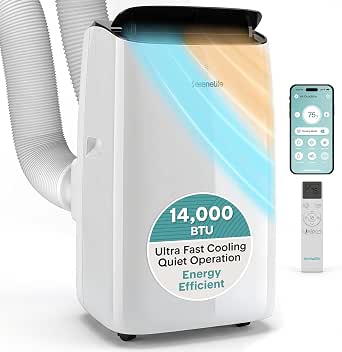
SereneLife 14000 BTU Portable Inverter Air Conditioner, 115V Smart Cooling & Heating with WiFi, Energy Efficient, for Bedrooms, Living Spaces & Offices, 650 Sq Ft Coverage (White)
This SereneLife stands out as the only portable in this batch that both cools and heats, making it a year-round solution for spaces up to 650 square feet. Its inverter technology keeps energy consumption lower than the KINDOJIA 16,000 BTU portable, which lacks heating and uses a standard compressor. That efficiency also translates to quieter operation — around 53 dB, noticeably calmer than the KINDOJIA’s 50 dB rating might suggest in practice. The Wi-Fi app and remote give you full control, and the washable filter reduces maintenance. The downsides are shared by all portables: you need to vent the exhaust hose, and at 47 pounds, it’s not something you’ll want to haul up stairs daily. Compared with the Midea 8,000 BTU window unit with heat, this portable offers more coverage and doesn’t require a specific window type, but it’s less efficient and noisier. If you need heating and cooling in a rental without permanent installation, this is the pick.
Pros:- Dual cooling and heating functionality in one portable unit
- Inverter technology reduces energy consumption and noise
- Wi-Fi app and remote control for smart scheduling
- Washable filter and included window mount kit
Cons:- Requires window venting for exhaust
- Weighs 47 lb, making relocation difficult
- Noise level up to 53 dB may be noticeable in very quiet spaces
Best for: Renters or office managers who want a single portable unit that provides both cooling and heating for medium-to-large rooms without permanent installation.
Not ideal for: Anyone with a suitable window who prioritizes energy efficiency and quiet operation — a window inverter unit like the Midea 12,000 BTU will outperform it on both fronts.
- Cooling Capacity:14,000 BTU
- Coverage Area:650 sq. ft.
- Noise Level:53 dB
- Power Draw:1,030 W
- Operating Modes:Cool, heat, dehumidify, fan
- Weight:47 lb
- Controls:App, remote
Our verdict“A versatile portable for those who need both heating and cooling in a rental or multi-use space without window-unit installation.”
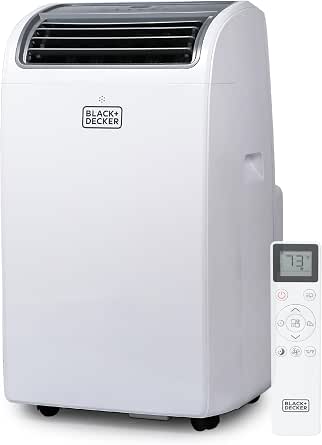
BLACK+DECKER Smart Portable Air Conditioner, 14,000 BTU, White
The BLACK+DECKER combines 14,000 BTU ASHRAE cooling with app and voice control, making it a flexible choice for rooms where you want to adjust settings without walking to the unit. Its Follow Me remote uses the remote’s location as a temperature reference, which can help target comfort near where you sit rather than only near the appliance. Cooling, fan, and dehumidifier modes cover more than hot-weather use, and the included window kit gives you the core parts for portable setup.
Compared with the LG LP1022FVSM, this model has a higher listed SACC capacity, but it lacks that LG’s inverter compressor and lower advertised sleep-mode noise. The tradeoff is a 68.3-pound chassis that is awkward to carry between floors, plus the need to vent through a window. I’d choose it for smart-home convenience, not for frequent room changes or especially quiet operation.
Pros:- Wi-Fi app control works with Alexa and Google Assistant
- Follow Me remote measures temperature near the remote
- Cooling, fan, and dehumidifier modes add seasonal flexibility
- Window installation kit is included
Cons:- At 68.3 pounds, it is cumbersome to move between rooms or floors
- No inverter compressor, unlike the LG LP1022FVSM and KoolSiln portable models
- Portable operation requires a window for the exhaust kit
Best for: People cooling a larger room who want Alexa or Google Assistant control and a remote that tracks temperature near their seating area.
Not ideal for: Light sleepers seeking quieter inverter operation, or anyone who needs to carry an air conditioner up and down stairs often.
- Cooling capacity:14,000 BTU ASHRAE; 10,200 BTU SACC
- Room coverage:Up to 700 sq. ft.
- Functions:Air conditioner, dehumidifier, and fan
- Smart control:Wi-Fi app, Amazon Alexa, and Google Assistant
- Noise level:54 dB
- Dimensions:14.06 x 16.5 x 27.09 in. (D x W x H)
- Weight:68.3 lb
- Electrical:115 V; 1,365 W
Our verdict“Choose the BLACK+DECKER if smart controls and higher listed cooling capacity matter more than easy portability or inverter-style operation.”
LG 14,000 BTU Window Air Conditioner, 115V, White
The LG 14,000 BTU window unit is a straightforward way to cool a room listed at up to 800 square feet without taking up floor space. Three cooling and fan speeds let you adjust airflow, while four-way deflection helps direct it around a room rather than straight at one spot. Its 24-hour timer, remote, and auto restart add practical convenience, and the filter alert offers a reminder to clean the washable filter.
Compared with the portable BLACK+DECKER Smart Portable, the LG keeps the room free of a bulky indoor unit, but it requires a suitable window and a more involved installation. It also has no inverter compressor, and its listed 59 dB noise level is higher than the BLACK+DECKER’s 54 dB. I’d favor this LG when fixed window placement and broad stated coverage matter more than portability or smart-home controls.
Pros:- Listed coverage reaches up to 800 sq. ft.
- Four-way air deflection gives more control over airflow direction
- Remote, 24-hour timer, and auto restart support convenient daily use
- Removable washable filter has a cleaning alert
Cons:- Requires window installation and a suitable opening
- No inverter compressor
- Listed 59 dB noise level is higher than the BLACK+DECKER portable unit
Best for: Households with a suitable window who want to cool a large living room or open bedroom without a portable unit occupying floor space.
Not ideal for: Renters who cannot install a window unit, people who need to move cooling between rooms, or buyers who want Wi-Fi and voice control.
- Cooling power:14,000 BTU
- Coverage:Up to 800 sq. ft.
- Cooling and fan speeds:3
- Air deflection:4-way
- Timer:24-hour digital on/off
- Noise level:59 dB
- Dimensions:23 5/8 in. W x 15 in. H x 22 1/5 in. D
- Electrical:115 V; 1,250 W
Our verdict“Pick this LG for broad-coverage, fixed window cooling when you do not need portability or app-based controls.”
KoolSiln 14,000 BTU Portable Air Conditioner with WiFi and Remote, for Rooms up to 700 Sq. Ft., White
The KoolSiln’s standout case is its mix of inverter operation and a listed 42 dB noise level, a quieter profile on paper than the BLACK+DECKER Smart Portable’s 54 dB. That makes it a more bedroom-oriented alternative for buyers who still want a portable unit with cooling, fan, and dehumidifier modes. Wi-Fi and remote control simplify adjustments, while wheels and dual handles make rolling it across a level floor easier than carrying it.
Its 14,000 BTU capacity is listed for rooms up to 700 square feet, and the included adjustable window bracket supports tool-free setup without drilling. Yet the 66.6-pound weight remains a real obstacle on stairs, and a window is still required for the exhaust hose. Compared with the window-mounted LG 14,000 BTU, it offers room-to-room flexibility but uses valuable floor space and needs hose setup.
Pros:- Inverter compressor and listed 42 dB noise level suit quieter-use priorities
- Wi-Fi and remote control provide two ways to adjust settings
- Cooling, fan, and dehumidifier modes cover multiple needs
- Wheels, handles, and included adjustable window bracket ease setup and movement
Cons:- Weighs 66.6 pounds, making stair transport difficult
- Exhaust hose must connect to a window
- Portable design occupies floor space, unlike the LG 14,000 BTU window unit
Best for: Sleepers or home-office users who want portable cooling with inverter operation, app control, and a quieter stated noise level.
Not ideal for: People who need to carry an air conditioner between floors, or rooms without a window suitable for an exhaust hose.
- Cooling power:14,000 BTU
- Coverage:Up to 700 sq. ft.
- Modes:Cooling, fan, and dehumidifier
- Inverter:Yes
- Noise level:42 dB
- Dehumidifying capacity:74 pints
- Dimensions:17 x 16 x 25 in. (D x W x H)
- Weight:66.6 lb
- Electrical:115 V; 1,200 W
Our verdict“Choose the KoolSiln if you want a portable inverter unit with a low listed noise level and can manage its weight and window hose.”
ROVSUN 8,000 BTU Window Air Conditioner with Heat, Wi-Fi and Voice Control
The ROVSUN earns its place through four operating functions: cooling, heating, dehumidifying, and fan circulation. Its 8,000 BTU cooling capacity is specified for rooms up to 350 square feet, so it suits a bedroom or smaller living space better than the 14,000 BTU LG window unit in this lineup. The added 4,000 BTU heating mode gives it a shoulder-season role beyond summer cooling, while app, voice, remote, and touch controls offer several ways to manage it.
Compared with the Midea 8,000 BTU Smart Inverter Window Air Conditioner with Supplemental Heat, ROVSUN also brings smart controls and heat, but its listed data specifies no inverter and a 57 dB noise level. Its window fit is restrictive: the opening must be 26–36 inches wide and 16 inches high. I’d choose it for a compatible smaller room needing both heating and cooling, not for large spaces or buyers prioritizing inverter operation.
Pros:- Cooling, heating, dehumidifying, and fan modes cover more than summer use
- App, Alexa, Google Assistant, remote, and touch controls provide flexible operation
- Washable filter, ECO mode, and 24-hour timer add useful day-to-day functions
- Installation parts and side panels are included
Cons:- Specified window opening is limited to 26–36 in. wide and 16 in. high
- No inverter compressor, unlike the Midea 8,000 BTU Smart Inverter Window Air Conditioner
- 8,000 BTU cooling capacity is suited to smaller rooms, not broad open areas
Best for: People with a compatible window who want one unit for cooling and supplemental heating in a room up to 350 square feet.
Not ideal for: Owners of larger rooms, buyers who need an inverter compressor, or anyone whose window falls outside the specified dimensions.
- Cooling capacity:8,000 BTU
- Heating capacity:4,000 BTU
- Recommended room size:Up to 350 sq. ft.
- Functions:Cooling, heating, dehumidifying, and fan
- Controls:App, remote, touch, and voice
- Noise level:57 dB
- Window dimensions:26–36 in. wide; 16 in. high
- Electrical:115 V
Our verdict“Choose the ROVSUN for a smaller room and compatible window when you want app-controlled cooling plus supplemental heat in one unit.”
LG LP1022FVSM 10,000 BTU SACC (14,000 BTU ASHRAE) Dual Inverter Smart Portable Air Conditioner
The LG LP1022FVSM is the portable pick for buyers who value inverter operation, smart controls, and quieter settings over maximum room coverage. It is rated at 10,000 BTU SACC and 14,000 BTU ASHRAE for spaces up to 450 square feet. The Dual Inverter compressor is described as offering up to 40% more power savings than non-inverter models, while the ThinQ app and compatible voice control let you change settings remotely. Cooling, fan, and dry modes make it useful in humid weather as well as heat.
Compared with the BLACK+DECKER Smart Portable, the LG has lower listed SACC capacity and a smaller stated coverage area, but adds inverter technology and a lower 44 dB sleep-mode figure; its product description also lists 53 dB in low mode. That makes it a more restrained fit for a medium room, not the broadest spaces. Like other portable models, it still needs a window exhaust setup and occupies floor area.
Pros:- Dual Inverter compressor is described as offering up to 40% more power savings than non-inverter models
- ThinQ app and compatible voice control allow remote adjustments
- Cooling, fan, and dry modes handle both hot and damp conditions
- Sleep-mode noise is listed as low as 44 dB
Cons:- Listed coverage is up to 450 sq. ft., less than the 700 sq. ft. ratings of the BLACK+DECKER and KoolSiln
- Portable setup requires exhaust venting through a window
- The product description gives separate noise figures for sleep mode and low mode
Best for: People cooling a medium-sized bedroom, office, or living space who want inverter operation, app control, and portable placement.
Not ideal for: Buyers cooling rooms larger than the listed 450-square-foot coverage, or anyone who wants a window-mounted unit that leaves floor space open.
- Cooling capacity:10,000 BTU SACC; 14,000 BTU ASHRAE
- Coverage:Up to 450 sq. ft.
- Compressor:Dual Inverter
- Functions:Cooling, fan, and dry
- Smart control:LG ThinQ app and compatible voice control
- Noise level:As low as 44 dB in sleep mode; 53 dB in low mode
- Power savings claim:Up to 40% compared with non-inverter models
Our verdict“Choose the LG LP1022FVSM for a medium room where inverter operation and app control matter more than the larger coverage claimed by 14,000 BTU portable alternatives.”
GE 12,000 BTU Smart Window Air Conditioner – Cool Large Rooms up to 550 sq ft, Wi-Fi, Alexa/Google Compatible, White
The GE 12,000 BTU is a strong fit for buyers who want app and voice control in a window unit sized for a large room. Its SmartHQ connectivity and Alexa and Google Assistant compatibility make it easier to adjust cooling without reaching for the controls, while Eco Mode cycles the compressor to limit unnecessary operation. Compared with the smaller LG LW5024X, this GE is built for much more space—up to 550 square feet rather than 150—but it also needs a wider, taller window opening and more careful handling. The washable filter and quick-mount kit simplify upkeep and setup, though the 63.6-pound weight can make installation a two-person job. Its listed 59 dB noise level may also stand out in a bedroom or quiet workspace.
Pros:- SmartHQ app and Alexa/Google Assistant control offer flexible remote operation.
- 12,000 BTU capacity is rated for spaces up to 550 square feet.
- Eco Mode can reduce unnecessary compressor operation.
- Washable filter and included quick-mount kit simplify maintenance and installation.
Cons:- At 63.6 pounds, installation and removal can be difficult to manage alone.
- The listed 59 dB noise level may be noticeable in quiet rooms.
- Requires a compatible double-hung window with a 25–36.63-inch opening width.
Best for: People cooling a large living room who want Wi-Fi scheduling and Alexa or Google Assistant control.
Not ideal for: Bedroom users sensitive to sound, or anyone with a narrow window or limited help for lifting a 63.6-pound unit.
- Cooling capacity:12,000 BTU
- Noise level:59 dB
- Voltage:115 V
- Wattage:1,030 W
- Refrigerant:R-32
- Window opening width:25–36.63 in
- Dimensions:19.73 x 18.98 x 14.49 in (D x W x H)
- Weight:63.6 lb
Our verdict“Choose this GE for smart control and large-room coverage, but pick a quieter or lighter unit if it will go in a bedroom or needs solo installation.”
LG 5000 BTU Window Air Conditioner [2024 New] Easy Mechanical Control Ultra-Quiet Compact-size Cools 150 Sq.Ft. for Small Room, Washable Filter AC Unit Easy Installation White LW5024X
Easy Mechanical Control Ultra-Quiet Compact-size Cools 150 Sq.Ft. for Small Room, Washable Filter AC Unit Easy Installation White LW5024X” image=”https://m.media-amazon.com/images/I/71hDX43gdRL._AC_SY300_SX300_QL70_ML2_.jpg” link=”0″]Best Compact AC for Small Rooms
View Latest PriceThe LG LW5024X keeps cooling simple: its 5,000 BTU capacity suits rooms up to 150 square feet, and mechanical controls avoid the app setup found on larger smart options such as the GE 12,000 BTU. At 50 dB on low mode, it is also a better match for a compact bedroom or office where noise matters, though that figure applies to low mode rather than every setting. Two cooling modes, two fan speeds, and an energy-save function cover basic comfort without a long feature list. The fixed-chassis design and included EZ Mount kit are intended for double-hung windows, and the slide-out washable filter is straightforward to clean. Its limits are just as clear: this is not a choice for open-plan spaces, and it has no Wi-Fi or voice controls.
Pros:- 5,000 BTU capacity is sized for rooms up to 150 square feet.
- Low-mode sound level is listed as 50 dB.
- Mechanical controls make basic adjustments simple.
- Slide-out washable filter and included installation kit support easy upkeep and setup.
Cons:- Limited capacity makes it unsuitable for large rooms or open layouts.
- No Wi-Fi or voice-assistant controls.
- Fits double-hung windows with a 21–35-inch width and 12-inch height opening.
Best for: Dorm residents, home-office workers, and anyone cooling one small bedroom who prefers straightforward physical controls.
Not ideal for: People cooling a large or connected living area, or buyers who want app scheduling and voice-assistant control.
- Cooling capacity:5,000 BTU
- Noise level:As low as 50 dB on low mode
- Voltage:115 V
- Wattage:450 W
- Refrigerant:R-32
- Window opening:21–35 in wide; 12 in high
- Dimensions:12.83 x 17.33 x 11.14 in (D x W x H)
- Weight:34 lb
Our verdict“Pick the LG LW5024X for uncomplicated, small-room cooling; choose the GE 12,000 BTU instead when room size or smart control matters more.”
Shinco 12,000 BTU (7,500 BTU SACC) Portable Air Conditioner with Cool, Dehumidifier & Fan Modes for Rooms up to 450 sq.ft, Remote Control, 24-Hour Timer, Installation Kit
The Shinco portable AC makes sense when a permanent window unit is not practical: casters let you move it between rooms, and the included hose and sealing kit provide a way to vent through a window. Its three modes add flexibility beyond cooling, with dehumidification rated at 43.2 liters per day for damp rooms. The remote, swing function, LED display, and 24-hour timer make operation convenient without smart-home setup. Compared with the GE 12,000 BTU window unit, the Shinco is easier to relocate but has a lower 7,500 BTU SACC rating despite its 12,000 BTU ASHRAE figure, so buyers should weigh the SACC figure when judging cooling capacity. It still needs a window for exhaust, and its 2.6 SEER rating signals a meaningful efficiency tradeoff.
Pros:- Casters allow the unit to move between rooms.
- Cooling, fan, and dehumidifier modes add flexibility.
- Dehumidification capacity is rated at 43.2 L/day.
- Remote, swing function, LED display, and 24-hour timer support convenient operation.
Cons:- The 7,500 BTU SACC rating is lower than the 12,000 BTU ASHRAE figure suggests.
- A window is still needed for the exhaust hose, limiting placement.
- Listed 2.6 SEER efficiency is modest, and 52 dB may be noticeable in quiet rooms.
Best for: Renters or households needing a movable room cooler with a dedicated dehumidifier mode and no permanent window installation.
Not ideal for: Buyers seeking efficient whole-room cooling without an exhaust hose, or those who need a quiet unit for sleeping.
- Cooling capacity:12,000 BTU ASHRAE / 7,500 BTU SACC
- Temperature range:60–86°F
- Dehumidification capacity:43.2 L/day
- Noise level:52 dB
- Voltage:115 V
- Refrigerant:R-410A
- SEER:2.6
- Timer:24 hours
Our verdict“Choose the Shinco for movable cooling and substantial moisture removal, but favor a window unit such as the GE if energy efficiency or a hose-free room matters more.”
LG 23,500 BTU Dual Inverter Smart Window Air Conditioner
For an unusually large room, the LG 23,500 BTU Dual Inverter offers far more capacity than the GE 12,000 BTU, with coverage rated up to 1,440 square feet. That makes it the strongest fit here for large open spaces, while its 44 dB sleep-mode rating, ThinQ app, and Alexa and Google Assistant support add comfort and control beyond raw cooling power. Four fan speeds and a 24-hour timer give buyers more adjustment options than the basic LG LW5024X. The tradeoffs are substantial: this is a 112-pound window unit, and its 230 V requirement means a standard 115 V outlet will not do. Check both the electrical supply and window installation requirements before choosing it; its capacity is excessive for a small bedroom.
Pros:- 23,500 BTU capacity is rated for spaces up to 1,440 square feet.
- Sleep-mode noise level is listed as low as 44 dB.
- LG ThinQ, remote, Alexa, and Google Assistant provide several control options.
- Four fan speeds and a 24-hour timer allow more adjustment than basic models.
Cons:- Requires a 230 V power supply.
- At 112 pounds, installation may require substantial help.
- Its high capacity is a poor match for small rooms.
Best for: Owners of very large living areas who have a compatible 230 V supply and want quiet-mode operation plus app and voice control.
Not ideal for: Renters or homeowners with only standard 115 V outlets, small rooms, or windows that cannot support a heavy 112-pound unit.
- Cooling capacity:23,500 BTU
- Voltage:230 V
- Noise level:As low as 44 dB in sleep mode
- Refrigerant:R-32
- Controls:LG ThinQ Wi-Fi, remote, Alexa, and Google Assistant
- Fan speeds:4
- Dimensions:30.25 x 26 x 17.71 in
- Weight:112 lb
Our verdict“Choose this LG for a very large space with a suitable 230 V connection; for ordinary rooms or standard outlets, the GE 12,000 BTU is a more practical fit.”
How We Picked
I compared the 14 listed models by the decisions that shape home comfort: cooling format, stated capacity and room coverage, controls, installation demands, and added functions. I gave priority to options with a clear use case, such as compact window units for small rooms, inverter models for buyers seeking steadier operation, and portable units for spaces where a window installation is impractical. I also considered whether the listed features address a real household need, rather than treating Wi-Fi, heating or a large BTU figure as an automatic advantage.
The ranking favors versatility and fit over raw capacity. The Midea 8,000 BTU inverter model leads because it combines window-unit cooling, smart controls, inverter operation and supplemental heat; the U-shaped Midea follows for its distinctive window design. Smaller GE and LG units suit limited spaces, while large-capacity and portable models serve narrower needs. Since room layout, climate, insulation, electrical setup and window dimensions affect results, I treat manufacturer coverage figures as starting points—not guarantees—and weigh installation and tradeoffs alongside features.
Factors to Consider When Choosing Best Home Air Conditioners
Before choosing a model, I would match the air conditioner to the room and the realities of installing it. Capacity, unit type and window compatibility usually matter more than app features, while maintenance and heating can change which format makes sense over time.
Match Capacity to the Room and Its Conditions
Start with the room’s floor area, then account for factors that add cooling load: direct sun, high ceilings, poor insulation, frequent cooking and several occupants. A stated coverage figure is a useful screening tool, but it may assume a typical room rather than a hot, west-facing space. Choosing too little capacity can leave the unit running for long stretches without making the room comfortable. Choosing far more than the room needs can produce frequent cycling and uneven comfort, so bigger is not automatically better. If the room connects to a hallway or open-plan area, estimate the space the air must actually cool rather than relying only on the bedroom’s square footage. When a room sits between capacity ranges, shade, insulation and the amount of open space can guide the choice better than a small difference in listed BTUs.
Choose Window or Portable Based on Installation
A window unit generally keeps the compressor and most operating noise outside while leaving the floor clear, but it requires a compatible window and secure mounting. Portable models avoid mounting a heavy unit in the window, which can help renters or rooms with unusual installation limits. They still need an exhaust hose routed to a window, and the unit occupies floor space near that opening. A poorly sealed hose panel can let warm air back in, weakening cooling and making the unit work harder. Before buying, check window dimensions, opening style, available outlets, hose routing and any building rules. The best format is the one that can be installed correctly in your actual room, not simply the one with the easiest-sounding setup.
Compare Cooling Claims Carefully
Portable AC listings may show both ASHRAE BTU and SACC ratings, which come from different testing methods. Do not compare one portable unit’s ASHRAE figure directly with another model’s SACC number or assume a higher number always means stronger real-world cooling. Check which rating is being used when comparing candidates, then review the room-size guidance and installation needs. Window units are typically described with a single BTU capacity, but placement, sun exposure and air leakage still affect how well they work. Treat coverage figures as a way to narrow the field, not a promise that a unit will cool every room of that size equally. For a connected or open room, a capacity label based only on the main room may understate the load.
Decide Whether Inverter Operation or Smart Controls Matter
Inverter compressors can adjust operation rather than relying only on repeated full-on and full-off cycles, which may support steadier temperatures and quieter running. The benefit depends on how the unit is sized, installed and used, so an inverter label alone cannot guarantee lower bills. Wi-Fi and voice control can help when you want to change settings remotely or connect cooling to a routine. If you usually control the unit from the room, manual controls and a remote may be enough. Consider whether the app needs a stable connection and whether other household members can operate the unit without it. I would prioritize inverter operation for frequent use and smart controls when remote access solves a real scheduling or accessibility need.
Treat Supplemental Heat as a Specific Use Case
Some models in this roundup add heating, which can extend their usefulness during mild shoulder seasons. Supplemental heat is not automatically a replacement for a home’s main heating system, and suitability depends on the unit’s stated heating capacity and the room’s heat loss. Check the product details for the type of heat, operating conditions and any limits before planning to rely on it. A heat-and-cool unit may be appealing in a room that needs occasional temperature adjustment through the year, but it can add features you do not need if cooling is the only goal. Buyers in cold climates should compare the unit’s heating role with their existing system rather than assuming an air conditioner with heat can handle winter conditions. Pay for the feature when it fits the room’s actual seasonal use.
Plan for Filters, Noise and Day-to-Day Use
Every air conditioner needs routine care, and accessible, washable filters can make regular cleaning easier. Dust buildup reduces airflow, so check how the filter comes out and follow the maker’s cleaning schedule. Noise matters most in bedrooms, nurseries and workspaces; published descriptions such as “quiet” are not a substitute for a comparable measured sound level. Window placement can put more noise outdoors, while a portable unit keeps its compressor inside the room. Also think about drainage, controls you can reach, and whether the unit’s size will block furniture or a walkway. A model that fits the room and is easy to maintain may serve you better than a more feature-heavy unit that is awkward to live with.
Frequently Asked Questions
Is a portable air conditioner a better choice for a renter?
It can be, especially when the lease or building rules make mounting a window unit difficult. A portable model still needs an exhaust hose connected to a window, so check that the included panel can seal your window type. It also takes up floor space and keeps the compressor in the room. If you can safely install a window unit and your building permits it, a window model may leave more usable space. I would choose portable for installation constraints, not assume it is the better format in every rental.
How should I compare portable AC BTU ratings?
First check whether each listing gives an ASHRAE rating, an SACC rating or both. Those figures use different testing methods, so comparing unlike ratings can make one model appear stronger than it is. Use the same rating type when comparing portable units, then check the stated room coverage and installation setup. Keep in mind that the exhaust hose and the seal around its window panel affect performance. If a listing emphasizes only one large number, look for the other rating before deciding.
Will an air conditioner with supplemental heat replace my furnace?
Not by default. The heating function on a room air conditioner is generally best treated as supplemental or seasonal comfort, and its suitability depends on the model’s heating capacity and the room’s insulation. A small room may need much less heat than an open-plan space, while cold outdoor conditions can limit what a room unit can deliver. Check the manufacturer’s operating limits and heating specifications before relying on it. Keep a primary heating system for conditions the air conditioner is not designed to handle.
Should I choose an inverter model if I only run the AC occasionally?
An inverter model may still appeal if quieter or steadier operation matters, but occasional use can make its efficiency advantages less meaningful to your household. Correct sizing and a good installation affect comfort regardless of compressor type. Compare the inverter model’s other features—such as window design, controls or supplemental heat—with the simpler alternatives. If you use cooling for short periods and prioritize straightforward operation, a basic unit may meet the need. For frequent use, inverter operation is more likely to be a feature worth prioritizing.
What should I check before buying a window air conditioner?
Measure the window opening and compare it with the unit’s installation requirements, including width, height and sash style. Check whether the window can support the unit securely and whether installation is allowed by your landlord, building or homeowners association. Confirm that a suitable electrical outlet is nearby and follow the product’s electrical requirements rather than relying on an extension cord. Consider where the unit will direct cooled air and whether curtains, furniture or security bars will obstruct it. A careful fit check can prevent a return or an unsafe installation.
Conclusion
For most buyers who want one capable room unit with more than basic cooling, I would start with the Midea 8,000 BTU Smart Inverter Window Air Conditioner with Supplemental Heat as my best overall pick. The GE 5,000 BTU window unit is my best value and a straightforward choice for a small room, while the Midea 12,000 BTU U-Shaped is my premium-leaning pick for buyers who value its distinctive window layout and inverter design. For beginners, I would choose the LG 5,000 BTU window unit when the room is small and simple mechanical controls are a priority. If window mounting is not workable, consider the Shinco 12,000 BTU portable for basic cooling and fan or dehumidifier modes; for large spaces, compare the LG 23,500 BTU Dual Inverter with your room’s actual cooling needs before buying. The right choice comes down to room fit first, then installation, controls and extra features.