TL;DR

Get home appliances delivered free with Prime
- Fast, free delivery on millions of items
- Prime Video, Amazon Music and more included
- Member-only deals all year
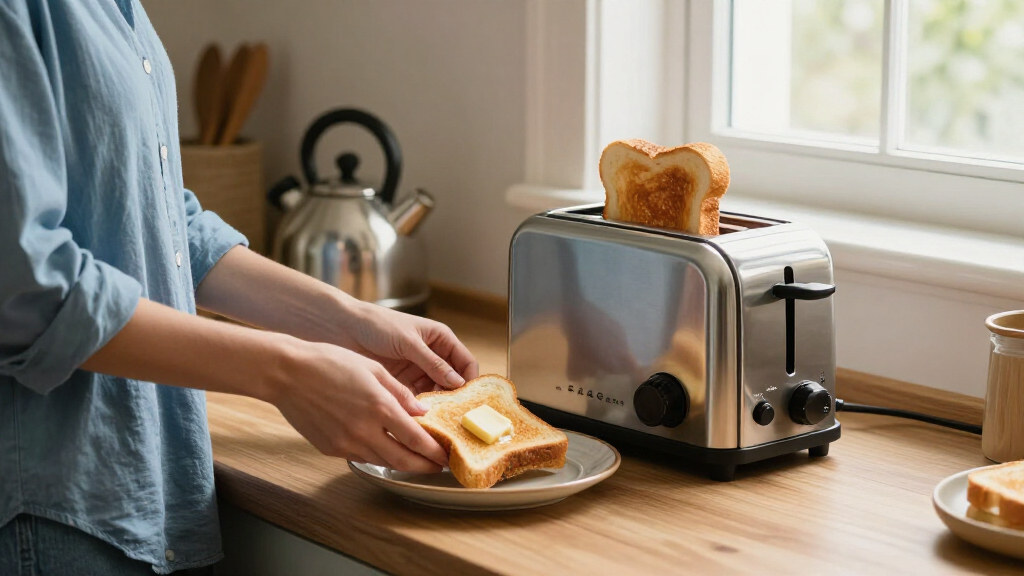
Sage’s Eye Q Auto toaster uses optical sensors to monitor bread as it browns and stop when it reaches the selected shade, rather than relying only on a preset timer. Ideal Home’s reviewer reported even golden results across sourdough, crumpets and white bread, but the toaster is a premium-priced appliance and broader performance claims have not been independently established.
Sage’s Eye Q Auto toaster uses an optical sensor to track bread as it browns and stop when it reaches the selected colour, the company says. The appliance is available in two-slice and four-slice versions, priced at £249.95 and £349.95 respectively, placing it in the premium end of the toaster market.
The Eye Q’s central feature is a patent-protected Eye Q Optic Sensor. According to Ideal Home’s report, it uses green and infrared LEDs to monitor changes in toast colour up to 10 times per second. The toaster then stops when the selected shade is reached, rather than relying solely on a set toasting time.
That approach is intended to address a common limitation of timed toasters: the same setting can produce different results with different breads. Ideal Home’s reviewer said they tried the appliance with sourdough, crumpets and white bread, and each reached a deep golden colour. This is one reviewer’s experience, not evidence of identical results for every bread type or user.
The report also describes a ceramic-coated top intended to resist crumbs and rust, and an automatic lift-and-lower function in place of a conventional springing pop-up. Users can switch to a traditional timed mode. The four-slice model can store two programmes, which may suit households where people prefer different settings.
How Colour Sensing Changes Toasting
The Eye Q’s pitch is practical rather than purely cosmetic: it aims to make browning depend on the toast’s appearance, not a fixed time that may behave differently with different bread. If the sensor works consistently in everyday use, it could reduce guesswork and make it easier to repeat a preferred shade across varieties.
That potential comes at a substantial price. At £249.95 for two slices and £349.95 for four, the device costs far more than a basic toaster. Buyers will need to decide whether sensor-led control, the finish and added functions justify the premium over a conventional model. The report does not provide comparative testing against other toasters or evidence of long-term reliability.
As an affiliate, we earn on qualifying purchases.
From Timer Settings to Toast Colour
Many household toasters use a dial or setting to control how long bread is heated. As the Ideal Home report explains, a chosen setting may not give the same result across different breads, making a preferred level harder to reproduce. Sage’s model instead monitors colour during toasting and stops at the selected shade.
The product is offered in two- and four-slice models. The larger version’s two stored programmes are presented as a way for two people to personalise their settings. Ideal Home characterises the Eye Q as a first-of-its-kind product, but that description comes from the source report and is not accompanied by a broader market survey.
“I’ve now tried this toaster on sourdough, crumpets and white bread, and can confirm it has achieved a deep golden colour each time.”
— Ideal Home reviewer
As an affiliate, we earn on qualifying purchases.
Questions About Everyday Performance
The available report does not establish how consistently the sensor performs across a wider range of bread, thicknesses, frozen slices or repeated use. It also does not provide independent test results, a comparison with competing sensor-based appliances, or long-term information on durability and repair costs.
Sage’s claim that the toaster can deliver a chosen colour should not be read as proof that it prevents all burnt toast. The source gives no details on how the sensor handles uneven slices, user-selected settings or variations in bread moisture, and it does not quantify any reduction in fire risk from crumbs or other hazards.
automatic bread toaster with sensor
As an affiliate, we earn on qualifying purchases.
As an affiliate, we earn on qualifying purchases.
Price and Independent Testing
The next useful evidence for shoppers would be side-by-side testing of the Eye Q against conventional toasters, including repeatability across bread types and performance over time. The source report does not announce a further testing date or product milestone.
For now, prospective buyers can compare the two sizes and consider whether automatic shade sensing and the additional design features matter enough to justify the stated price. The report does not specify availability by retailer or country beyond the listed UK prices.
As an affiliate, we earn on qualifying purchases.
Key Questions
How does the Sage Eye Q toaster work?
According to the report, its green and infrared optical sensors track toast colour up to 10 times per second. It stops heating when the selected shade is reached.
How much does the Sage Eye Q cost?
The two-slice model is listed at £249.95, while the four-slice version costs £349.95.
Can it still use a timer?
Yes. The report says users can switch the toaster back to a traditional timed mode instead of using colour sensing.
Has the toaster been shown to prevent burnt toast?
The design is intended to stop at a selected colour, and an Ideal Home reviewer reported golden results with three bread types. The source does not provide independent testing showing that it prevents burnt toast in all conditions.
Source: rss
Cold & flu season Picks
humidifiers
As an affiliate, we earn on qualifying purchases.