TL;DR

Get home appliances delivered free with Prime
- Fast, free delivery on millions of items
- Prime Video, Amazon Music and more included
- Member-only deals all year
An Ideal Home report says closing curtains just before sunset can help reduce heat loss through windows and keep rooms warmer. Its writer measured temperature differences of up to 2°C across thermal curtains, but the report provides no measured energy-bill savings, and results will vary by home.
An Ideal Home writer reports that closing curtains before sunset helped keep their home warmer in the evening, with a measured 2°C difference between the areas in front of and behind thermal curtains. The test supports curtains as a way to slow heat loss through windows, but it does not establish how much energy or money the habit saves.
The report’s writer says they closed curtains at dusk over the course of a week and noticed their home stayed comfortable for longer without switching the heating on for an extra hour. They measured temperatures on both sides of several window coverings after sunset. The largest difference was 2°C around thermal curtains and blinds; wooden blinds showed just under 1°C, while standard curtains showed about half a degree. These readings describe the writer’s home, not a controlled test or a result that can be assumed for every household.
Stuart Middleton, So Energy’s consumer energy expert, said windows can contribute to heat loss and curtains add a layer that can slow it. He said thick, well-fitting or thermally lined curtains may be particularly effective. The report does not provide a measured reduction in heating use, a bill saving, or a comparison of energy consumption with curtains open and closed.
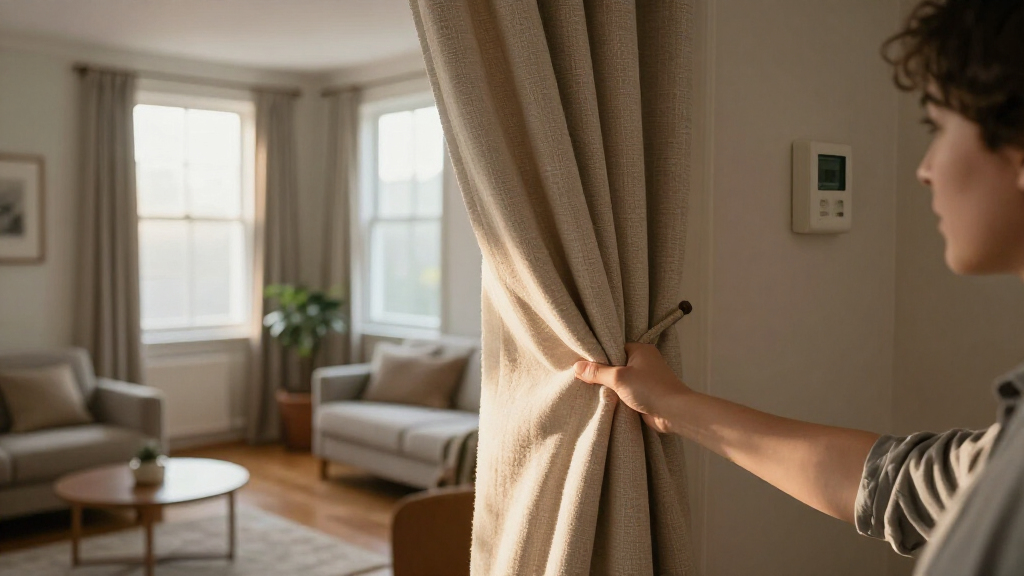
The writer recommends drawing curtains just before sunset, rather than leaving them open after daylight fades. Closing them at that point is intended to retain warmth while preserving any heat gained through sunlight during the day. Sunset time changes by location and date; the report suggests checking a local forecast or setting a phone reminder. It also describes curtain motors that can follow schedules or, for some products, respond to outdoor light levels.
Curtains Can Slow Window Heat Loss
The habit matters because it offers households a no-cost change that may improve comfort during colder evenings. If a room stays warmer, residents may be less inclined to extend central heating or use a portable heater, though the report does not quantify whether that occurred or how much energy it would save.
Results depend on the home’s windows, existing insulation, curtain fit and material, and how the room is heated. The writer’s readings suggest thermal coverings performed better than standard curtains in that particular home. They do not prove that all homes will experience the same temperature differences or that curtains alone can replace adequate heating.
For readers facing higher energy costs, the distinction is useful: the method may help reduce heat loss, but it is not a guaranteed bill-cutting figure. The report notes that energy prices rose by 4% in October and cites forecasts of increases between 16% and 25% in January; it does not specify the tariff, market, or forecast source in the supplied material, so those figures should not be treated as a universal price outlook.
Products Worth Considering

Sonos Era 100 Wireless Smart Speaker, Black

Hisense 85 U6 Pro Series Mini-LED ULED 4K UHD HDR Gaming AI Smart Fire TV (85U6SF Pro)

Levoit Core 400S-P Smart Air Purifier for Large Rooms
As an affiliate, we earn on qualifying purchases.
A Home Test, Not a Savings Trial
The Ideal Home article revisits advice attributed to consumer finance broadcaster Martin Lewis to close curtains as soon as the sun goes down. Its writer says they had used the approach before and restarted it during a week of colder, darker evenings. The article combines that personal experience with advice from Middleton, rather than reporting a laboratory study or a broad survey of households.
The timing advice aims to balance two effects: allowing daylight to enter before sunset, then adding a barrier across the window as outdoor temperatures fall. Window coverings vary in how much insulation they provide. In the writer’s home, thermal curtains and blinds produced the biggest reported temperature separation, while wooden blinds and standard curtains showed smaller differences. The report does not detail the measuring equipment, exact placement, room conditions, or window types.
“Windows can be a source of heat loss, so drawing your curtains creates an additional layer of insulation that helps slow the rate at which heat escapes.”
— Stuart Middleton, So Energy’s consumer energy expert
Energy Savings Remain Unmeasured
The article gives no figures for kilowatt-hours saved, heating costs avoided, or the length of time any household would need to use the method to see a financial effect. Its temperature readings come from one home and the supplied account does not describe a controlled comparison. It is also unclear how much the readings changed with outdoor conditions, heating settings, window design, or measurement position.
The reported 4% October energy-price rise and forecast January increases of 16% to 25% lack a defined market, tariff, and named forecast source in the source material. Those figures cannot establish what a particular reader will pay. The report also does not compare curtain motors’ purchase and running costs with any heating savings, so automation should be understood as a convenience option, not a proven financial return.
Check Sunset and Compare Comfort
Households wishing to try the approach can note local sunset time and close curtains shortly beforehand, then observe whether rooms remain comfortable. The report suggests prioritising well-fitting, lined curtains where practical and checking whether coverings leave gaps around the window. Any conclusion about savings would require tracking heating use or bills over comparable periods, while accounting for weather and changes in household routines.
The source does not announce a follow-up test or a next publication date. Its practical recommendation is to use a reminder or an automated schedule if no one is home at dusk. Whether that investment is worthwhile will depend on the home’s needs and the cost of the device; no verified payback estimate is provided.
Key Questions
Does closing curtains before sunset save energy?
It may help slow heat loss through windows and could reduce the need for heating, but the Ideal Home report does not measure energy use or confirm a specific saving.
When should curtains be closed?
The report recommends closing them just before sunset, so daylight can enter first and the coverings are in place as outdoor temperatures fall. Sunset time varies by location and date.
Which curtains performed best in the reported test?
In the writer’s home, thermal curtains and blinds showed a 2°C difference between the areas on either side. Wooden blinds showed just under 1°C, and standard curtains about half a degree. These are home-specific readings, not general performance guarantees.
Can automated curtain devices guarantee lower bills?
No. The article describes devices that can operate curtains on a schedule or in response to light, but it provides no evidence that automation guarantees energy or bill savings.
Source: rss