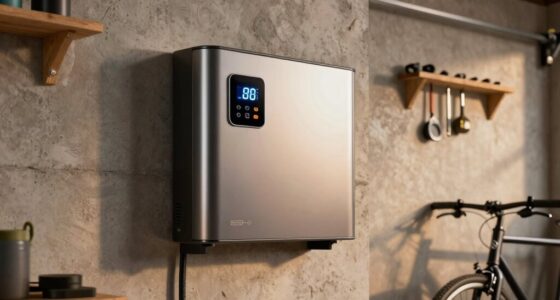
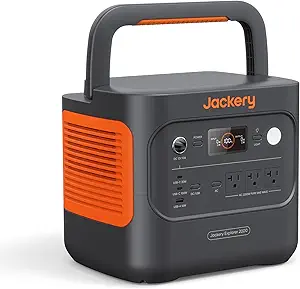
For a portable power station for a garage, I’d start with the Jackery HomePower 2000 Plus v2 as the best overall balance of capacity and AC output for running common garage equipment and backup loads. The Jackery HomePower 3600 Plus suits buyers who need more stored energy and higher output, while the Jackery Explorer 300 is a smaller choice for lights, chargers, and other modest loads. The key tradeoff is between a compact unit that’s easy to move and a larger station that can power more demanding tools or run devices longer. I also weigh inverter output, battery capacity, charging options, and how well each unit fits a real garage routine. Read on for the full comparison and guidance on matching a station to your equipment.

Get home appliances delivered free with Prime
- Fast, free delivery on millions of items
- Prime Video, Amazon Music and more included
- Member-only deals all year
Complete the kit


Key Takeaways
Capacity and output are separate limits: the HomePower 3600 Plus leads this lineup on both listed capacity and AC output, while the Anker SOLIX S2000 offers 2010Wh but 1500W output, so stored energy alone does not tell you which tools it can run.
The 2kWh class is the lineup’s middle ground: the Jackery HomePower 2000 Plus v2, Jackery Explorer 2000 v2, EBL Acc2400, and Anker SOLIX S2000 offer substantial capacity, but their listed output and battery details differ enough to affect tool choice and runtime.
Compact capacity has a clear job: the Jackery Explorer 300’s 292Wh makes more sense for lights, small electronics, and short tasks than for extended backup or high-demand garage equipment.
LiFePO4 appears across several sizes: the EBL Acc2400, BLUETTI AC180, BLUETTI Elite 100 V2, and 1000W 1024Wh unit list this battery chemistry, giving buyers a basis for comparing battery design alongside output and capacity.
Solar bundles change the setup, not the basic sizing math: the Jackery HomePower 3000 package includes two 200W panels, but buyers still need to match its 3072Wh capacity and 3600W output to their loads and plan where panels can receive sunlight.



| portable power station for garage | Weight | Battery capacity | Battery type | Dimensions |
|---|---|---|---|---|
| Jackery HomePower 2000 Plus v2 | 40.6 lb | 2048Wh | — | 14.37 × 10.24 × 10.73 in |
| Jackery Explorer 2000 v2 Porta | 39.5 lb | 2042Wh | — | — |
| Jackery Explorer 300 Portable | 7.1 lb | 292Wh | — | 9.1 × 5.2 × 7.8 in |
| EBL Acc2400 Portable Power Sta | 54 lb | 1843.2Wh | LiFePO4 | 16.93 × 11.8 × 11.02 in |
| Anker SOLIX C1000 Gen 2 Portab | 11.3 kg | 1024Wh | LiFePO4 | 15.1 × 8.2 × 9.6 in |
| BLUETTI AC180 Portable Power S | 37.4 lb | 1,152Wh | LiFePO₄ | 13.39 × 9.72 × 12.48 in |
| BLUETTI Elite 100 V2 Portable | 25 lb | 1,024Wh | LiFePO₄ | — |
| Jackery Explorer 1000 v2 Porta | 23.8 lb | 1,070Wh | LFP (LiFePO₄) | 12.87 × 8.82 × 9.72 in |
| UDPOWER S1200 Portable Power S | 25.8 lb | — | LiFePO₄ | 13.7 × 9.53 × 9.72 in |
| Jackery HomePower 3000 with 2x | — | 3,072Wh | LiFePO₄ | — |
| Jackery HomePower 3600 Plus Po | — | — | — | — |
| Anker SOLIX S2000 Portable Pow | 35.7 lbs | — | LiFePO4 | 8.2 x 11.1 x 12.7 inches |
| 1000W Portable Power Station 1 | 27.73 lbs | — | LiFePO4 | — |
More Details on Our Top Picks
Jackery HomePower 2000 Plus v2 Power Station, 2048Wh, 2400W AC Output
For a garage that may need to support essential circuits through a longer outage, I rank the HomePower 2000 Plus v2 ahead of the smaller Explorer 2000 v2 because its capacity can expand from 2048Wh to 12kWh. That gives a buyer a path to longer runtime without starting with a much larger fixed-capacity unit. Its listed 2200W output suits many chargers, lights, and smaller tools, but it is not a fit for every high-draw appliance or tool; check startup and running wattage before buying. At 40.6 pounds, it is portable for occasional repositioning, not something I would want to carry up and down stairs often. The smart energy-management angle makes this a stronger planned-backup choice than the compact Explorer 300, though the expansion option matters less if you only need brief, low-power jobs.
Pros:- 2048Wh capacity provides a substantial starting point for outage backup.
- Expandable capacity up to 12kWh can support longer runtimes as needs change.
- 140W USB-C charging is useful for compatible laptops and other electronics.
- Smart energy management supports essential-circuit backup planning.
Cons:- The listed 2200W output rules out some high-draw garage tools and appliances.
- At 40.6 pounds, it is awkward for frequent carrying despite its portable design.
Best for: Garage owners planning backup for essential circuits who want room to add battery capacity as their needs grow.
Not ideal for: Buyers who need to run high-wattage shop equipment beyond its listed 2200W output, or who want a lightweight unit for frequent carrying.
- Battery capacity:2048Wh
- AC output:2200W listed output
- Expandable capacity:Up to 12kWh
- USB-C power:140W with AVS Protocol
- Battery cycles:6000+ LFP cycles
- Weight:40.6 lb
- Dimensions:14.37 × 10.24 × 10.73 in
- Voltage:120V
Our verdict“Choose the HomePower 2000 Plus v2 if expandable capacity for planned garage backup matters more than a lower carry weight or a compact footprint.”
Jackery Explorer 2000 v2 Portable Power Station, 2042Wh, 2200W AC Output
The Explorer 2000 v2 makes sense for a garage where outages are occasional but a quick return to a high charge level matters. Its 2042Wh capacity and 2200W AC output put it close to the HomePower 2000 Plus v2 for basic capacity and output, while its stated AC charging time—66 minutes to 80%—is the sharper distinction. That can help between power interruptions or before a planned job, though a full charge is listed at 102 minutes. Unlike the HomePower model, the provided specs do not list expandable capacity, so I would favor this for a self-contained backup setup rather than one intended to grow. At 39.5 pounds it remains a substantial lift, and the 2200W ceiling still calls for checking tool startup loads. It is a more capable garage backup option than the Explorer 300, but far less suited to frequent portability.
Pros:- 2042Wh capacity supports longer use than compact stations such as the Explorer 300.
- AC fast charging is listed at 66 minutes to 80% capacity.
- 2200W AC output covers a range of household and garage electronics.
- Solar charging is supported with compatible panels.
Cons:- The 39.5-pound weight is still cumbersome for frequent carrying.
- No expandable capacity is listed, unlike the HomePower 2000 Plus v2.
- The 2200W output can limit use with demanding shop equipment.
Best for: Garage owners who want a high-capacity, self-contained backup unit and value rapid AC recharging between outages or work sessions.
Not ideal for: Buyers who want expandable storage, need to power equipment above 2200W, or regularly carry a power station over long distances.
- Battery capacity:2042Wh
- AC output:2200W
- AC charge time:66 minutes to 80%; 102 minutes to full
- Solar charging:About 6 hours with 400W panels
- Weight:39.5 lb
- Battery life:Up to 10 years
Our verdict“Pick the Explorer 2000 v2 for fast-recharging, high-capacity backup in a fixed garage setup, but choose the HomePower 2000 Plus v2 if future expansion is a priority.”
Jackery Explorer 300 Portable Power Station, 292Wh
For small garage jobs, the Explorer 300 is the easy-carry option in this group: at 7.1 pounds, it can move from a shelf to a workbench without the effort required by the 39.5-pound Explorer 2000 v2. Its 292Wh battery and 300W rated output suit phones, lights, laptops, and other modest loads, not corded tools that demand more power. Two AC outlets and a 100W USB-C port let it handle several electronics, while the 600W peak rating may cover brief surges only when the connected device is compatible. Solar charging is available, but the panel is sold separately. Compared with the Anker SOLIX C1000 Gen 2, this Jackery gives up most of the runtime and output in exchange for far less weight and a smaller footprint. I would treat it as a portable electronics station, not whole-garage outage backup.
Pros:- At 7.1 pounds, it is much easier to carry around a garage than the larger stations.
- 100W USB-C and multiple port types support several small electronics.
- LiFePO4 battery is rated for over 4,000 charge cycles before reaching 70% capacity.
- Solar charging is supported with a compatible panel.
Cons:- The 300W rated output excludes many power tools and other high-draw equipment.
- The 292Wh battery offers limited runtime for prolonged outage backup.
- A compatible solar panel is not included.
Best for: DIYers who want a light station for charging phones, laptops, and work lights at a bench or in a vehicle.
Not ideal for: Garage owners seeking hours of backup for larger appliances or power tools; its 292Wh capacity and 300W rated output are limiting.
- Battery capacity:292Wh
- Battery chemistry:LiFePO4
- Peak output:600W
- Ports:2 AC, 1 USB-C PD (100W), 2 USB-A, 1 car port
- Weight:7.1 lb
- Dimensions:9.1 × 5.2 × 7.8 in
- Solar charging:About 80% in 2.8 hours with a 100W panel; panel not included
Our verdict“Choose the Explorer 300 for lightweight charging of small devices around the garage, not for running tools or backing up major loads.”
EBL Acc2400 Portable Power Station, 1843.2Wh LiFePO4 Battery, 2400W Output
The EBL Acc2400 is the lineup’s port-rich workhorse: four AC outlets plus USB, DC, car, and wireless charging make it practical when several people or devices need power in the same garage. Its 2400W maximum output and 4800W starting wattage give it more stated headroom than the Jackery Explorer 2000 v2’s 2200W output, which may help with compatible equipment that draws extra power at startup. The tradeoff is a notably heavier 54-pound body, so I would plan to keep it parked rather than move it between floors. Its 1843.2Wh capacity is slightly below the two 2kWh-class Jackery options, and no expansion figure is provided. The 0.1-second backup switching is useful for supported backup applications, but buyers should verify device compatibility rather than assume every garage load will switch seamlessly.
Pros:- 2400W maximum output and 4800W starting wattage provide more listed headroom than the Explorer 2000 v2.
- Four AC outlets and several other charging options support up to 12 devices.
- LiFePO4 battery is rated for over 3500 charge-discharge cycles.
- 0.1-second emergency backup switching and a four-mode LED light add useful garage functions.
Cons:- At 54 pounds, it is the least convenient option here to reposition by hand.
- Its 1843.2Wh capacity is lower than the 2042Wh Explorer 2000 v2 and 2048Wh HomePower 2000 Plus v2.
- The listed dimensions require substantial storage space.
Best for: Garage owners who need to connect multiple devices at once and want higher listed output and starting wattage than the Explorer 2000 v2.
Not ideal for: Anyone who needs a station that is easy to carry frequently, or buyers who want a clearly specified expandable battery system.
- Battery capacity:1843.2Wh
- Battery type:LiFePO4
- Maximum output:2400W
- Starting wattage:4800W
- AC outlets:4
- Other connections:2 USB-A, 2 USB-C (up to 100W), 1 car port, 2 DC ports, wireless charging panel
- Backup switching:0.1 seconds
- Weight:54 lb
- Dimensions:16.93 × 11.8 × 11.02 in
Our verdict“Choose the EBL Acc2400 if many simultaneous connections and higher stated output matter more than carrying convenience or the largest battery capacity.”
Anker SOLIX C1000 Gen 2 Portable Power Station, 1,024Wh
The Anker SOLIX C1000 Gen 2 hits a useful middle ground for a garage: its 1024Wh battery is much smaller than the two roughly 2kWh Jackery stations, but its 2000W output can still handle many individual loads that exceed the Explorer 300’s 300W limit. That balance suits a homeowner who wants to run selected devices rather than keep a whole garage powered for an extended outage. Recharging is a strength: the supplied specifications list 49 minutes for AC charging at 1600W and 1.8 hours with solar, while the under-10ms UPS switchover may help supported equipment stay on during an interruption. The tradeoffs are less stored energy than the larger Jackery models and a 600W solar-input ceiling. Port counts also conflict between the specifications and product copy, so I would confirm the exact outlet layout before planning a multi-device setup.
Pros:- 2000W output is substantially higher than the Explorer 300’s 300W rated output.
- AC recharge is listed at 49 minutes at 1600W, with solar recharge listed at 1.8 hours.
- Under-10ms UPS switchover supports backup for compatible equipment.
- LiFePO4 battery is rated to retain at least 80% capacity after 4,000 cycles.
Cons:- Its 1024Wh capacity is about half that of the 2kWh-class Jackery stations.
- Solar input is limited to 600W and 60V maximum.
- Listed port counts conflict between the specifications and product copy.
Best for: Garage owners seeking a manageable mid-size station for selected tools, electronics, and brief backup, with fast recharge and UPS switching.
Not ideal for: Buyers who need long runtimes for several high-energy loads or want to plan around a confirmed outlet count without checking the product details.
- Battery capacity:1024Wh
- Battery type:LiFePO4
- Output:2000W
- Peak output:3000W
- AC recharge:49 minutes at 1600W
- Solar input:600W, 60V maximum
- UPS switchover:Under 10 ms
- Weight:11.3 kg
- Dimensions:15.1 × 8.2 × 9.6 in
Our verdict“Pick the SOLIX C1000 Gen 2 for a fast-recharging, mid-size garage station when 1kWh of storage is enough and you verify the port layout first.”
BLUETTI AC180 Portable Power Station 1152Wh 1800W LiFePO4 Solar Generator
The BLUETTI AC180 pairs an 1,152Wh LiFePO₄ battery with 1,800W of output, giving a garage setup room to run several smaller tools, lights, or chargers without reaching for a larger, heavier station. Its standout advantage is the stated one-hour AC recharge: after a work session or outage, it can be replenished quickly from a wall outlet. Compared with the BLUETTI Elite 100 V2, it carries more energy but weighs considerably more at 37.4 pounds, so it is less appealing to move between the garage and a vehicle. The 11 outlets and USB ports suit mixed equipment, though the provided data does not detail solar input capacity. I’d choose it for quick turnaround and useful capacity, not frequent carry or a large off-grid solar setup.
Pros:- 1,152Wh LiFePO₄ capacity offers more stored energy than the BLUETTI Elite 100 V2.
- Stated one-hour AC charging can shorten downtime between garage tasks.
- 1,800W output and 11 outlets support a mix of tools and personal devices.
- Five-year warranty is specified.
Cons:- At 37.4 pounds, it is less convenient to carry around a garage or off-site.
- Solar input capacity is not specified in the supplied product data.
- Its 1,800W output may not suit equipment that draws more than that continuously.
Best for: Garage owners who want a fast-recharging station for lights, chargers, and moderate-power equipment, and can keep it mostly in one place.
Not ideal for: Buyers who regularly carry a power station up stairs or need clearly specified, high-capacity solar charging; its 37.4-pound weight and limited solar-input details are drawbacks.
- Battery capacity:1,152Wh
- Battery type:LiFePO₄
- AC output:1,800W
- Peak output:2,700W
- AC charging time:1 hour
- Solar charging time:2.8–3.3 hours
- Outlets:11
- Weight:37.4 lb
- Dimensions:13.39 × 9.72 × 12.48 in
Our verdict“Choose the AC180 if fast wall charging and higher capacity matter more than low carry weight or detailed solar specifications.”
BLUETTI Elite 100 V2 Portable Power Station for Camping 1024Wh 1800W
For a garage station that may also travel to a job site or campsite, the BLUETTI Elite 100 V2 balances 1,024Wh capacity and 1,800W AC output in a 25-pound package. That is notably easier to move than the BLUETTI AC180, which stores somewhat more energy but weighs 37.4 pounds. A stated 70-minute recharge, UPS backup, and 30dB silent mode add practical value when the station serves both work sessions and quiet overnight backup. Its 11 ports and app control add flexibility, though buyers who prefer physical controls alone may find remote management less appealing. The capacity is enough for many chargers, lights, and moderate loads, but it trails larger stations such as the Jackery HomePower 3000 when longer runtimes or demanding equipment are the priority.
Pros:- 25-pound weight is easier to carry than the BLUETTI AC180.
- 1,800W AC output and 1,024Wh capacity fit many everyday garage loads.
- Stated 70-minute charging time helps reduce downtime.
- UPS backup and a 30dB silent mode suit sensitive electronics and quiet spaces.
Cons:- Its 1,024Wh capacity may run short for long sessions or high-energy equipment.
- Full remote management relies on app control, which may not suit every buyer.
- At 25 pounds, it is still a substantial item for frequent one-handed carrying.
Best for: DIYers who need a portable garage power source for chargers, lighting, and moderate loads, plus quiet UPS backup for electronics.
Not ideal for: Buyers planning extended backup for high-draw equipment or those who want to manage every function without an app; capacity is limited compared with larger stations.
- Battery capacity:1,024Wh
- Battery type:LiFePO₄
- AC output:1,800W
- Surge output:2,700W
- Weight:25 lb
- Charging time:70 minutes
- Number of ports:11
- Silent-mode noise:30dB
- Battery lifespan:Over 4,000 cycles to 80% capacity
Our verdict“Pick the Elite 100 V2 if you want a capable 1,800W station that is easier to move than the AC180 and can also provide quiet UPS backup.”
Jackery Explorer 1000 v2 Portable Power Station, 1070Wh, 1500W
The Jackery Explorer 1000 v2 is a compact choice for a garage where storage space and portability matter more than maximum tool output. Its 1,070Wh battery and 23.8-pound weight make it easier to stash or carry than the BLUETTI AC180, while its 1,500W AC rating is lower than the AC180 and Elite 100 V2. That output can cover many chargers, lights, and smaller appliances, but buyers should check their equipment’s running and startup demands before relying on it for power tools. Jackery lists a one-hour charge mode, but it must be enabled as emergency charging in the app; default charging takes 1.7 hours. Solar panels are not included, and solar compatibility is limited to Jackery panels, so it is less flexible for buyers building around other solar gear.
Pros:- 23.8-pound weight and compact dimensions make it easier to store and carry than the BLUETTI AC180.
- 1,070Wh LFP battery and multiple AC, USB, and DC ports support varied smaller loads.
- App charging modes include quiet and energy-efficiency options.
- USB-C output reaches 100W for compatible devices.
Cons:- 1,500W AC output is lower than the BLUETTI Elite 100 V2 and may rule out some tools.
- One-hour charging requires enabling emergency mode in the app; default charging takes 1.7 hours.
- Solar panels are not included, and the unit is specified as compatible only with Jackery panels.
Best for: Garage owners with limited storage who need a lighter station for lights, device charging, and equipment that stays within a 1,500W AC draw.
Not ideal for: Buyers running higher-draw tools, needing solar panels in the box, or wanting broad compatibility with third-party solar panels.
- Battery capacity:1,070Wh
- Battery type:LFP (LiFePO₄)
- AC output:1,500W
- Surge output:3,000W
- Weight:23.8 lb
- Dimensions:12.87 × 8.82 × 9.72 in
- Ports:3 AC, 2 USB-C, 1 USB-A, 1 DC car port
- USB-C output:100W
- Charging time:1 hour with emergency charging enabled; 1.7 hours by default
Our verdict“Choose the Explorer 1000 v2 for a space-conscious garage setup with moderate loads, provided its lower output and Jackery-only solar compatibility fit your plans.”
UDPOWER S1200 Portable Power Station 1200W (Surge 1800W), Max 400W Solar Input, UPS, UL2743, for Home RV Emergency, Pure Sine Wave
The UDPOWER S1200 takes a more restrained output approach than the BLUETTI Elite 100 V2 or Jackery Explorer 1000 v2: it is rated for 1,200W continuous, with 1,800W surge capacity. That makes it a better match for garage owners whose needs center on lights, electronics, and moderate loads rather than tools with demanding startup or sustained draw. Its specified 400W solar input gives buyers a clearer basis for planning solar charging than the AC180’s supplied product information, though it remains a cap for larger off-grid setups. The product data lists five AC outlets, two USB-C PD ports, and a 1.5-hour recharge, but does not provide battery capacity, so runtime is difficult to compare directly with the other stations. I’d weigh that missing figure carefully before choosing it for extended outage backup.
Pros:- 1,200W pure sine wave output is suited to compatible electronics and moderate-power equipment.
- 400W maximum solar input is specified for planning a solar setup.
- Five AC outlets and two USB-C PD ports accommodate several devices.
- LiFePO₄ battery is described as lasting over 4,000 cycles.
Cons:- Battery capacity is not provided, making runtime comparisons with the BLUETTI AC180 difficult.
- 1,200W continuous output is below the 1,500W Jackery Explorer 1000 v2 and 1,800W BLUETTI models.
- A 400W solar-input ceiling may limit recharge speed in larger off-grid setups.
Best for: Garage owners prioritizing a defined solar-input limit, multiple AC outlets, and backup for moderate loads rather than long runtimes or high-draw tools.
Not ideal for: Buyers who need a clearly stated battery capacity to estimate runtime, or who plan to run demanding tools above 1,200W continuously.
- Continuous output:1,200W
- Surge output:1,800W
- Battery type:LiFePO₄
- Maximum solar input:400W
- AC outlets:5
- USB-C ports:2 USB-C PD
- Recharge time:1.5 hours
- Weight:25.8 lb
- Dimensions:13.7 × 9.53 × 9.72 in
Our verdict“Consider the S1200 if specified solar input and moderate-load backup matter more than a clearly documented capacity or higher continuous output.”
Jackery HomePower 3000 with 2x200W Solar Panels, 3072Wh, 3600W AC Output
When a garage needs longer runtimes and more output than a portable mid-size station can provide, the Jackery HomePower 3000 stands apart with 3,072Wh capacity and 3,600W AC output. It offers far more headroom than the BLUETTI AC180 or Elite 100 V2, making it the stronger fit for multiple appliances or higher-demand equipment—subject to checking each device’s draw. Recharge times are stated as 2.2 hours from AC and 1.7 hours with hybrid AC/DC charging. Two 200W solar panels are included in the product title, but the supplied details say the panels and station ship separately, so buyers should plan for separate package arrivals. The tradeoff is portability: the exact weight and dimensions are not provided, which makes it hard to judge storage and handling in a crowded garage.
Pros:- 3,072Wh capacity provides substantially more stored energy than the BLUETTI AC180.
- 3,600W AC output and 7,200W surge rating offer more power headroom than the other reviewed stations.
- AC and hybrid charging times are specified at 2.2 hours and 1.7 hours.
- LiFePO₄ battery is rated for 4,000 cycles.
Cons:- Exact weight and dimensions are not supplied, making portability and storage fit harder to judge.
- The product details say the panels and station may arrive in separate packages.
- Its larger capacity and output are more than needed for buyers powering only lights and small electronics.
Best for: Homeowners who want substantial stored energy and high AC output for longer garage backup sessions, and have space for a larger station and panels.
Not ideal for: Buyers who need a compact unit they can easily carry or need precise weight and dimensions before planning a tight storage location.
- Battery capacity:3,072Wh
- AC output:3,600W
- Surge output:7,200W
- Battery type:LiFePO₄
- Cycle life:4,000 cycles
- AC recharge time:2.2 hours
- Hybrid AC/DC recharge time:1.7 hours
- Included solar panels:2 × 200W
- Solar recharge time:Up to 80% in 9 hours
Our verdict“Choose the HomePower 3000 if extended backup and high output outweigh the uncertainty around its size and handling requirements.”
Jackery HomePower 3600 Plus Power Station, 3584Wh, 3600W AC Output
For a garage where backup needs extend beyond lights and phone charging, the Jackery HomePower 3600 Plus offers the largest stated capacity in this group: 3584Wh paired with 3600W AC output. That headroom makes it a stronger fit than the Anker SOLIX S2000 for running several compatible appliances or tools, though actual runtime and startup demands depend on the equipment. Its stated 120V and 240V operation in parallel may suit broader backup setups, while expandable capacity leaves room to scale. Charging options include AC and DC, solar, and a gas generator; the listed times are two, four, and 2.5 hours respectively. Wheels and a telescopic handle help with repositioning, but the product data gives no exact weight, so portability is harder to judge. It is more station than a small garage needs.
Pros:- 3584Wh capacity and 3600W AC output provide the highest stated capacity and output among these three picks.
- Expandable options can support larger backup needs.
- AC/DC, solar, and gas-generator charging offer several ways to replenish the battery.
- Wheels and a telescopic handle aid movement around a garage or home.
Cons:- No specific weight is provided, making it difficult to judge whether one person can move it comfortably.
- Very large power needs may require multiple units.
- Its high capacity may be unnecessary for buyers who only need to run lights or charge small devices.
Best for: Garage owners who want substantial outage backup for multiple compatible appliances and value expandable capacity.
Not ideal for: Buyers who need to lift a station frequently, have only small electronics to power, or want a clearly stated weight before choosing.
- Capacity:3584Wh
- AC output:3600W
- Voltage:120V and 240V in parallel
- Cycle life:6000 cycles
- Stated lifespan:10 years
- AC and DC charging time:2 hours
- Solar charging time:4 hours
- Gas-generator charging time:2.5 hours
Our verdict“Choose the HomePower 3600 Plus if your garage needs high-output, expandable backup and you can accommodate a large station.”
Anker SOLIX S2000 Portable Power Station, 2010Wh, 1500W
The Anker SOLIX S2000 is the middle-ground choice for a garage that needs more than a small backup battery but not the HomePower 3600 Plus’s larger capacity and output. Its 2010Wh capacity can support essential devices for longer than the 1024Wh 1000W Portable Power Station, while its 1500W continuous output sets a firm limit on which tools or appliances can run. The compact listed dimensions and 35.7 lb weight make its portability easier to assess than the Jackery HomePower 3600 Plus, whose specific weight is not supplied. A LiFePO4 battery rated for 10,000 cycles and solar input up to 400W add useful longevity and recharge flexibility. The tradeoff is that there is no 12V DC port, and runtime still depends on the connected load.
Pros:- 2010Wh capacity offers more stored energy than the 1024Wh 1000W Portable Power Station.
- 35.7 lb weight and compact listed dimensions make its portability relatively easy to gauge.
- LiFePO4 battery is rated for 10,000 cycles.
- Supports solar input up to 400W.
Cons:- 1500W continuous output rules out equipment that needs more power.
- No 12V DC port for devices that require that connection.
- Actual runtime varies with appliance draw and operating conditions.
Best for: Garage users who want a moveable station for lights, electronics, and compatible essential appliances, with solar charging as an option.
Not ideal for: Buyers who need a 12V DC connection or plan to run high-draw garage tools that exceed its 1500W continuous output.
- Capacity:2010Wh
- Continuous power:1500W
- Peak power:3000W
- Battery type:LiFePO4
- Battery life:10000 cycles
- Dimensions:8.2 x 11.1 x 12.7 inches
- Weight:35.7 lbs
- Solar input:Up to 400W
Our verdict“Pick the SOLIX S2000 for a portable, mid-capacity garage backup station when its 1500W output and AC-focused connections fit your equipment.”
1000W Portable Power Station 1024Wh LiFePO4 for Outdoor & Home
This 1000W station suits a garage backup plan built around lights, device charging, and small appliances, rather than power-hungry tools. Its 1024Wh capacity is about half the Anker SOLIX S2000’s 2010Wh, and its 1000W continuous output is also lower, so buyers trade runtime and load flexibility for a smaller, simpler power target. The LiFePO4 battery is rated for 3000+ charge cycles, and solar input up to 300W offers a way to recharge away from an outlet. At 27.73 lb, it has a handle for carrying, though that is still a substantial lift for repeated trips. Compared with the Jackery HomePower 3600 Plus, this model is far less suited to broad household backup; its appeal is keeping a modest set of garage essentials running.
Pros:- 1024Wh LiFePO4 battery provides useful stored energy for basic backup loads.
- 1000W continuous output fits many lights, chargers, and small appliances.
- Solar compatible with input up to 300W.
- Handle and 27.73 lb weight support carrying between storage and use locations.
Cons:- Lower capacity and output than the Anker SOLIX S2000 limit runtime and compatible loads.
- 27.73 lb may feel heavy for frequent carrying.
- Solar input is capped at 300W, which limits recharge speed from panels.
Best for: DIYers and homeowners who want backup for garage lighting, phones, and small appliances without needing high-output tool support.
Not ideal for: Buyers who need extended runtimes, higher-output equipment, or faster solar replenishment than a 300W input can provide.
- Capacity:1024Wh
- Continuous power output:1000W
- Battery type:LiFePO4
- Charge cycles:3000+
- Solar input:Up to 300W
- Weight:27.73 lbs
- Available colors:Gray, blue, and yellow
Our verdict“Choose this station for a manageable set of garage essentials, but step up to the SOLIX S2000 if you need more capacity or output.”
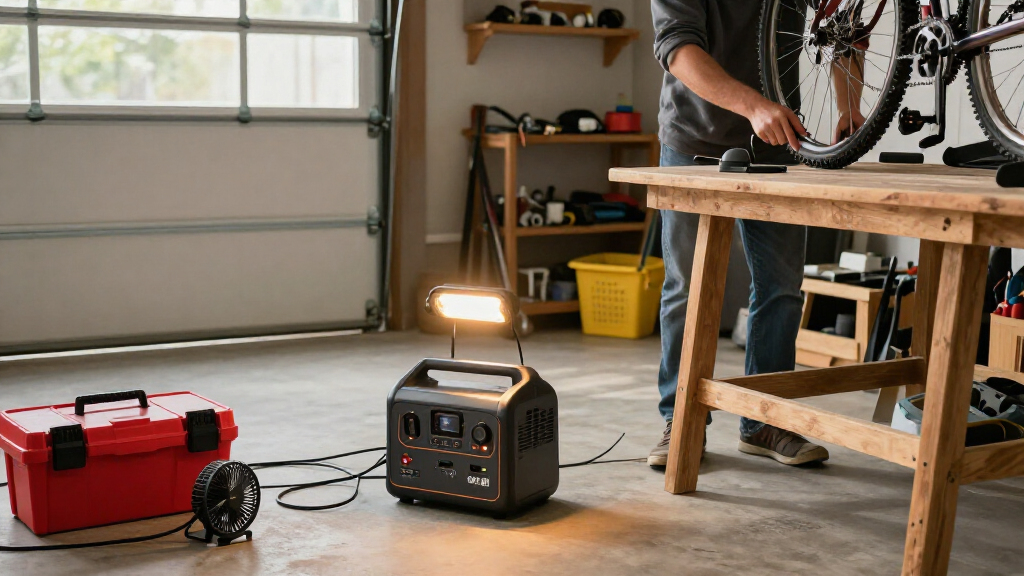
How We Picked
I ranked these stations for garage use by comparing their listed capacity, continuous AC output, and stated surge output where provided. Those figures help distinguish a unit for lights and chargers from one that may suit more demanding equipment, though a tool’s startup draw and operating wattage must still be checked against the manufacturer’s limits. I also considered battery chemistry when specified, solar input or included panels, UPS features where stated, and the practical difference between compact, mid-size, and high-capacity models.
The ranking favors stations that present a useful balance for a range of garage tasks, rather than simply placing the largest battery first. Models with more output and capacity rank well for buyers who need flexibility, while smaller or lower-output options earn a place for lighter loads, mobility, or a narrower budget and use case. I have not treated product names or broad marketing claims as proof of performance; buyers should confirm exact port, charging, weight, and compatibility details before choosing.
| portable power station for garage | Battery type |
|---|---|
| Jackery HomePower 2000 Plus v2 | — |
| Jackery Explorer 2000 v2 Porta | — |
| Jackery Explorer 300 Portable | — |
| EBL Acc2400 Portable Power Sta | LiFePO4 |
| Anker SOLIX C1000 Gen 2 Portab | LiFePO4 |
| BLUETTI AC180 Portable Power S | LiFePO₄ |
| BLUETTI Elite 100 V2 Portable | LiFePO₄ |
| Jackery Explorer 1000 v2 Porta | LFP (LiFePO₄) |
| UDPOWER S1200 Portable Power S | LiFePO₄ |
| Jackery HomePower 3000 with 2x | LiFePO₄ |
| Jackery HomePower 3600 Plus Po | — |
| Anker SOLIX S2000 Portable Pow | LiFePO4 |
| 1000W Portable Power Station 1 | LiFePO4 |
Factors to Consider When Choosing Portable Power Station For Garage
Choosing a garage power station starts with the equipment you plan to run, not the biggest capacity number on a product page. I’d sort intended loads into must-run tools, occasional devices, and backup essentials, then compare their draw with the station’s output and usable energy. These factors help avoid paying for capacity you cannot use—or choosing a station that cannot start the equipment you need.
Match the inverter to your actual tools
List each tool’s running wattage and check its startup or surge demand if the manufacturer provides it. Motors in compressors, shop vacuums, and some saws can briefly draw more power when they start, so a station whose continuous rating merely matches the tool’s running figure may still be a poor fit. Add up devices you expect to operate at the same time, not every tool in the garage. Keep a margin for startup spikes and avoid assuming that a higher surge rating can be sustained. If the product listing omits surge details, confirm them in the official specifications before buying. This check often matters more than choosing between two stations with similar battery capacities.
Estimate runtime from energy use, not battery size alone
Capacity in watt-hours gives a starting point for estimating how long a station can power a load, but real AC runtime is lower than a simple capacity-divided-by-watts calculation because of conversion losses and operating conditions. Add the watt-hours of the devices you expect to use during an outage, including lights, a router, or a refrigerator if it is stored in the garage. A high-wattage tool can drain a large battery quickly even if the station can run it. For intermittent tool use, count actual operating time rather than the whole period you are in the workshop. If you need overnight or multi-day backup, plan for recharging or choose more capacity. This prevents confusing a high output rating with long runtime.
Decide whether portability matters in your garage
A station that stays beside a workbench can be heavier and larger than one you need to carry between a house, garage, and vehicle. Check the listed weight, dimensions, handle design, and whether the unit needs clear space for ventilation; capacity alone does not tell you how easy it will be to move or store. A compact model may be convenient for lights and charging but can be limiting for tools and longer outages. Conversely, a large station can be awkward to reposition around shelves, vehicles, or narrow doors. Think through where it will live and how you will move it before selecting a capacity class. If it will stay put, prioritize the loads it serves rather than portability for its own sake.
Treat solar charging as a site-planning decision
Solar input is useful only if you can place panels where they receive suitable sun, which may mean setting them outside rather than inside a garage. Check the station’s maximum solar input, compatible voltage range, connector requirements, and whether panels are included; a bundled panel set does not guarantee it will suit every installation. Panel output varies with shade, season, weather, and placement, so avoid planning around peak wattage as a constant. A garage with limited outdoor access may make wall charging or vehicle charging more practical than solar. Consider how quickly you need to replenish energy between uses, not only how much the battery stores. This helps determine whether paying for a solar bundle is useful for your routine.
Check battery chemistry, care, and storage conditions
Battery chemistry can affect expected cycle life and product behavior, but it should be compared alongside warranty terms and the manufacturer’s operating guidance. Several options here explicitly list LiFePO4, while other listings do not identify chemistry in the supplied product name; verify the full specifications rather than guessing. Garages can experience temperature swings, so check the permitted charging and storage temperatures and follow the maker’s instructions. A station stored for emergencies may need periodic charge checks or maintenance charging. Dust, moisture, and crowded storage can also affect safe placement, so do not assume a portable unit is suitable for an exposed or dirty work area. Choose a location that stays within its rated conditions and leaves access to ports and ventilation.
Compare recharge needs and backup behavior
For frequent workshop use, recharge time can matter as much as capacity: a station that takes too long to refill may not be ready for the next job or outage. Compare the supported AC and solar charging rates, and check whether the stated maximum requires specific accessories or conditions. A listed UPS feature, as on the UDPOWER S1200, may appeal when continuity matters for a compatible device, but confirm transfer behavior and what equipment it supports before relying on it. Do not assume every portable power station can replace a generator or provide whole-home backup. Identify the exact devices you want backed up and how they will connect. A smaller station with a suitable recharge routine may serve a daily workshop better than a larger unit that is seldom replenished.
Frequently Asked Questions
Can a portable power station run my garage air compressor?
It depends on the compressor’s running wattage and startup surge, not just the station’s battery capacity. Check the compressor label or manual for both figures, then compare them with the station’s continuous and surge ratings. A unit such as the Jackery HomePower 2000 Plus v2 lists 2400W AC output, while the Anker SOLIX S2000 lists 1500W, but those numbers alone do not confirm compatibility with a particular compressor. Also account for any other devices running at the same time. If startup demand is not published for either product, ask the manufacturers before relying on the pairing.
Is a 1,000Wh station enough for garage backup?
It can be enough for selected essentials such as LED lights, chargers, and a router, especially if those loads run only part of the day. It is less suited to long runtimes or repeated use of high-wattage tools, which consume stored energy quickly. The Jackery Explorer 1000 v2, Anker SOLIX C1000 Gen 2, and BLUETTI Elite 100 V2 sit near this capacity class, but their output ratings and other features differ. Add up the watt-hours your devices use over the period you need, then allow for conversion losses. If you need to run a refrigerator or power tools for extended periods, compare larger-capacity options as well.
Should I choose higher wattage or more battery capacity for workshop tools?
Choose enough output to start and run the tools you need, then choose enough capacity for the duration of the work. Higher wattage does not automatically mean longer runtime, and a larger battery does not make a low-output inverter suitable for a demanding tool. For example, the Anker SOLIX S2000 lists 2010Wh but 1500W output, while the EBL Acc2400 lists 1843.2Wh and 2400W output. That difference shows why both specifications belong in the decision. Check tool startup needs and estimate total operating time before favoring either side of the tradeoff.
Can I leave a power station plugged in as garage backup?
Do not assume continuous connection is suitable for every model or that every station offers UPS-style backup. Read the manufacturer’s instructions for standby use, battery maintenance, temperature limits, and charging behavior. The UDPOWER S1200 listing identifies a UPS feature, but buyers should verify its transfer time and compatibility with the specific device they want to protect. A garage may be hotter, colder, or dustier than the station’s recommended storage environment. If uninterrupted power is important, confirm the required backup behavior directly in the product documentation before relying on a portable unit.
Is a solar bundle useful if I keep the station in the garage?
A solar bundle can help recharge the station during an outage, but panels generally need a suitable outdoor location with direct sunlight; placing them inside behind a window may reduce output. The Jackery HomePower 3000 bundle includes two 200W panels, while other listed stations may require separately selected panels. Check the station’s solar input limits, connector compatibility, cable reach, and the time needed to recharge under realistic conditions. Shade, weather, and season can all affect production. If you cannot safely place panels outside, prioritize AC recharge speed or another charging method instead.
Conclusion
For most garage owners, I recommend the Jackery HomePower 2000 Plus v2 as the best overall because its listed 2048Wh capacity and 2400W AC output balance substantial stored energy with a useful output rating. For a value-focused mid-size choice, compare the BLUETTI AC180 and Jackery Explorer 1000 v2 against your load list and budget, since their capacity and output profiles differ. For a premium, higher-capacity setup, the Jackery HomePower 3600 Plus offers 3584Wh and 3600W output; the HomePower 3000 adds a two-panel solar bundle for buyers who can use it. For beginners with modest needs, the Explorer 300 is a simpler fit for lights and small electronics, while the Explorer 1000 v2 gives more headroom. For compact backup, consider the Anker SOLIX C1000 Gen 2; for a stated UPS feature, examine the UDPOWER S1200; and for heavier tools, compare the higher-output EBL Acc2400 and 2kWh-class Jackery options against each tool’s startup demand. Pick by verified load compatibility and expected runtime, not capacity alone.