TL;DR
An electric roasting pan is a countertop appliance with a removable cooking pan, lid, and thermostat-controlled heating base. It can roast poultry and meat, cook some sides, and hold prepared food warm, freeing your oven for other dishes. Check fit and food temperature, since capacity labels and dial settings cannot guarantee that a particular turkey will fit or be safely cooked.
When the turkey takes over your oven, your carefully planned sides can end up waiting on the counter. An electric roasting pan gives you another place to cook: it sits on the counter, has its own heating element, and keeps the main oven free for the pie, rolls, or casserole.

Get home appliances delivered free with Prime
- Fast, free delivery on millions of items
- Prime Video, Amazon Music and more included
- Member-only deals all year
These appliances can do more than roast a holiday bird. Depending on the model, you can use one for meat, poultry, vegetables, baked dishes, and holding food warm. The covered design traps heat and moisture, which can help keep a roast juicy, though it may not give you the same crisp, deeply browned skin as an uncovered oven.
This guide explains what electric roasting pans are, how to choose a size, what to expect from their cooking, and how to use and clean one safely. You’ll also learn why the temperature dial is only a guide and why a food thermometer belongs beside the carving knife.
Measure the bird, interior pan, lid clearance, and counter footprint before choosing a roaster.
Use a food thermometer to check doneness; the temperature dial and cooking time are only guides.
Expect a covered roaster to retain moisture, with browning and crisp skin that can differ from an uncovered oven roast.
Use a warming setting for cooked food only, and add water only when the manual or recipe directs.
Unplug the appliance before cleaning, never immerse its heating base, and check dishwasher guidance for removable parts.
What an Electric Roasting Pan Can Do for Your Kitchen
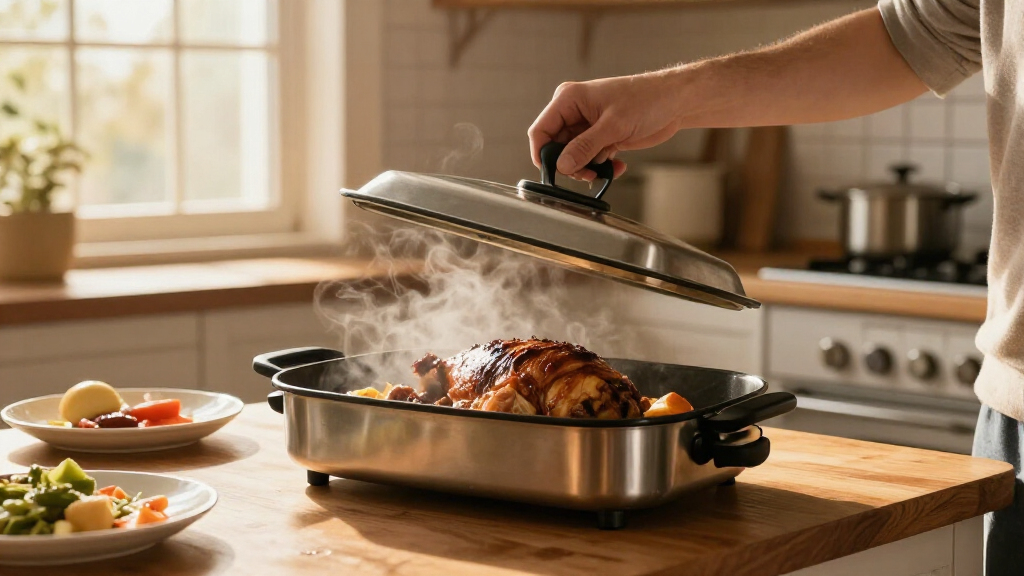
An electric roasting pan is a countertop appliance with a removable cooking pan, a lid, and a heating element in its base. A thermostat cycles the heat to maintain the selected setting, letting the appliance roast or cook food without using your oven. Many models also include a rack that lifts meat above the juices collecting below.
Think of it as an extra oven station: the heating base supplies heat, while the lid holds warmth and moisture close to the food. A family preparing Thanksgiving dinner, for example, might roast a turkey in the roaster while baking stuffing and sweet potatoes in the main oven. That extra space can make the whole meal easier to time.
Features vary. One model may offer a simple temperature dial and enamel pan; another might add digital controls, a timer, nonstick coating, or a warming setting. Read the manual to see which jobs the manufacturer supports. A label that advertises roasting, baking, slow cooking, and warming does not mean the appliance behaves exactly like four separate machines.
There is a tradeoff: a covered roaster often keeps meat moist, but it may limit the dry heat that creates crisp skin. For a roast chicken, you might get tender meat and flavorful juices, yet miss the crackly skin you’d expect from an uncovered oven. Knowing that difference helps you pick the right appliance for your priorities.
Products Worth Considering

Dyson V8 Cyclone Cordless Vacuum

Philips Hue Bridge Pro Smart Lighting Hub

iRobot Roomba 105 Combo Robot Vacuum and Mop with AutoEmpty Dock
As an affiliate, we earn on qualifying purchases.
Choose a Size That Fits the Bird and Your Counter
Choose an electric roasting pan by checking its interior dimensions, lid clearance, and exterior footprint, not capacity alone. Quart ratings describe volume, but they do not tell you whether a tall or broad turkey will fit beneath the lid. A snug fit can block circulation or prevent the lid from closing properly.
Imagine shopping for a roaster ahead of a family gathering. The product page says it can hold a large turkey, but the bird you plan to buy has a high breast and wide wings. Compare the roaster’s interior length, width, and height with the bird, then account for a rack if you plan to use one. Check the outside measurements too: a full-size appliance may take up much of a small counter and need a dedicated storage shelf.
Capacity matters for sides as well. A larger pan can handle a batch of roasted vegetables, but the appliance itself will be heavier and may be awkward to lift when hot. If you mainly cook for two or four, a smaller model could be easier to store and position. If you host often, extra volume may pay off in flexibility.
Before you buy, compare the details that affect your actual kitchen:
- Interior size: Measure the food and leave room for the lid and rack.
- Counter space: Check the footprint and allow ventilation around the appliance.
- Storage and handling: Consider the roaster’s weight and where you’ll keep it.
- Parts: Confirm whether the rack and pan are removable and how the manual says to wash them.
A measurement taken before checkout is much easier than discovering on cooking day that the lid won’t close.
Get Juicy Results Without Guessing at Doneness
Electric roasting pans cook with a thermostatically controlled heating element, but the dial setting does not tell you whether the food is done. Cooking time depends on the appliance, food size, starting temperature, and how often you lift the lid. Follow the model’s manual and your recipe as guides, then check the food itself with a food thermometer.
For example, two whole chickens of similar weight can finish at different times if one starts chilled and the other has rested at room temperature. Opening the lid repeatedly to check can also release heat and extend cooking. Use the thermometer in the recommended part of the meat and follow current food-safety guidance for the food you’re preparing.
The lid helps retain moisture, much like a greenhouse holds warmth around plants. That can be welcome for a turkey breast or a pot roast, but it may also mean less crisping than you’d get from dry, uncovered oven heat. Some recipes or models may produce more browning than others. Check the instructions for any recommended approach; don’t assume that a single technique works for every roaster.
Use this simple sequence to keep the process controlled:
- Read the manual for preheating, rack placement, water use, and temperature guidance.
- Prepare the food according to your recipe and place it securely in the removable pan.
- Keep the lid closed as much as practical during cooking.
- Check internal temperature with a food thermometer rather than relying on the dial or a time estimate.
- Rest and serve according to the recipe and food-safety guidance.
A thermometer is the small tool that turns a hopeful guess into a checkable result.
Decide Whether Moist Meat or Crisp Skin Matters More
A covered electric roasting pan often holds in more heat and moisture than an uncovered oven roast, so it can produce tender meat and flavorful cooking juices. Its lid can also limit the dry air that helps skin brown and crisp. Your best choice depends on whether you value a moist roast, crisp exterior, or a balance of both.
Picture a holiday turkey: the roaster cooks it while your oven handles the stuffing, but the skin may look paler than a bird roasted uncovered. If golden skin is a priority, read the appliance manual and your recipe for approved methods to improve browning. Some cooks finish food in an oven, but only do this if the cookware, recipe, and appliance instructions support that approach.
Here’s how the cooking setups compare:
| Cooking setup | What it does well | Tradeoff to expect |
|---|---|---|
| Covered electric roaster | Frees oven space and holds moisture | May give less crisp, even browning |
| Uncovered oven roast | Promotes dry heat and surface browning | Uses the main oven and can dry food if overcooked |
For a pot roast, extra moisture is often welcome; for a bird with shattering crisp skin, the oven may suit you better. Neither method wins every meal. Match the cooking method to the result you want on the plate.
Use the Extra Cooking Space Safely
Set an electric roaster on a stable, heat-resistant surface with the clearance and ventilation specified in its manual. The exterior can get hot, and lifting the lid can release a concentrated plume of steam. Keep the cord away from walkways and keep children clear of the appliance while it runs.
For instance, if you set up a roaster near a buffet, place it where guests won’t brush against the cord or reach over the lid. Use oven mitts when handling hot parts, lift the lid carefully, and angle escaping steam away from your face and hands. Follow the manual on preheating and on whether water belongs in the pan; adding water is not a universal requirement and changes the cooking environment.
Use a warming setting only for holding already cooked food as the manufacturer directs. It is not a substitute for properly cooking raw meat. Cooking and holding are different jobs, much like heating a pan and keeping a finished dish ready to serve.
Electric roasting pans use mains power, so don’t use a damaged cord or place the appliance where it can be splashed. Unplug it before cleaning. If you’re using other high-powered appliances nearby, check the manual and household setup rather than relying on an overloaded outlet or improvised extension cord. For electrical work or outlet problems, use a licensed electrician.
Keep hot surfaces, cords, and rising steam away from children, and follow the appliance manual for each setup and cooking step.
Clean the Removable Pan Without Damaging the Base
Unplug the roaster and let it cool before cleaning; wash removable parts only as the manufacturer directs, and never immerse the heating base in water. The removable pan and rack make cleanup simpler, but dishwasher safety varies from model to model. Check the manual before placing either part in a dishwasher.
After Sunday dinner, for example, you might lift out the pan once it is cool enough to handle and wash it in the sink with a soft sponge and dish soap. If it has a nonstick coating, avoid metal utensils, abrasive pads, and harsh scraping that can scratch the surface. A scratched coating can make cooking and cleanup less convenient.
Wipe the base according to its instructions, taking care around the heating element and controls. Never submerge it to remove a stubborn spill. If drips or grease reach the outside, use the cleaning method the manufacturer specifies rather than improvising with water near electrical parts.
Think about storage while the appliance is clean and dry. The roaster may be bulky, and stacking heavy cookware inside it could scratch a coated pan or strain a rack. Put removable parts where you can find them next time; on a busy holiday morning, a missing rack can turn a simple setup into a frustrating cupboard search.
Compare Energy Use and Everyday Value Honestly
An electric roasting pan may use less energy than heating a large oven for some meals, but you cannot count on a fixed saving. Actual use depends on the roaster’s wattage, how long it runs, how often its thermostat cycles, and the oven you’re comparing it with. Check the appliance label or manual for wattage rather than relying on a broad claim.
Consider a small casserole: heating a full-size oven for one dish may seem wasteful, while a countertop roaster could be a practical alternative if its instructions allow that use. But if the roaster needs a much longer cooking time or you already have the oven on for other dishes, the comparison changes. Like comparing two cars, the answer depends on how each one is used.
The appliance’s day-to-day value also comes from the space it frees. A host who often cooks a main roast and several sides may appreciate having another cooking station, even if energy savings are modest or hard to predict. Someone with little counter space and a small household may prefer to keep using an existing oven.
Before buying, weigh the jobs you’ll actually use it for: holiday poultry, large roasts, side dishes, or warming cooked food. Digital controls, timers, and multipurpose claims appear on some models, but the category remains a practical, established one. Compare real specifications and read the manufacturer’s directions instead of assuming that a newer control panel makes every model cook the same way.
Frequently Asked Questions
What is an electric roasting pan used for?
An electric roasting pan can roast meat and poultry, cook some vegetables or baked dishes, and hold cooked food warm, depending on the model. It is especially handy when you need to free up your oven for other dishes.
Can an electric roasting pan cook a whole turkey?
Many full-size models are designed for whole poultry, but a capacity label alone cannot confirm that your particular turkey will fit. Check the interior dimensions and clearance beneath the lid against the bird’s shape and height.
Does food cook faster in an electric roaster than in an oven?
It can, but the timing varies with the appliance, food size, starting temperature, and cooking conditions. Use the recipe and manual as guides, and check doneness with a food thermometer.
Will a turkey brown in an electric roaster?
It may brown less evenly or become less crisp than a turkey roasted uncovered in an oven because the roaster’s lid traps moisture. Results depend on the model and method, so follow its manual if you want to improve browning.
Should I put water in an electric roasting pan?
Only add water if the manufacturer’s instructions or your recipe call for it. Water changes the cooking environment, so it is not a standard requirement for every roast or model.
Can an electric roaster replace my slow cooker or oven?
It can handle some similar jobs, but it is not a complete replacement. Capacity, temperature behavior, and recommended uses differ, so check the roaster’s instructions before adapting a slow-cooker or oven recipe.
How do I clean an electric roasting pan?
Unplug the appliance and let it cool first. Clean the base as the manual directs without immersing it, and wash the pan and rack according to their care instructions.
How much electricity does an electric roaster use?
Check the model’s wattage on its label or in its manual. Actual consumption depends on how long it runs and how its thermostat cycles, so wattage alone does not give a fixed cost per meal.
Conclusion
An electric roasting pan earns its counter space when you need another place to cook and value a moist roast or a free oven. Check the dimensions before buying, follow the manual, and use a thermometer instead of trusting the dial alone.
Then let the roaster handle its share of dinner while the oven tackles the sides—and keep those hot, steaming surfaces safely out of the traffic around your table.