
TL;DR

Get home appliances delivered free with Prime
- Fast, free delivery on millions of items
- Prime Video, Amazon Music and more included
- Member-only deals all year
Apple’s $299 HomeView and Amazon’s $499.99 Echo Show 16 are new smart displays with more capable hardware and features aimed at shared household use. A hands-on report says they could function as family information hubs, but their software, privacy trade-offs and everyday performance still need testing.
Apple and Amazon have introduced new smart displays that aim to make a shared household screen more useful: the $299 HomeView and $499.99 Echo Show 16. After brief hands-on time, The Verge’s reviewer said their stronger hardware and household-focused software could make them function as family information hubs, though both devices still need full testing.
The two products address a familiar weakness of smart displays: earlier models often combined limited processing power with software that tried to serve too many purposes. The Verge reports that the HomeView uses Apple’s A18 chip and a Liquid Retina display, while the Echo Show 16 has a MediaTek processor and the Nanomatte display also used on Amazon’s new Alexa Tablet. The hardware is a change from the lower-priced devices that helped define the category.
The companies are also pitching different ways to use a screen shared by a household. Amazon’s Echo Show 16 is presented as a device for the home that can operate without a phone, while Apple’s HomeView is described as an extension of the iPhone. The reviewer says HomeView’s shared features appear more limited unless it recognizes a person and that person’s phone is nearby.
In demonstrations described by The Verge, Apple showed Siri using information from text messages to anticipate a friend’s arrival and prepare a coffee machine. Amazon showed its Omnisense technology detecting activity and displaying a person approaching a home, with a tap opening a live view from a Ring camera. These are company demonstrations, not independent tests of how reliably the features work in daily use.
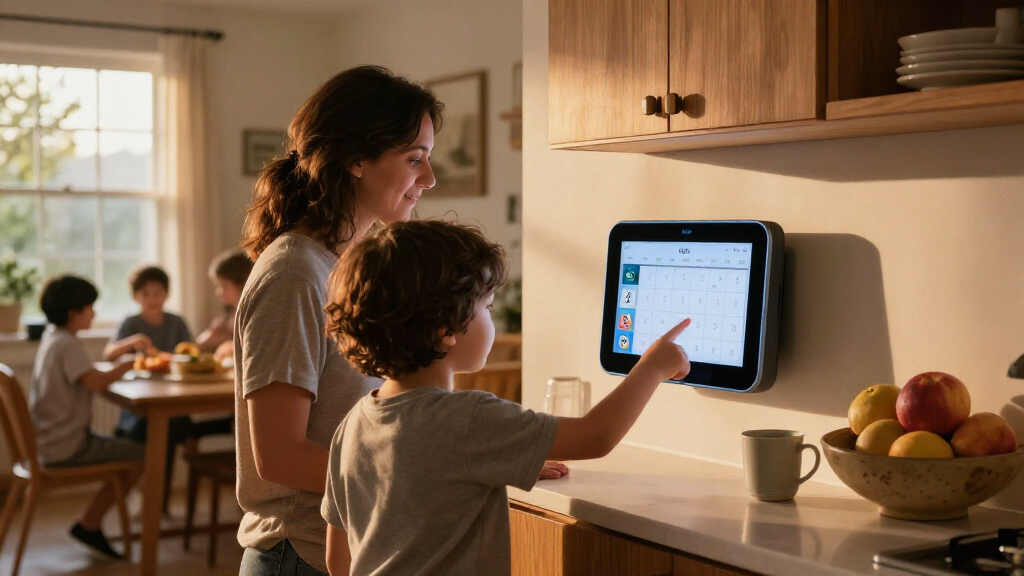
A household display could make shared information easier to find than a calendar or grocery list kept on one person’s phone. The use case described in the report includes checking a family calendar, coordinating meals, seeing who is at the door and adjusting connected lights or a thermostat from one place.
The practical question is whether the devices make those tasks straightforward for everyone in a home. A screen that stays in a common area and can be used without unlocking a personal phone may serve a different role from a tablet that belongs to one person. The reviewer argues that the new models appear better suited to that role, but says the impression is preliminary.
Price is a major part of the decision. The HomeView costs $299, while the Echo Show 16 costs $499.99. The Verge compares those prices with a 2023 Echo Show 5 at $85 and a Nest Hub at $99. The higher cost means buyers will need more than a voice assistant or a decorative screen to justify the purchase.
Products Worth Considering

Ring Alarm 8-Piece Kit (2nd Gen) Home Security System

Philips Hue Festavia 130-Foot Indoor/Outdoor Smart String Lights, 500 LEDs

Philips Hue Bridge Pro Smart Lighting Hub
As an affiliate, we earn on qualifying purchases.
Why Smart Displays Stalled
Three years before this report, The Verge’s reviewer described the smart-display category as stalled, citing underpowered devices that attempted to do too much without doing any one task well. The reviewer argued that better hardware, a genuinely shared interface and an always-available screen were needed to make the category useful in a household.
The need for a shared screen is not new. The report points to the popularity of products such as the Skylight Calendar as evidence that some households want a central place for schedules and lists. Tablets can fill part of that role, but the reviewer says they can be difficult to share across users and may be carried away from their intended place. The reviewer also cites personal experience with Google’s Pixel Tablet, saying its detachable display and limited smart-home support caused problems at home. Google reportedly canceled a successor 18 months later, according to the report.
HomeView and Echo Show 16 are not identical answers to those problems. Apple’s approach draws on personal information and iPhone-based features; Amazon’s is oriented toward household controls and home sensing. That distinction shapes both what the products may do well and what data or devices a household may need to use them fully.
“These could finally turn the smart display into what it should have been all along: the family computer.”
— The Verge reviewer
Performance Beyond the Demonstrations
The available assessment is based on brief hands-on time, and the reviewer explicitly says both products require proper testing. The report does not establish how well their interfaces work for multiple household members over time, whether the advertised features respond reliably, or how often users will find them more convenient than a phone or tablet.
It is also not clear from the source material how much of HomeView’s functionality depends on a nearby iPhone, how consistently its identity features will recognize users, or what limitations apply to household members without compatible Apple devices. Amazon’s demonstrations show what its sensing and Ring integration can do in a presentation, but do not establish real-world accuracy or the full privacy and setup implications.
The source does not provide independent test results, battery or energy-use details, full software specifications, or information about broader availability. Those details would help buyers judge whether the higher prices are justified for their homes.
Full Reviews Will Test Daily Use
The next meaningful step is extended testing of both displays in real households. That should show whether people can move between calendars, meal planning and smart-home controls without friction, and whether the screens remain useful when several people share them.
Buyers will also need final details about availability, supported services and device compatibility. Until those are clear and independent reviews measure day-to-day performance, the strongest conclusion is limited: Apple and Amazon have presented more powerful, more household-focused smart displays, but their promise as family computers remains a proposition to test.
Key Questions
What are the HomeView and Echo Show 16?
They are new smart displays from Apple and Amazon, respectively. The report describes them as screens for household information and smart-home controls, rather than conventional computers for homework or bills.
How much do the devices cost?
The HomeView is priced at $299 and the Echo Show 16 at $499.99, according to the source report.
How do Apple and Amazon’s approaches differ?
The report characterizes HomeView as an extension of the iPhone, with some features tied to recognizing a person and having their phone nearby. Amazon’s Echo Show 16 is designed to serve the household without requiring a phone for setup.
Have the devices been independently tested?
Not in the material provided. The reviewer had brief hands-on time and said proper testing is still needed, so demonstrations and early impressions do not confirm how the products perform in everyday use.
Source: theverge.com