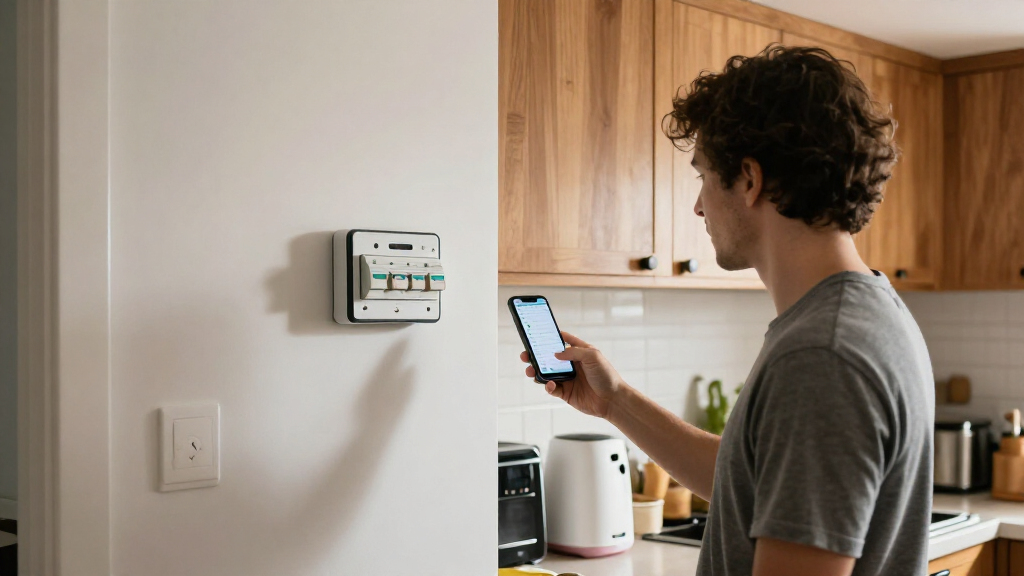

The best home electricity monitor overall in this roundup is the Emporia Vue 3, which pairs whole-home tracking with 16 circuit sensors for a detailed view of household use. For a bundle that also tracks selected appliances, the Emporia Whole-Home Energy Monitor Bundle adds four smart plugs; the Eyedro 200A is a strong alternative for shoppers who value Wi-Fi and Ethernet connectivity. The main tradeoffs are how much detail you need, whether your electrical panel can accommodate sensors, and whether you prefer whole-home readings or simple plug-in measurements. Circuit-level systems offer a broader picture but take more setup than plug-in meters. Read on for the full breakdown and guidance on choosing the right monitoring approach.

Get home appliances delivered free with Prime
- Fast, free delivery on millions of items
- Prime Video, Amazon Music and more included
- Member-only deals all year
Complete the kit

![[Genuine] Waterdrop PF-01A Water Filter Replacement for W...](https://m.media-amazon.com/images/I/41+5tl9EiKL._SX342_SY445_QL70_FMwebp_.jpg)
Key Takeaways
Whole-home and circuit-level monitoring lead this lineup: The Emporia Vue 3, Emporia bundle, Siemens Inhab, and several 16-sensor models are aimed at buyers who want to identify which household circuits use energy.
The Emporia bundle covers two layers of monitoring: It combines a 16-sensor whole-home setup with four smart plugs, while the separate Emporia smart-plug pack focuses on individual plugged-in devices.
Connectivity can matter as much as sensor count: Eyedro offers both Wi-Fi and Ethernet, while the Refoss EM16P stands apart for local control and Home Assistant integration.
More circuit capacity is not automatically better: The Meross 18-circuit model may suit homes needing more monitored branches, but buyers should match capacity to their panel and monitoring plans rather than choosing by number alone.
Plug-in meters solve a narrower problem with less installation: The HBN, generic plug-in meters, Emporia smart plugs, and Tapo P115 are better suited to individual appliances than to mapping a home’s whole electrical system.
| SEM-Meter Smart Home Energy Monitor with 16 Circuit Sensors |  | Best for Local Home Assistant Control | Circuit sensors: 16 × 50A | Supported voltage: Up to 240VAC line-neutral; 120/240VAC split-phase; up to 415Y/240VAC three-phase; no Delta | Connectivity: 2.4 GHz Wi-Fi; local MQTT mode | VIEW LATEST PRICE | See Our Full Breakdown |
| Eyedro Smart Home Energy Monitor, 200A, Wi-Fi and Ethernet |  | Best for Straightforward Whole-Home Monitoring | Model: EYEDRO-HOME | Current sensors: 2 directional 200A sensors | Connectivity: 2.4 GHz Wi-Fi or Ethernet | VIEW LATEST PRICE | See Our Full Breakdown |
| Siemens Inhab Smart Home Energy Monitor with Circuit-Level Sensors |  | Best for Solar and Energy Management | Model: INHEM1216 | Main sensors: 2 × 200A CTs | Circuit sensors: 16 × 50A CTs | VIEW LATEST PRICE | See Our Full Breakdown |
| Emporia Whole-Home Energy Monitor Bundle with 16 Sensors and 4 Smart Plugs |  | Best for Tracking and Controlling Devices | Circuit monitoring: Up to 16 individual circuits | Sensors: 16 | Smart plugs: 4 Wi-Fi smart plugs | VIEW LATEST PRICE | See Our Full Breakdown |
| Meross Smart Home Energy Monitor with 16 Branch Circuit Sensors |  | Best for Long-Term Local Data | Model: EM16 | Circuit support: 2 main circuits at 200A and 16 branch circuits at 60A | Accuracy: ±1% | VIEW LATEST PRICE | See Our Full Breakdown |
| Meross Smart Home Energy Monitor, 18-Circuit | | Best for Solar-Aware Home Assistant Users | Model: EM16 | Circuit coverage: 2 main circuits up to 200A and 16 branch circuits up to 60A | Measurement accuracy: ±2% | VIEW LATEST PRICE | See Our Full Breakdown |
| Refoss Smart Home Energy Monitor with 16 Circuit Sensors |  | Best for Accuracy and Open Integrations | Model: EM16P | Sensors: 2 main sensors up to 200A and 16 branch sensors up to 60A | Measurement accuracy: ±1% | VIEW LATEST PRICE | See Our Full Breakdown |
| Plug-In Power Meter and Home Energy Monitor |  | Best for Appliance Cost Tracking | Power source: Corded electric | Minimum operating voltage: 120 V | Overload threshold: 1,800 W | VIEW LATEST PRICE | See Our Full Breakdown |
| HBN Plug-In Watt Meter with Backlit LCD |  | Best Compact Plug-In Meter | Model: U167J | Voltage and current: 125 V AC; up to 15 A | Maximum wattage: 1,875 W | VIEW LATEST PRICE | See Our Full Breakdown |
| Refoss EM16P Smart Home Energy Monitor with Local Control and Home Assistant Integration |  | Best for Local-First Smart Home Automation | Model: EM16P | Circuit sensors: 2 main sensors, 2–200A each; 16 branch sensors, 1–60A each | Accuracy: ±1%; ±2% at low current | VIEW LATEST PRICE | See Our Full Breakdown |
| Nestool WiFi Home Energy Monitor with 3 CT Clamps |  | Best for a Few Key Circuits | Model: PW03 | Circuits monitored: Up to 3 | CT clamp capacity: 80A each | VIEW LATEST PRICE | See Our Full Breakdown |
| Emporia Energy Monitoring Smart Plug, 4-Pack |  | Best for Multi-Device Plug-In Tracking | Model: EMSO1-4 | Pack size: 4 plugs | Operating voltage: 120 V | VIEW LATEST PRICE | See Our Full Breakdown |
| Plug-In Watt Meter and Home Electricity Usage Monitor |  | Best for On-the-Spot Appliance Readings | Display: 2.36 × 1.85-inch backlit LCD | Display modes: 7 | Monitoring parameters: Power, energy, voltage, current, frequency, power factor, cost, minimum and maximum power, cumulative days and time | VIEW LATEST PRICE | See Our Full Breakdown |
| Emporia Vue 3 Home Energy Monitor with 16 Circuit Sensors |  | Best for Whole-Home and Circuit-Level Coverage | Model: EMV3A-2P-16 | Included circuit sensors: 16 branch sensors, 50A each | Sensor accuracy: ±2% | VIEW LATEST PRICE | See Our Full Breakdown |
| Tapo P115 Smart Wi-Fi Plug with Energy Monitoring, 4-Pack, 15A |  | Best Smart-Plug Pack for Higher-Rated Appliances | Model: P115 | Pack size: 4 plugs | Operating voltage: 110 V AC | VIEW LATEST PRICE | See Our Full Breakdown |
More Details on Our Top Picks
SEM-Meter Smart Home Energy Monitor with 16 Circuit Sensors
The SEM-Meter earns its place for homeowners who want circuit-by-circuit visibility without relying entirely on a cloud service. Its 16 included sensors can show which large loads are driving usage, while customizable peak, off-peak, and holiday rates turn readings into more useful cost estimates. Compared with the Siemens Inhab, it offers local MQTT operation for Home Assistant but does not list the same solar-management and load-shedding features. Its stated 1% accuracy and support for several common single-, split-, and three-phase systems add flexibility, though Delta three-phase systems are excluded. Installation means working inside the electrical panel, and local operation also calls for Home Assistant and an MQTT server. Choose it for local integrations; skip it if you want a setup that avoids panel work or self-hosted software.
Pros:- Tracks usage across up to 16 circuits with included 50A sensors
- Custom peak, off-peak, and holiday rates help connect consumption to electricity costs
- Local MQTT mode supports Home Assistant integrations
- Provides real-time app monitoring and usage-history exports
Cons:- Installation requires access to the electrical panel
- Does not support three-phase Delta configurations
- Local MQTT operation requires Home Assistant and an MQTT server
Best for: Home Assistant users who want local MQTT data, circuit-level readings, and cost tracking based on custom electricity rates.
Not ideal for: Households with a three-phase Delta panel or buyers who want to avoid electrical-panel installation and setting up an MQTT server.
- Circuit sensors:16 × 50A
- Supported voltage:Up to 240VAC line-neutral; 120/240VAC split-phase; up to 415Y/240VAC three-phase; no Delta
- Connectivity:2.4 GHz Wi-Fi; local MQTT mode
- Measurement accuracy:1%
- Usage history:Hourly exports retained for 90 days; day, month, and year exports are permanent
- Dimensions:3.1 × 1.2 × 4.18 inches
- Weight:4.05 pounds
- Warranty:1 year
Our verdict“Choose the SEM-Meter if local Home Assistant control and custom rate tracking matter more than a cloud-free, setup-free installation.”
Eyedro Smart Home Energy Monitor, 200A, Wi-Fi and Ethernet
The Eyedro is the simplest fit here for buyers who mainly want whole-home or solar readings, rather than a breakdown of every circuit. Its two directional 200A sensors can monitor grid energy, solar generation, or net metering, and the MyEyedro cloud provides usage history without a subscription. Unlike the Emporia Whole-Home Energy Monitor Bundle, it does not add individual circuit sensors or smart plugs for tracking and controlling specific devices. Its advantage is a more focused setup, with Wi-Fi and Ethernet as connection choices; wired Ethernet may suit a home where Wi-Fi coverage near the equipment is unreliable. The key limitation is that separating grid use from solar generation requires two meters. Pick Eyedro for a clear view of overall flows, not granular household diagnostics.
Pros:- Directional 200A sensors support whole-home electricity or solar monitoring
- Offers both 2.4 GHz Wi-Fi and Ethernet connectivity
- MyEyedro cloud provides usage history without a subscription
- Can be configured for grid energy, solar, or net metering
Cons:- A single meter cannot separately monitor grid use and solar generation at the same time
- Separate grid and solar readings require two meters
- Does not provide the circuit-level detail or smart-plug control included with the Emporia bundle
Best for: Homeowners who want to track overall grid use, solar generation, or net metering through a no-subscription cloud dashboard.
Not ideal for: Solar households that need separate grid and generation readings from one unit, or buyers who want per-circuit and plug-level monitoring.
- Model:EYEDRO-HOME
- Current sensors:2 directional 200A sensors
- Connectivity:2.4 GHz Wi-Fi or Ethernet
- Power source:AC
- Cloud service:MyEyedro cloud access; no subscription
- Intended use:Indoor electricity monitoring
- Dimensions:8 × 8 × 3 inches
- Weight:1.54 pounds
Our verdict“Choose Eyedro for uncomplicated whole-home or solar-flow tracking, but look to a circuit-sensor system if you need to find which appliances drive consumption.”
Siemens Inhab Smart Home Energy Monitor with Circuit-Level Sensors
The Siemens Inhab stands out for combining mains and circuit-level monitoring with tools aimed at acting on what the data shows. It includes two 200A main sensors and 16 50A circuit sensors, plus app features for solar management, net metering, peak demand, alerts, and load shedding. That makes it a stronger match for households managing solar or trying to shift and limit loads than the Eyedro, which focuses on whole-home flows and needs a second meter to separate grid use from solar generation. The Inhab’s tradeoff is that its app is available only in the USA and Canada, and installation requires panel access. Compared with the SEM-Meter, the Siemens emphasizes built-in energy-management tools rather than local MQTT operation. Choose it when the management features fit your system and region.
Pros:- Measures whole-home use and production alongside up to 16 individual circuits
- Includes 2 × 200A main sensors and 16 × 50A circuit sensors
- App features address solar, net metering, peak demand, alerts, and load shedding
- UL Listed
Cons:- Mobile app availability is limited to the USA and Canada
- Installation requires access to the electrical panel
- Does not list the SEM-Meter’s local MQTT mode for Home Assistant
Best for: US and Canadian homeowners with solar, time-of-use concerns, or controllable loads who want mains and individual-circuit data in one app.
Not ideal for: Buyers outside the USA and Canada, or Home Assistant users who specifically want local MQTT support.
- Model:INHEM1216
- Main sensors:2 × 200A CTs
- Circuit sensors:16 × 50A CTs
- Compatibility:USA and Canada
- Energy management:Time-of-use, peak demand, solar management, net metering, and load shedding
- Certifications:CE marked and UL Listed
- Dimensions:1.1 × 5.71 × 2.76 inches
- Weight:4.8 pounds
Our verdict“Choose the Siemens Inhab if you are in its supported region and want solar and load-management tools alongside circuit-level monitoring.”
Emporia Whole-Home Energy Monitor Bundle with 16 Sensors and 4 Smart Plugs
The Emporia bundle is the most useful choice in this group when monitoring should lead directly to device-level action. Alongside whole-home and 16-circuit monitoring, it includes four Wi-Fi smart plugs that show outlet usage and let you schedule or remotely control connected devices. That combination can help distinguish a large fixed load from a frequently used plug-in appliance, a level of outlet detail the Siemens Inhab does not provide through included smart plugs. The Emporia app also supports solar net metering and Alexa-enabled devices. The tradeoff is that energy data is stored in the cloud, so this is a weaker fit for buyers prioritizing local-only data handling. Like the other panel-based options, its sensors require installation in the main electrical panel. Choose this bundle for a joined-up view of circuits and everyday plugged-in loads.
Pros:- Monitors whole-home usage and up to 16 individual circuits
- Four included smart plugs add outlet-level energy tracking
- Smart plugs support remote control and scheduling
- App supports solar net metering and Alexa-enabled devices
Cons:- Energy data is stored in the cloud
- Panel sensors require installation in the main electrical panel
- Smart-plug monitoring covers only devices connected to the four included plugs
Best for: Households that want to track both panel circuits and plug-in devices, then use schedules or remote control to manage those devices.
Not ideal for: Buyers who require local-only energy data or who want to avoid installing sensors inside the main electrical panel.
- Circuit monitoring:Up to 16 individual circuits
- Sensors:16
- Smart plugs:4 Wi-Fi smart plugs
- App:Emporia app for iOS and Android
- Compatible systems:Smart plugs, energy monitors, solar systems, iOS devices, Android devices, and Alexa-enabled devices
- Solar feature:Solar net metering support
- Data storage:Cloud-stored energy data
Our verdict“Choose the Emporia bundle if you want circuit monitoring plus practical plug-level tracking and control in one app.”
Meross Smart Home Energy Monitor with 16 Branch Circuit Sensors
The Meross EM16 is the strongest fit for buyers who want branch-circuit detail with local data access and a long history of readings. It monitors two 200A main circuits and up to 16 branch circuits, while its charts cover short intervals through yearly views and storage is specified for up to five years. Home Assistant, Open API, and web control give it more routes into a local setup than the Eyedro, whose history is delivered through MyEyedro cloud. Meross also claims ±1% accuracy and includes a two-year warranty. Those strengths come with system limits: it supports several common single-, split-, and three-phase Wye arrangements, but not Delta wiring. Clamp-on installation still means working at the electrical panel. Pick it for local integrations and long-term tracking, not if your wiring configuration is unsupported.
Pros:- Monitors two 200A main circuits and up to 16 branch circuits
- Offers local data storage, Home Assistant, Open API, and web control
- Provides usage charts, exportable reports, and customizable alerts
- ETL-certified and backed by a two-year warranty
Cons:- Does not support Delta wiring systems
- Requires compatible wiring and clamp-on installation at the electrical panel
- Its broader circuit coverage and local integrations may be more setup than needed for buyers seeking only whole-home readings
Best for: Homeowners with a compatible single-phase, split-phase, or three-phase Wye system who want long-term data, local integrations, and branch-level monitoring.
Not ideal for: Households with Delta wiring or buyers who want a monitor that does not require clamp-on installation at the electrical panel.
- Model:EM16
- Circuit support:2 main circuits at 200A and 16 branch circuits at 60A
- Accuracy:±1%
- System compatibility:Single-phase 2-wire, split-phase 3-wire, and three-phase 4-wire Wye with earthed neutral; no Delta
- Data storage:Up to 5 years
- Connectivity and integration:Wi-Fi, Home Assistant, Open API, and web control
- Warranty:2 years
- Dimensions:4.5 × 3.48 × 1.1 inches
- Weight:3.19 pounds
Our verdict“Choose the Meross EM16 if your panel is compatible and local integrations plus years of circuit-level history outweigh simple setup.”
Meross Smart Home Energy Monitor, 18-Circuit
The Meross EM16 makes sense for households that want whole-home readings plus detail on individual circuits, with two main and 16 branch sensors. Its solar surplus detection and Home Assistant support give automation-minded owners more to work with than a plug-in meter such as the HBN U167J, which measures only the appliance connected to it. Meross also stores data locally for up to five years, so reviewing trends does not depend on a subscription. The tradeoff is that its stated ±2% accuracy is less precise than the Refoss EM16P’s ±1% specification, and the electrical panel must use a supported wiring configuration. It does not work with Delta systems, so checking panel compatibility is a prerequisite rather than a minor detail.
Pros:- Tracks two main circuits and up to 16 branch circuits
- Supports Home Assistant and solar surplus detection
- Stores up to five years of data locally without a subscription
- Provides usage alerts and historical charts
Cons:- Does not support Delta electrical systems
- ±2% stated accuracy is lower than the Refoss EM16P’s ±1% specification
- Requires access to a panel with a compatible wiring configuration
Best for: Home Assistant users with a compatible electrical panel who want solar surplus detection and long-term local circuit data.
Not ideal for: Households with Delta wiring, or buyers who want a simple appliance-level meter without panel installation.
- Model:EM16
- Circuit coverage:2 main circuits up to 200A and 16 branch circuits up to 60A
- Measurement accuracy:±2%
- Supported systems:Single-phase 2-wire, split-phase 3-wire, and 3-phase 4-wire Wye with earthed neutral; not Delta
- Home Assistant:Supported
- Data storage:Up to 5 years
- Connectivity:Open API and web control
- Certification and warranty:ETL-certified; compliant with UL 61010 testing standard; 2-year warranty
Our verdict“Choose the Meross EM16 if solar-aware Home Assistant control and long-term local records matter more than the Refoss EM16P’s tighter stated accuracy.”
Refoss Smart Home Energy Monitor with 16 Circuit Sensors
For buyers who want panel-wide coverage without giving up control of their data, the Refoss EM16P pairs two main sensors with 16 branch sensors and supports Home Assistant, MQTT, Open API, and WebSocket. Its stated ±1% accuracy is tighter than the Meross EM16’s ±2% figure, a distinction that may matter when comparing circuit trends over time. Refoss also stores daily data for up to five years and allows export, making it a stronger fit for people who want to analyze their own records rather than rely on a cloud dashboard. Compared with the appliance-focused HBN U167J, it offers whole-home and circuit-level visibility, but installation is more involved: the sensors go inside the breaker box. The broad system support applies to specified configurations, including 3-phase 4-wire Wye, not every panel type.
Pros:- Tracks two main circuits and 16 branch circuits
- Lists ±1% measurement accuracy
- Supports Home Assistant, Open API, MQTT, and WebSocket
- Stores and exports up to five years of daily data
Cons:- Installation requires placing sensors in the breaker box
- Compatibility depends on the home’s electrical system
- Reported utility-bill savings are not guaranteed
Best for: Technically confident homeowners who want circuit-level tracking, exportable local data, and integrations beyond a single smart-home platform.
Not ideal for: Renters or buyers unwilling to work with an electrical panel, and homes whose wiring falls outside the listed supported systems.
- Model:EM16P
- Sensors:2 main sensors up to 200A and 16 branch sensors up to 60A
- Measurement accuracy:±1%
- Supported systems:Single-phase, split-phase, and 3-phase 4-wire Wye
- Integrations:Home Assistant, Open API, MQTT, and WebSocket
- Data retention:Daily data stored for 5 years
- Connectivity:Wi-Fi with external high-gain antenna
- Warranty and certification:2-year warranty; ETL certified
Our verdict“Pick the Refoss EM16P if accuracy, local data exports, and multiple integration options outweigh the effort of panel installation.”
Plug-In Power Meter and Home Energy Monitor
This plug-in meter is the practical choice for answering a focused question: how much electricity does one appliance use? It displays power, energy, voltage, current, power factor, and cumulative cost, so it offers more diagnostic detail than a basic watt-only readout. Its memory keeps settings and cumulative data through a disconnection or power failure, a useful contrast with readings that vanish when power is interrupted. Still, it cannot map a home’s circuits like the Refoss EM16P; it measures only a compatible appliance connected to a standard US socket. The 1,800 W overload warning is a clear limit, so this is not a tool for loads above that threshold. The backlight also switches off after ten minutes without button presses, and several live electrical readings are not retained in memory.
Pros:- Displays eight electrical and energy-cost measurements
- Offers eight display modes and a backlit LCD
- Retains settings and cumulative data during disconnection or power failure
- Warns when a connected load exceeds 1,800 W
Cons:- Measures an appliance at a standard US socket, not household circuits
- Backlight turns off after ten minutes without button presses
- Current, voltage, power, and power factor readings are not saved
Best for: Households comparing the consumption and estimated electricity cost of individual plug-in appliances.
Not ideal for: People seeking whole-home or breaker-level monitoring, or anyone measuring a load above 1,800 W.
- Power source:Corded electric
- Minimum operating voltage:120 V
- Overload threshold:1,800 W
- Display modes:8
- Measurements:Power, energy, voltage, frequency, current, power factor, unit price, and total cost
- Compatible devices:Appliances that fit a standard US socket
- Dimensions:5.5 x 3.5 x 2.5 inches
- Certification:CE
Our verdict“Choose this meter for detailed readings from individual socket-powered appliances, not for whole-home monitoring like the Refoss EM16P.”
HBN Plug-In Watt Meter with Backlit LCD
The HBN U167J takes a straightforward approach to appliance monitoring: one plug-in unit, a single-button interface, and nine display modes covering consumption, estimated cost, and electrical readings. Its 160° LCD viewing angle gives it an advantage when the outlet is low or partly out of direct view, while stored data survives a power outage. Compared with the larger-display-oriented Plug-In Power Meter and Home Energy Monitor, the HBN is more compact and offers one additional display mode, but its backlight times out after just 15 seconds. Its 125 V AC, 15 A rating also confines it to compatible outlets and loads. Like any plug-in meter, it can help identify an appliance’s usage; it cannot show what is happening across a breaker panel.
Pros:- Measures energy, cost, voltage, current, frequency, power factor, and usage time
- Nine display modes with a wide 160° viewing angle
- Retains stored data after a power outage
- Single-button interface keeps mode changes simple
Cons:- Backlight turns off after 15 seconds
- Limited to outlets rated up to 125 V AC and 15 A
- Cannot monitor multiple circuits or whole-home consumption
Best for: Buyers who want a compact, simple meter for checking the energy use and estimated cost of compatible 125 V appliances.
Not ideal for: Homeowners seeking circuit-by-circuit data, or users who need a backlight that stays on during extended readings.
- Model:U167J
- Voltage and current:125 V AC; up to 15 A
- Maximum wattage:1,875 W
- Display modes:9
- Measurements:Energy consumption, voltage, current, frequency, power factor, usage time, and electricity cost
- LCD viewing angle:160°
- Dimensions:2.68 x 1.47 x 4.72 inches
- Certification and warranty:ETL; 1-year warranty
Our verdict“Pick the HBN for compact, readable appliance checks, but choose a panel monitor such as the Refoss EM16P for whole-home circuit data.”
Refoss EM16P Smart Home Energy Monitor with Local Control and Home Assistant Integration
This Refoss listing centers the case for local-first monitoring: web access, Open API, MQTT, and Home Assistant support let owners build automations without depending on a cloud service. Its clamp-on sensors cover two main circuits and up to 16 branch circuits, while solar self-consumption automation, alerts, and five years of exportable data make the readings useful beyond a live dashboard. It resembles the other Refoss EM16P in this roundup, but its stated accuracy is more qualified: ±1% overall and ±2% at low current. That caveat matters for circuits with small loads. The plug-in HBN U167J is much simpler to install, yet cannot offer panel-wide views or home automation. Refoss is the more capable system, with the tradeoff of breaker-panel access and more setup.
Pros:- Monitors two main circuits and up to 16 branch circuits
- Offers local web access, Open API, MQTT, and Home Assistant integration
- Supports solar self-consumption automation and usage alerts
- Keeps up to five years of exportable data without requiring cloud service
Cons:- Clamp-on installation requires access to the home’s circuit panel
- Accuracy is specified at ±2% at low current
- More setup-intensive than a plug-in appliance meter
Best for: Homeowners building a local Home Assistant setup who want circuit-level monitoring, solar automation, and exportable records.
Not ideal for: Renters, buyers who cannot access a breaker panel, or anyone needing the stated ±1% accuracy at very low currents.
- Model:EM16P
- Circuit sensors:2 main sensors, 2–200A each; 16 branch sensors, 1–60A each
- Accuracy:±1%; ±2% at low current
- Local interfaces:Web UI, Open API, and MQTT
- Smart home integration:Home Assistant
- Data storage:Up to 5 years; exportable
- Installation:Clamp-on sensors
- Certification and warranty:ETL certified; compliant with UL 61010; 2-year warranty
Our verdict“Choose this Refoss EM16P if local smart-home automation and solar-aware circuit monitoring matter more than easy plug-in installation.”
Nestool WiFi Home Energy Monitor with 3 CT Clamps
The Nestool is a focused choice for tracking up to three selected circuits without fitting sensors to an entire panel. Its Smart Life and Tuya app connection provides live readings and historical usage, while the temperature alert adds a warning for panel heat. Compared with the Emporia Vue 3, which monitors whole-home use and up to 16 circuits, the Nestool covers less but may suit someone who only needs visibility into a few high-use loads. It also offers remote control of one circuit, capped at 15A, a feature that makes it more than a monitor but not a broad circuit-control system. Installation involves panel wiring, so this is not a beginner plug-in meter; I’d skip it if you want whole-home coverage or aren’t prepared to arrange qualified installation.
Pros:- Tracks up to three selected circuits simultaneously
- Provides live readings and historical energy data through Smart Life or Tuya
- Temperature alerts can flag readings above 50°C
- Offers remote control for one circuit up to 15A
Cons:- Panel installation may require a qualified electrician
- Remote control applies to only one circuit
- Three-circuit coverage is limited beside the Emporia Vue 3’s whole-home and 16-circuit monitoring
Best for: Homeowners who want app-based readings from up to three selected circuits and can arrange safe electrical-panel installation.
Not ideal for: Buyers seeking whole-home or many-circuit coverage, or renters who need a simple plug-in monitor without panel wiring.
- Model:PW03
- Circuits monitored:Up to 3
- CT clamp capacity:80A each
- Input voltage:AC 100–240V
- Wi-Fi:2.4 GHz
- Compatible apps:Smart Life, Tuya
- Temperature alert:Above 50°C
- Remote relay control:One circuit, up to 15A
Our verdict“Choose the Nestool if three-circuit tracking and one remotely controlled load are enough, but pick the Emporia Vue 3 for broader household coverage.”
Emporia Energy Monitoring Smart Plug, 4-Pack
This four-pack makes sense when I want to compare the energy use of several plug-in appliances without opening an electrical panel. The Emporia app tracks connected-device use, and schedules plus Alexa and Google Assistant support add straightforward control. Unlike the Emporia Vue 3, these plugs cannot show whole-home or hardwired circuit consumption; they measure only appliances connected through them. That tradeoff keeps setup simple and lets me move a plug between devices, but the 10A continuous-load limit calls for care with higher-draw equipment. The 2.4GHz-only Wi-Fi requirement is another compatibility check before buying. Compared with the Tapo P115 four-pack, this option lists a lower maximum wattage, so I’d favor it for ordinary compatible appliances rather than loads near the plug’s capacity.
Pros:- Four plugs let buyers monitor multiple appliances separately
- Tracks energy use for connected devices
- Supports app control, scheduling, Alexa, and Google Assistant
- ETL and FCC certifications are listed
Cons:- Limited to a 10A continuous load and 1200W maximum
- Requires 2.4GHz Wi-Fi and does not support 5GHz
- Measures only plugged-in devices, not whole-home or panel circuits
Best for: Households that want to track and schedule several compatible 120V appliances without installing equipment in an electrical panel.
Not ideal for: Buyers monitoring hardwired circuits or higher-draw appliances that may exceed the 10A continuous-load limit.
- Model:EMSO1-4
- Pack size:4 plugs
- Operating voltage:120 V
- Maximum wattage:1200 W
- Connectivity:2.4GHz Wi-Fi
- Voice assistants:Amazon Alexa, Google Assistant
- Control methods:App, remote, touch, voice, push button
- Warranty:1 year
Our verdict“Pick this Emporia pack for simple tracking and scheduling across several standard appliances, not for panel-level or high-load monitoring.”
Plug-In Watt Meter and Home Electricity Usage Monitor
This plug-in watt meter is the lineup’s most direct option for reading an appliance’s electrical draw at the outlet. Its seven display modes cover power, energy, voltage, current, frequency, power factor, estimated cost, and more, so the screen gives detail without requiring an app or Wi-Fi. That makes it a useful counterpoint to the Emporia Energy Monitoring Smart Plug: the Emporia adds remote control and scheduling, while this meter puts a broad set of readings on its built-in LCD. Memory retention also helps preserve measurements through unplugging or a power failure. The tradeoff is that it is a local, plug-in meter rather than a whole-home monitor or smart plug. I’d check the overload setting before use, since its default limit may need adjustment for the intended appliance.
Pros:- Displays a wide range of electrical measurements across seven modes
- Backlit LCD supports several adjustable backlight durations
- Retains readings after unplugging or a power failure
- Includes overload protection with an adjustable limit
Cons:- Does not offer app-based remote monitoring or smart-home control
- Default overload limit may need adjustment before use
- Measures appliances at an outlet rather than whole-home or circuit-level use
Best for: People who want detailed, visible readings from individual plug-in appliances without relying on a smartphone app or Wi-Fi.
Not ideal for: Buyers who need remote monitoring, voice control, scheduling, or electrical-panel coverage.
- Display:2.36 × 1.85-inch backlit LCD
- Display modes:7
- Monitoring parameters:Power, energy, voltage, current, frequency, power factor, cost, minimum and maximum power, cumulative days and time
- Backlight settings:10 minutes, 1 hour, 4 hours, 8 hours, or always on
- Default overload limit:3680 W
- Adjustable overload limit:0–3680 W
- Data memory:Retains readings after unplugging or power failure
Our verdict“Choose this meter for detailed readings at the outlet; choose the Emporia smart plug if remote control and scheduling matter more.”
Emporia Vue 3 Home Energy Monitor with 16 Circuit Sensors
For a buyer who wants to understand both total household consumption and individual circuit use, the Vue 3 is the strongest fit in this batch. Its 16 branch sensors and whole-home monitoring can help separate major loads, while solar and net-metering support extends its usefulness to homes that generate electricity. Compared with the Nestool WiFi Home Energy Monitor, it covers many more circuits and supports whole-home tracking, though the Nestool adds a limited remote relay function. The Vue 3’s ±2% sensor accuracy and app notifications add useful context, but installation still means working in an electrical panel, and some system types need an extra sensor. It also depends on 2.4GHz Wi-Fi and internet access; its one-second data is available only while the app is open and stays available for three hours.
Pros:- Monitors whole-home use and up to 16 individual circuits
- Supports solar and net metering
- Provides real-time app data, notifications, and automation features
- UL and CE listed, with stated sensor accuracy of ±2%
Cons:- Requires electrical-panel installation, 2.4GHz Wi-Fi, and internet access
- Some 3-wire and 3-phase systems require an additional sensor
- One-second data is available only while the app is open and retained for three hours
Best for: Homeowners with an electrical panel who want whole-home and multi-circuit tracking, including solar or net-metering data.
Not ideal for: Renters, buyers who need a plug-in setup, or households whose electrical system requires an additional sensor they do not plan to add.
- Model:EMV3A-2P-16
- Included circuit sensors:16 branch sensors, 50A each
- Sensor accuracy:±2%
- Connectivity:2.4 GHz Wi-Fi and internet connection required
- Compatible systems:Single phase, single-split phase, and 2-wire systems; some 3-wire and 3-phase systems require an additional sensor
- Solar support:Supports solar and net metering
- Certifications:UL and CE
- Warranty:1 year
Our verdict“Choose the Vue 3 for broad household and circuit visibility, especially with solar, but skip it if you want a simple plug-in monitor.”
Tapo P115 Smart Wi-Fi Plug with Energy Monitoring, 4-Pack, 15A
The Tapo P115 four-pack pairs per-device energy statistics with remote control, schedules, and automatic shutoff, making it a practical pick for several appliances that use standard outlets. Its listed 1800W maximum gives it more headroom than the Emporia four-pack’s 1200W maximum, although buyers should still check each appliance’s requirements. Compact bodies are intended to leave neighboring outlets accessible, a useful detail when several sockets share a wall plate. Compared with the Plug-In Watt Meter and Home Electricity Usage Monitor, the Tapo trades an on-device screen and broad electrical measurements for app charts and smart-home control. It requires 2.4GHz Wi-Fi, and the listed 110V AC operating voltage narrows its stated fit. I’d choose it for connected-device tracking, not for panel-level household monitoring.
Pros:- Four plugs provide separate energy statistics and charts for connected devices
- Supports Tapo app control, Alexa, Google Assistant, and SmartThings
- Schedules and automatic shutoff add control options
- Compact design is intended to preserve access to neighboring outlets
Cons:- Works with 2.4GHz Wi-Fi only
- Product data lists operating voltage as 110V AC
- Monitors plug-connected devices rather than whole-home or panel circuits
Best for: Smart-home users who want energy statistics and scheduled control for several standard-voltage plug-in appliances.
Not ideal for: Buyers who need whole-home or hardwired circuit data, a built-in readout, or 5GHz Wi-Fi compatibility.
- Model:P115
- Pack size:4 plugs
- Operating voltage:110 V AC
- Maximum wattage:1800 W
- Connectivity:2.4 GHz Wi-Fi
- Control compatibility:Tapo app, Alexa, Google Assistant, SmartThings
- Certifications:ETL, FCC, RoHS
- Material:Polycarbonate
Our verdict“Pick the Tapo pack for app-based energy tracking and smart control across several appliances, especially when its listed 110V rating suits your setup.”

How We Picked
I compared these monitors by the kind of energy picture they can provide: whole-home totals, circuit-level readings, or measurements from an individual plugged-in appliance. I also weighed setup demands, sensor or plug capacity, connectivity, integration options, and how clearly each product’s design matches a particular buyer’s needs. A larger sensor count can be useful, but it only helps when it suits the home’s panel and the circuits the owner wants to track.
The ranking favors products that offer a useful balance of monitoring coverage, practical setup, and flexibility for typical household goals. Whole-home systems rank ahead of plug-in meters for buyers seeking a household overview, while plug-in options remain relevant for focused appliance checks and simpler installation. Distinctive features such as Ethernet, local control, Home Assistant support, bundled smart plugs, and extra circuit capacity shape each product’s placement; no single approach is right for every home.
Factors to Consider When Choosing Best Home Electricity Monitors
Before choosing a monitor, decide what question you want it to answer. A household total, a circuit-by-circuit breakdown, and the consumption of one appliance call for different hardware and different levels of setup.
Choose the measurement scope before comparing features
Start by deciding whether you need a whole-home picture, circuit-level detail, or readings for a few appliances. A whole-home monitor can show changes across the property, while circuit sensors help narrow those changes to selected branches. Plug-in meters are better for devices that connect directly to a wall outlet, but they cannot explain the use of hardwired equipment or the rest of the home. A common mistake is buying an outlet meter to answer a panel-level question. If your goal is to find which part of the house drives consumption, prioritize circuit monitoring; if you only want to compare a refrigerator and a dehumidifier, a plug-in option may be enough.
Check panel compatibility and installation demands
Panel-based monitors require more planning than plug-in devices, and sensor count alone does not confirm a fit. Check the monitor’s installation guidance against your panel type, available space, circuit layout, and electrical service before buying. If you are unsure how to work safely around a panel, arrange qualified help rather than treating installation as a routine DIY task. Also think about whether you want to monitor every branch or only a few high-interest circuits; unused sensors add little value. A simpler plug-in meter avoids panel work, but it also gives a much narrower view.
Match circuit capacity to your actual monitoring plan
A 16- or 18-circuit model may sound like a straightforward upgrade, but the useful capacity depends on the home and the questions you want answered. List likely targets such as heating, cooling, water heating, cooking, or a workshop, then check how those loads are arranged in the panel. Some household loads may span more than one circuit, so confirm how the monitor handles the configurations relevant to your home. Buying the highest sensor count without checking circuit layout can leave capacity unused. If you expect to add monitored branches later, extra capacity may offer flexibility; otherwise, prioritize fit and ease of use.
Treat connectivity and data control as separate choices
Wi-Fi makes readings accessible through a connected app, while Ethernet can be useful where a wired connection is preferred or wireless coverage is unreliable near the panel. Local control and smart-home integrations matter more to buyers building their own dashboards or automation than to someone who wants occasional usage checks. Before purchase, verify that the specific monitor supports the network, platform, and data access you plan to use. Do not assume that two products with similar sensor counts offer the same integrations. A product with fewer headline features may be the better fit if its connection method matches your home’s setup.
Decide whether appliance-level tracking deserves a separate device
Whole-home monitoring can show that consumption changed, but it may not identify the exact device responsible. Smart plugs and plug-in watt meters can fill that gap for appliances connected to accessible outlets. They are not suitable for every load: hardwired equipment and some high-demand appliances may require another monitoring method, and buyers should follow each device’s electrical limits. Bundles that combine panel sensors and smart plugs can reduce guesswork across both levels, but they also add devices to configure. Choose separate plug-in tools only for appliances whose readings would change a decision, such as whether to replace, repair, or adjust how a device is used.
Look beyond the first setup to ongoing usability
Energy data only helps when it is easy to interpret and available in a format you will check. Consider who will set up circuit labels, review readings, and maintain the connected account or smart-home integration. A detailed system can produce more useful comparisons, yet it may ask more of the owner during setup than a basic outlet meter. Think about whether you need live visibility, longer-term comparisons, or occasional spot checks, and confirm the product supports that workflow. Paying for features you will not use can make a simple monitoring goal harder rather than easier.
Frequently Asked Questions
Can a plug-in electricity monitor tell me what my whole house uses?
No. A plug-in meter measures the appliance connected through it, not the home’s full electrical service or other circuits. It can help compare individual outlet-powered devices, but it will miss hardwired equipment and anything plugged in elsewhere. For household totals, look at a whole-home monitor; for identifying which branches contribute to those totals, choose circuit-level sensors. Some owners use both approaches when they need a broad view and targeted appliance checks.
Do I need an electrician to install a circuit-level home energy monitor?
It depends on the product, your panel, and your comfort with electrical work, but panel-based monitors involve a different level of risk from plugging in a watt meter. Read the manufacturer’s installation instructions and check whether the system fits your service and panel configuration. If you are uncertain, hire a qualified electrician rather than opening or working inside a panel without the right skills. Factor installation help into your decision, since it can affect the effort and total cost of choosing a panel monitor. Plug-in meters avoid panel installation but provide less coverage.
Should I choose a 16-circuit or 18-circuit monitor?
Choose based on your panel layout and the branches you want to track, not the largest number on the box. Make a short list of the loads you care about and confirm how many monitored circuits they require under the product’s setup. Extra capacity may help if you plan to expand monitoring, while an 18-circuit model may offer little benefit if your needs are already covered by a smaller system. Check product compatibility before assuming the sensor count maps directly to the circuits in your home. When uncertain, an electrician can help identify the relevant panel layout.
Is local control worth prioritizing over Wi-Fi app access?
Local control is most useful if you want data or automations to remain within your home network or you plan to connect the monitor to a platform such as Home Assistant. Wi-Fi app access can be simpler for buyers who mainly want to check readings remotely through a manufacturer’s service. The two approaches serve different preferences, so compare supported integrations and data access rather than treating one as universally better. Also check whether a product’s local features cover the functions you expect; integration support can vary by device. If you do not plan to build automations, a straightforward connected app may be enough.
When does a bundle with smart plugs make more sense than a monitor alone?
A bundle makes sense when you want panel-level context and separate readings from selected plug-in appliances. The panel monitor can show broader household or circuit patterns, while smart plugs help isolate the use of devices connected through them. If you only need to check one or two appliances, a plug-in meter or a small smart-plug pack may be a simpler start. If you want to trace changes across both hardwired circuits and outlet-powered devices, a combined setup can reduce blind spots. Before buying, confirm that the plugs suit the appliances and electrical limits you intend to monitor.
Conclusion
For the best overall balance of whole-home and circuit-level coverage, I recommend the Emporia Vue 3 with 16 circuit sensors. The Emporia whole-home bundle is my pick for buyers who also want appliance-level readings from included smart plugs, while the Eyedro 200A makes more sense for shoppers who prefer a choice of Wi-Fi or Ethernet. For a more integration-focused setup, consider the Refoss EM16P with local control and Home Assistant support; for a beginner who wants to check a single appliance without panel work, start with a plug-in watt meter or smart plug. Buyers who need more monitored branches can compare the Meross 18-circuit model with their panel layout. Match the device to the scale of the question you want answered, and you can avoid paying for coverage or complexity you will not use.
Cold & flu season Picks
humidifiers
As an affiliate, we earn on qualifying purchases.