The best glass break sensor overall is the eufy Security Glass Break Sensor E10 for shoppers who want a dedicated detector rather than a basic window alarm. The Honeywell Intellisense FG-1625 is a strong fit for a wired security setup, while the SimpliSafe Glassbreak Sensor suits households already using that system. The main choice is between a sensor that listens for breaking glass and an inexpensive vibration alarm that reacts to movement at the window. System compatibility, coverage, and installation needs can matter as much as detection style. Read on for the full comparison and recommendations by buyer type.

Get home appliances delivered free with Prime
- Fast, free delivery on millions of items
- Prime Video, Amazon Music and more included
- Member-only deals all year
Complete the kit

![[Genuine] Waterdrop PF-01A Water Filter Replacement for W...](https://m.media-amazon.com/images/I/41+5tl9EiKL._SX342_SY445_QL70_FMwebp_.jpg)
Key Takeaways
- Detection method separates the lineup: Honeywell, SimpliSafe, and eufy are dedicated glass break sensors, while the EVA LOGIK, Wsdcam, and Catsonic options use vibration detection at the window.
- System fit can outweigh standalone features: SimpliSafe and eufy make the most sense when their compatibility matches the security setup already in place; neither should be chosen without checking system requirements.
- Honeywell’s stated 25-foot range is a coverage advantage, but a wired acoustic sensor calls for a different installation plan than peel-and-stick window alarms.
- Multi-packs favor room-by-room placement: EVA LOGIK’s four- and eight-packs, Wsdcam’s eight-pack, and Catsonic’s six-pack suit buyers protecting several windows, though they rely on vibration rather than room-level acoustic detection.
- The right pick depends on the risk being addressed: acoustic sensors monitor sounds within a coverage area, while vibration alarms sit on the glass and can react to impacts or movement before a pane breaks.
| EVA LOGIK Ultra-Thin Window Alarms with Vibration Sensors, 4-Pack |  | Best Small-Window Starter Set | Model: NST003-4 | Quantity: 4 alarms | Sensor technology: Contact sensor; vibration detection | VIEW ON AMAZON | See Our Full Breakdown |
| EVA LOGIK Ultra-Thin Window Alarm, 8-Pack |  | Best Multi-Window Value | Model: NST003-8 | Pack size: 8 alarms | Sensor technology: Vibration sensor | VIEW ON AMAZON | See Our Full Breakdown |
| eufy Security Glass Break Sensor E10 |  | Best Smart Acoustic Detection | Model: T90G0 | Detection range: 25 ft | Compatible glass types: Plate, coated, laminated, tempered, wired, and dual pane | VIEW ON AMAZON | See Our Full Breakdown |
| Honeywell Intellisense FG-1625 Acoustic Glassbreak Sensor 25 Ft. |  | Best for Alarm-System Installations | Detection type: Acoustic glass-break detection | Detection range: 25 ft | Signal processing: FlexCore signal processor | VIEW ON AMAZON | See Our Full Breakdown |
| Wsdcam Wireless Glass Break Sensor Alarm, 8-Pack |  | Best for Included Batteries and Loud Local Alerts | Model: C100 | Pack size: 8 sensors | Sensor technology: Vibration | VIEW ON AMAZON | See Our Full Breakdown |
| Catsonic Window Glass Break Alarm with Vibration Sensor, 6-Pack |  | Best for Multi-Window Coverage | Quantity: 6 alarms | Sensor type: Vibration | Alarm volume: Up to 130 dB | VIEW ON AMAZON | See Our Full Breakdown |
| SimpliSafe Glassbreak Sensor, 20 ft Range |  | Best for SimpliSafe Homes | Model: GBK301 | Detection range: 20 feet | Power source: Battery powered | VIEW ON AMAZON | See Our Full Breakdown |
| glass break sensor | Mounting | Model | Alarm volume | Dimensions |
|---|---|---|---|---|
| EVA LOGIK Ultra-Thin Window Al | Window mount | NST003-4 | 120 dB | 3.2 × 3 × 0.6 in |
| EVA LOGIK Ultra-Thin Window Al | Window mount | NST003-8 | 120 dB | 3.2 × 3 × 0.65 in |
| eufy Security Glass Break Sens | Wall mount; adhesive or screw | T90G0 | — | — |
| Honeywell Intellisense FG-1625 | Mounting location not specified | — | — | — |
| Wsdcam Wireless Glass Break Se | Door mount; peel-and-stick installation | C100 | 125 dB | — |
| Catsonic Window Glass Break Al | Window mount with adhesive | — | Up to 130 dB | 2.75 × 2.75 × 0.43 in |
| SimpliSafe Glassbreak Sensor | Wall mount; may also be placed on a shelf | GBK301 | — | 2.13 × 1.6 × 2.13 inches |
More Details on Our Top Picks
EVA LOGIK Ultra-Thin Window Alarms with Vibration Sensors, 4-Pack
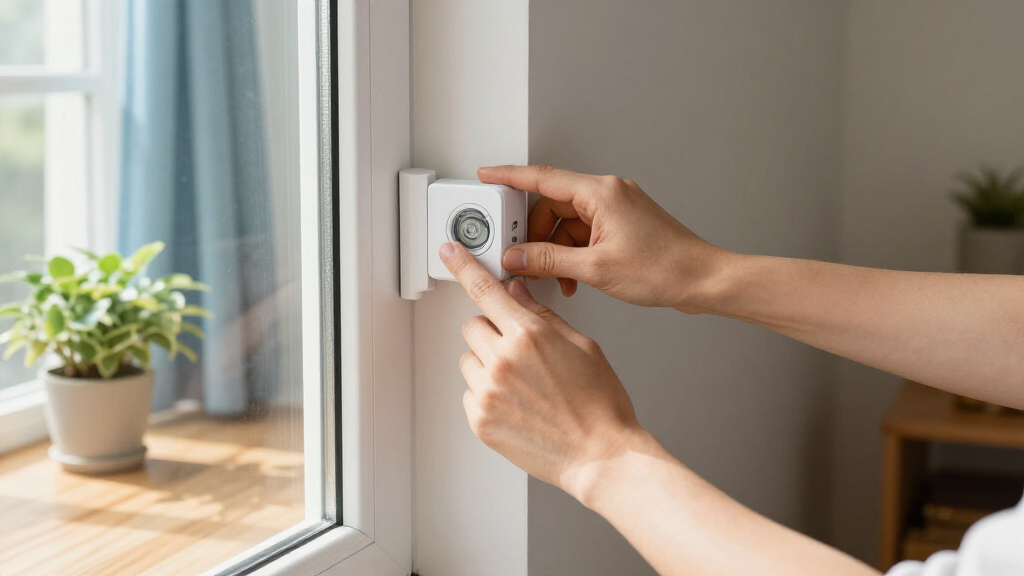
I’d choose this four-pack for a few vulnerable windows when I want a local alarm without adding a hub or wiring. Its 120 dB siren and adjustable high/low sensitivity offer the same core approach as the EVA LOGIK 8-pack, but fewer units mean less coverage and a smaller commitment for a limited setup. These are vibration-triggered alarms, not acoustic sensors that listen for the sound of breaking glass, so they alert at the window rather than identifying glass breakage by sound across a room. The slim, wire-free units are simple to mount, and the low-battery and flashing indicators help with upkeep. I’d factor in the missing 2 AAA batteries per alarm and expect to adjust sensitivity: higher sensitivity can catch more disturbance, but may also invite false alerts.
Pros:- 120 dB local alarm can make a disturbance conspicuous at the window.
- High and low sensitivity settings let buyers tune response to the installation.
- Wire-free window mounting avoids running cables.
- Flashing and low-battery indicators, plus deterrent stickers, are included.
Cons:- Two AAA batteries per alarm are required and not included.
- Vibration sensing may trigger on incidental impacts unless sensitivity is adjusted.
- Four units cover fewer windows than the matching EVA LOGIK 8-pack.
Best for: People who want local vibration alarms on a handful of windows and do not need a connected security system.
Not ideal for: Buyers seeking acoustic glass-break detection across a room, or anyone who wants included batteries and broad window coverage in one purchase.
- Model:NST003-4
- Quantity:4 alarms
- Sensor technology:Contact sensor; vibration detection
- Alarm volume:120 dB
- Sensitivity:High and low settings
- Power:2 AAA alkaline batteries per alarm; not included
- Dimensions:3.2 × 3 × 0.6 in
- Mounting:Window mount
Our verdict“Choose this set for a few windows and a loud, standalone vibration alarm; pick the EVA LOGIK 8-pack if you need more coverage.”
EVA LOGIK Ultra-Thin Window Alarm, 8-Pack
For buyers covering several windows with individual alarms, I’d favor this eight-pack over the EVA LOGIK 4-pack: it doubles the number of sensors while keeping the same 120 dB vibration-triggered alert and two sensitivity settings. That makes it a practical choice for a home where coverage matters more than app controls or a central hub. The tradeoff is the sensing method: these units respond to vibration at the mounted window, unlike the eufy Security Glass Break Sensor E10, which uses acoustic detection and supports multiple glass types. Each EVA LOGIK alarm needs batteries that are not included, so outfitting all eight means planning for that separately. Sensitivity adjustment can help reduce nuisance alarms, but setup may take some tuning depending on the window and surrounding activity.
Pros:- Eight alarms provide broader window coverage than the EVA LOGIK 4-pack.
- 120 dB siren gives each unit a loud local alert.
- High and low sensitivity settings allow adjustment for different placements.
- Wire-free mounting, visual indicators, and deterrent stickers are included.
Cons:- Batteries are not included, adding setup work across eight units.
- Vibration sensing can be affected by ordinary impacts and may need tuning.
- Does not offer the acoustic glass-break detection or HomeBase connection of the eufy E10.
Best for: Households that want standalone vibration alarms on many windows without adding a hub or wiring.
Not ideal for: Buyers who need acoustic detection from a central room, smart-home integration, or a kit with batteries supplied.
- Model:NST003-8
- Pack size:8 alarms
- Sensor technology:Vibration sensor
- Alarm volume:120 dB
- Sensitivity:High and low settings
- Battery type:3A batteries; not included
- Dimensions:3.2 × 3 × 0.65 in
- Mounting:Window mount
Our verdict“Pick this pack when you want broad, standalone vibration coverage across many windows and can supply the batteries yourself.”
eufy Security Glass Break Sensor E10
This is the lineup’s strongest fit for buyers who want a sensor designed to recognize the sound of breaking glass, rather than vibration at the window. Its AI algorithm and neural chip are specified for six glass types, and a 25-foot detection range can cover several panes from a suitable placement. Compared with the EVA LOGIK window alarms, the E10 offers a more room-oriented detection approach and a two-year stated battery life, but it cannot work on its own: a compatible eufy HomeBase is required, and supported models need specific firmware versions. That extra hardware and compatibility check make it a less straightforward choice for a basic setup. Wall mounting with adhesive or screws adds placement flexibility, though buyers still need to follow the sensor’s glass size and thickness limits.
Pros:- AI-based acoustic detection supports six listed glass types.
- 25-foot detection range can cover multiple panes from a suitable position.
- Two-year stated battery life reduces routine battery changes.
- Adhesive or screw mounting gives placement options.
Cons:- Requires a compatible HomeBase Mini, 2, 3, or Pro to operate.
- Compatible HomeBase models require specific firmware versions.
- Glass size and thickness must fall within the stated compatibility limits.
Best for: eufy users with a compatible, current-firmware HomeBase who want acoustic monitoring for multiple glass types from one sensor location.
Not ideal for: People seeking a standalone alarm, buyers without a compatible eufy HomeBase, or anyone whose glass falls outside the stated size and thickness range.
- Model:T90G0
- Detection range:25 ft
- Compatible glass types:Plate, coated, laminated, tempered, wired, and dual pane
- Glass size compatibility:12 × 12 in to 32 × 40 in
- Glass thickness compatibility:2–14 mm
- Battery life:Up to 2 years
- HomeBase connection range:656 ft (200 m)
- Required hardware:eufy HomeBase Mini, 2, 3, or Pro
- Mounting:Wall mount; adhesive or screw
Our verdict“Choose the E10 for smart acoustic detection if you already have a compatible eufy HomeBase; otherwise, the EVA LOGIK alarms are simpler standalone options.”
Honeywell Intellisense FG-1625 Acoustic Glassbreak Sensor 25 Ft.
I’d place the Honeywell FG-1625 on the shortlist for buyers building around an alarm system and looking for acoustic glass-break detection with a 25-foot range. Its FlexCore signal processing and adjustable sensitivity make it more appropriate for a fixed, carefully positioned installation than the EVA LOGIK 4-pack, which triggers from vibration at the window and provides its own local siren. The Honeywell’s stated coverage of all glass types is useful when a room has different panes, but the supplied product data does not specify power, system compatibility, or a standalone alarm. That leaves more setup questions than with a self-contained window alarm. Mounting also matters: unlike peel-and-stick vibration units, this sensor needs proper positioning for its acoustic detection to work as intended.
Pros:- Acoustic detection is distinct from the vibration sensing used by the EVA LOGIK window alarms.
- 25-foot detection range suits a planned room-level placement.
- FlexCore signal processing and adjustable sensitivity support setup tuning.
- Listed coverage includes all glass types.
Cons:- Proper mounting and placement are needed for effective operation.
- Product data does not specify power source or compatibility requirements.
- The supplied details do not identify a standalone siren or wireless setup.
Best for: Homeowners or installers adding a 25-foot acoustic glass-break sensor to a compatible alarm setup and able to plan its placement.
Not ideal for: Renters or buyers seeking a battery-powered, peel-and-stick standalone alarm with clearly specified power and system compatibility.
- Detection type:Acoustic glass-break detection
- Detection range:25 ft
- Signal processing:FlexCore signal processor
- Sensitivity:Adjustable
- Glass coverage:All glass types
- Mounting:Mounting location not specified
Our verdict“Choose the FG-1625 when you need a fixed acoustic sensor for an alarm installation; choose a standalone vibration alarm for simpler window-by-window setup.”
Wsdcam Wireless Glass Break Sensor Alarm, 8-Pack
The Wsdcam set stands out for pairing eight vibration alarms with batteries in the box, avoiding the extra battery purchase required by the EVA LOGIK 8-pack. Its 125 dB alarm is also louder on paper than the 120 dB EVA LOGIK models, with a flashing red indicator to make an alert visible as well as audible. These are still local, peel-and-stick sensors that respond to vibration on a window or door—not room-level acoustic detectors like the eufy Security Glass Break Sensor E10. Adjustable sensitivity helps tailor each placement, though vibration detection can still react to incidental impacts. The stated battery life is up to one year, so buyers should plan for more frequent replacement than the E10’s stated two years. This is a practical choice for broad, simple coverage, not a connected security system.
Pros:- Eight sensors provide broad coverage in one set.
- 125 dB local alarm is louder on paper than the EVA LOGIK alarms.
- Three LR44 batteries per sensor are included.
- Peel-and-stick installation, adjustable sensitivity, flashing indicator, and low-battery warning.
Cons:- Stated battery life is up to one year, so replacement is part of ongoing upkeep.
- Vibration sensing can produce unwanted alerts if sensitivity is not suited to the placement.
- Does not provide the room-level acoustic detection offered by the eufy E10.
Best for: Buyers covering multiple doors or windows who want a hub-free vibration alarm kit with batteries supplied.
Not ideal for: People who want acoustic detection across a room, smart-home integration, or longer stated battery life between replacements.
- Model:C100
- Pack size:8 sensors
- Sensor technology:Vibration
- Alarm volume:125 dB
- Batteries:3 LR44 batteries per sensor; included
- Battery life:Up to 1 year
- Maximum range:12 m
- Mounting:Door mount; peel-and-stick installation
Our verdict“Pick Wsdcam for an eight-unit, hub-free vibration setup with batteries included; choose an acoustic model if you need detection away from the glass.”
Catsonic Window Glass Break Alarm with Vibration Sensor, 6-Pack
The six-alarm bundle suits buyers who want a separate, self-contained alert at several windows without adding a security hub. Its vibration sensor reacts to impacts or forceful opening, while the alarm is rated up to 130 dB; that makes it a different kind of protection from the SimpliSafe Glassbreak Sensor, which listens for breaking glass and can send app alerts through a compatible system. Adhesive mounting and included LR44 batteries keep setup simple, and the mute switch gives you a way to silence the unit.
The tradeoff is coverage type: this is a local window alarm, not a 20-foot acoustic sensor, and sliding windows or doors that move without much force may go undetected. Vibration sensing can also depend on placement and the window itself. Choose Catsonic for several accessible windows and audible alerts; skip it if you need app notifications or broad room coverage.
Pros:- Six alarms provide coverage for multiple windows
- Alarm rated up to 130 dB for a strong local warning
- Adhesive mounting requires no tools
- Three LR44 batteries are included per alarm
Cons:- Vibration sensing may miss sliding windows or doors opened without force
- Detection depends on mounting location and how vibrations travel through the window
- No phone alerts or security-system integration are listed
Best for: Households seeking independent, loud alarms for several windows without installing a connected security system
Not ideal for: Buyers who need phone alerts, room-wide acoustic detection, or reliable coverage for sliding windows that open with little force
- Quantity:6 alarms
- Sensor type:Vibration
- Alarm volume:Up to 130 dB
- Power source:Battery powered
- Batteries:3 LR44 batteries per alarm, included
- Battery life:Up to 1 year
- Mounting:Window mount with adhesive
- Dimensions:2.75 × 2.75 × 0.43 in
- Color:Black
Our verdict“Choose Catsonic for simple, loud, multi-window alerts; choose an acoustic system sensor if you need room coverage or connected notifications.”
SimpliSafe Glassbreak Sensor, 20 ft Range
For a home already using SimpliSafe Gen 3, this sensor adds glass-break detection without requiring an alarm stuck directly to each pane. It listens for breaking glass from up to 20 feet away and can send phone alerts through the SimpliSafe app, giving it a broader room-level role than the Catsonic Window Glass Break Alarm, which relies on vibration at the window and sounds locally. Wall or shelf placement also lets one sensor cover a suitable area rather than dedicating a unit to each window.
That convenience comes with a firm compatibility limit: it works with the listed SimpliSafe Gen 3 system, not as a standalone alarm. Its four-year average battery life reduces routine replacement, though it offers less independence than Catsonic’s self-contained alarms. I’d pick it for existing SimpliSafe owners who want app-connected detection; buyers outside that ecosystem should look at a standalone option or another compatible sensor.
Pros:- Acoustic detection reaches up to 20 feet
- Can send phone alerts through the SimpliSafe app
- Wall or shelf mounting offers placement flexibility
- Average battery life is four years
Cons:- Requires a compatible SimpliSafe Gen 3 system
- Does not provide the listed standalone local alarm function of the Catsonic alarms
- Coverage depends on placing the sensor within its 20-foot detection range
Best for: SimpliSafe Gen 3 households seeking app-connected glass-break detection across a room
Not ideal for: Shoppers without a SimpliSafe Gen 3 system or anyone wanting a standalone alarm that works independently
- Model:GBK301
- Detection range:20 feet
- Power source:Battery powered
- Battery type:Lithium
- Battery life:4 years
- Mounting:Wall mount; may also be placed on a shelf
- Dimensions:2.13 × 1.6 × 2.13 inches
- Weight:2.24 ounces
- Compatibility:SimpliSafe Gen 3 home security system
Our verdict“Choose this sensor if you already use SimpliSafe Gen 3 and want app alerts; otherwise, its system dependency makes a standalone alarm a better fit.”
How We Picked
I compared the seven options by the kind of event they detect, how they fit into a home security setup, their stated coverage or intended placement, and the effort involved in installation. I gave dedicated acoustic sensors an edge for buyers specifically seeking glass-break detection, while treating vibration alarms as a different, lower-commitment approach rather than direct equivalents. Pack size and the ability to cover several windows also mattered, but quantity alone did not outweigh detection type or system fit.
The order reflects how broadly useful each option is for its intended buyer, not a claim that every model suits every home. eufy ranks first as the leading dedicated sensor choice in this group; Honeywell follows for buyers who can use a wired detector and value its stated range. SimpliSafe is strongest inside its own ecosystem, while the multi-packs rank as practical options for targeted window coverage when buyers accept vibration-based detection and verify their needs.
| glass break sensor | Model | Mounting |
|---|---|---|
| EVA LOGIK Ultra-Thin Window Al | NST003-4 | Window mount |
| EVA LOGIK Ultra-Thin Window Al | NST003-8 | Window mount |
| eufy Security Glass Break Sens | T90G0 | Wall mount; adhesive or screw |
| Honeywell Intellisense FG-1625 | — | Mounting location not specified |
| Wsdcam Wireless Glass Break Se | C100 | Door mount; peel-and-stick installation |
| Catsonic Window Glass Break Al | — | Window mount with adhesive |
| SimpliSafe Glassbreak Sensor | GBK301 | Wall mount; may also be placed on a shelf |
Factors to Consider When Choosing Glass Break Sensors
Before choosing a glass break sensor, decide what you need it to detect and how it will connect to the rest of your security plan. These factors can prevent a common mismatch: buying several window alarms when you actually need one room-level detector, or choosing a system sensor that cannot work with your existing setup.
Acoustic Detection or Window Vibration
Acoustic sensors listen for the sound of breaking glass within a stated area, while vibration alarms attach to a pane and react to shock or movement. Neither method covers every risk in the same way: a window-mounted device is tied to that specific pane, and an acoustic sensor’s usefulness depends on placement and room layout. Buyers often treat the two types as interchangeable because both use “glass break” language, but their triggers differ. Consider whether you want room-level listening or a separate alarm on each selected window. If you need warning about force against glass before it shatters, vibration sensing may better match that goal; if you want a detector for the sound of breakage, choose an acoustic model.
Check Compatibility Before Buying
A security sensor is only useful if your system can receive its signal and notify you as intended. Confirm the required hub, base station, app, or alarm panel before choosing a connected model; brand names alone do not prove compatibility with every product generation. Standalone window alarms avoid some ecosystem questions, but they may not send alerts to a central system or trigger a monitored response. A frequent mistake is assuming a sensor will pair with an existing alarm because it uses wireless communication. Check the manufacturer’s compatibility information and any required subscription or service separately. If the device will be part of a monitored setup, verify that the specific sensor type is supported.
Plan Coverage Around Rooms and Windows
Count the panes and rooms you need to protect before comparing pack sizes. A multi-pack of window-mounted alarms can cover multiple individual windows, while one acoustic unit may cover a room subject to its stated range and placement conditions. A published range is not a guarantee that every corner of a home will be covered; walls, furnishings, room shape, and background noise can affect where a detector should go. Avoid placing an acoustic sensor based only on the largest number on the package. Sketch the room, note likely sound obstructions, and follow the maker’s installation guidance. For open-plan spaces or rooms with separated windows, verify coverage rather than assuming one sensor handles them all.
Balance Installation Effort Against Flexibility
Adhesive alarms are generally simpler to place, while wired detectors need more planning. A peel-and-stick device can make sense for renters or people seeking a quick addition to a window, but placement is limited to the surface it attaches to and the alarm may be local rather than system-connected. A wired model can suit a permanent security installation, though wiring and panel compatibility may call for professional help. Think about whether you may move, renovate, or change alarm systems before committing. Another common mistake is buying a sensor based on installation convenience without checking how it reports an alarm. Match installation work to the level of integration you actually need.
Know What a Sensor Can and Cannot Protect
Glass break detection supplements other security measures; it does not secure every entry point. A window sensor cannot stop someone from opening an unlocked door or entering through an unprotected window. Acoustic models may respond to sounds within their detection area, and vibration alarms focus on movement at the pane, so neither automatically replaces contact sensors or a broader alarm plan. Think through likely entry routes and decide whether you need alerts for opening, impact, or breaking glass. Buyers sometimes overbuy sensors for one type of threat while leaving doors or other windows uncovered. A balanced setup may combine sensor types according to the home’s layout and the alarm system’s capabilities.
Factor in Upkeep and Everyday Use
Battery checks, test procedures, and alert behavior affect long-term usefulness. Before purchase, find out how the device signals low power, how the manufacturer recommends testing it, and whether testing requires a particular sound or procedure. For adhesive models, check whether the mounting method allows battery replacement without damaging the surface. In a connected system, confirm how alerts appear and whether a sensor can be identified clearly in the app or alarm panel. A device that is difficult to test may be neglected, while a local alarm that is too disruptive may be disabled. Choose a maintenance routine you can realistically keep up with and follow the product’s instructions rather than improvising a test.
Frequently Asked Questions
Should I choose an acoustic glass break sensor or a vibration alarm?
Choose an acoustic model if you want a detector that listens for breaking-glass sounds across a room, subject to its range and placement guidance. A vibration alarm attaches to a particular window and reacts to movement or impact at that pane. That makes vibration units practical for covering several selected windows, while an acoustic detector may suit a room where multiple panes are within its coverage area. They are not interchangeable, so decide whether you want room-level sound detection or pane-level vibration detection. For broader protection, some homes may use these alongside door or window opening sensors.
Can one glass break sensor cover several windows in the same room?
It may, if it is an acoustic detector and the windows fall within the manufacturer’s stated coverage under suitable placement conditions. A range figure should not be treated as a guarantee for every room, since walls, furnishings, and room shape can affect sound reaching the sensor. A vibration alarm normally protects the specific pane it is attached to, so each additional window may need its own unit. Check the instructions for placement and coverage before deciding how many to buy. When coverage is uncertain, plan around the room layout rather than relying on the maximum stated range.
Will a glass break sensor work with my existing home alarm?
Compatibility depends on the specific sensor and the alarm system, not simply on whether both products are wireless. Some models are designed for a named ecosystem or control panel, while standalone alarms may sound locally without sending an alert to your central system. Check the manufacturer’s compatibility list for your exact hub, base station, or panel model before ordering. Also verify whether the sensor needs a separate hub or service for notifications. If monitored response matters, confirm that the monitoring setup accepts that device and sensor type.
Are multi-pack window alarms a better choice than one room sensor?
A multi-pack can be the better fit when you want a separate vibration alarm on several specific panes and do not need every unit integrated with a central security system. One acoustic room sensor may be simpler when its coverage suits the room and your alarm setup supports it. Compare the number and location of windows with the device’s detection method before judging pack size. A larger pack does not automatically provide broader room coverage if each alarm is limited to the pane where it is mounted. Choose based on the protection plan, not the number of devices in the box.
Do glass break sensors replace door or window contact sensors?
No. A glass break sensor is intended to detect a particular type of event, while a contact sensor typically reports when a door or window opens. A pane could be opened without breaking, and a glass break detector does not cover other entry points in the same way. The devices can complement each other when a home needs both breakage alerts and open/close notifications. Review each vulnerable entry point and decide which event you need to detect there. If you rely on an alarm system, check that it can support the combination you plan to use.
Conclusion
For the best overall dedicated glass-break option, I recommend the eufy Security Glass Break Sensor E10, provided it fits your system. Choose the Honeywell Intellisense FG-1625 as the premium wired pick if its 25-foot stated range and installation requirements suit your setup; SimpliSafe users should look to the SimpliSafe Glassbreak Sensor for the clearest ecosystem match. For a beginner seeking straightforward, pane-level coverage, the EVA LOGIK four-pack is a sensible starting point, while the eight-pack offers more units for multiple windows. The Wsdcam eight-pack is my value-oriented choice for buyers who want several vibration alarms, and Catsonic’s six-pack fits a smaller multi-window plan. If you specifically want sound-based detection, prioritize eufy, Honeywell, or SimpliSafe; if you need a separate alarm at each chosen pane, compare the vibration packs instead.
Fall yard work Picks
leaf blowers
As an affiliate, we earn on qualifying purchases.