For a garage heater for a low ceiling, I’d start with the Comfort Zone 5,000-Watt Hardwired Ceiling-Mount Garage Heater as the best overall balance of ceiling mounting and substantial output. The VEVOR 5000W Electric Garage Heater adds a remote for easier adjustments, while the Shinic 120V Ceiling-Mounted Radiant Quartz Heater suits people who want localized warmth without a 240V circuit. The main tradeoff is between higher-output fan heaters, which call for suitable wiring and clearance, and lower-wattage radiant heaters, which warm people and nearby surfaces rather than a whole garage. Mounting height, manufacturer-specified clearances, and the room’s electrical capacity matter as much as wattage. Read on for the full breakdown and a guide to matching heater type and power to your space.

Get home appliances delivered free with Prime
- Fast, free delivery on millions of items
- Prime Video, Amazon Music and more included
- Member-only deals all year
Complete the kit



Key Takeaways
- The 5,000W Comfort Zone hardwired ceiling model is my best overall pick because it pairs ceiling mounting with stronger heating capacity than the 120V options; it requires a compatible 240V circuit and professional installation may be appropriate.
- The two 7,500W models—Tempware and VEVOR—are the high-output choices, but their greater power demands make them a poor match for garages with limited electrical capacity.
- Shinic’s 120V radiant options solve a different problem: they can provide nearby warmth without the installation demands of a hardwired 240V heater, but they are not equivalent to heating an entire garage.
- Mounting flexibility separates CTSC’s 5,600W unit from ceiling-only picks; its wall-or-ceiling design may help when overhead placement is awkward, subject to required clearances.
- Low wattage does not automatically mean an easy whole-room solution: the 1,500W models are better suited to modest, localized needs than rapid heating in a large or poorly insulated garage.
| Comfort Zone 5,000-Watt Hardwired Ceiling-Mount Garage Heater |  | Best Overall | Brand: Comfort Zone | Model: CZ220BK | Power: 5,000 watts | VIEW ON AMAZON | See Our Full Breakdown |
| VEVOR 5000W Electric Garage Heater with Remote Control |  | Best for Convenient Controls | Brand: VEVOR | Model: BGP2102-50R | Power: 5,000 watts | VIEW ON AMAZON | See Our Full Breakdown |
| Comfort Zone 5000W Ceiling-Mounted Garage Heater |  | Best Simple Manual Pick | Power: 5,000 watts | Voltage: 240 volts | Mounting: Ceiling-mounted | VIEW ON AMAZON | See Our Full Breakdown |
| Omberr 4000W 240V Graphene Electric Garage Heater |  | Best for Fine Temperature Control | Brand: Omberr | Model: GHA40 | Power: 4,000 watts | VIEW ON AMAZON | See Our Full Breakdown |
| Mr. Heater 5,000/4,000/3,000W 240V Ceiling-Mount Garage Heater |  | Best for Adjustable Heat Output | Brand: Mr. Heater | Model: 2VAHG5000 | Heat settings: 5,000 / 4,000 / 3,000 watts | VIEW ON AMAZON | See Our Full Breakdown |
| Tempware 240V Hardwired Electric Garage Heater, 7500W, with Remote Control |  | Best for Large Low-Ceiling Garages | Voltage: 240V | Power settings: 6,250W low; 7,500W high | Heat output: 25,590 BTU | VIEW ON AMAZON | See Our Full Breakdown |
| Shinic 120V Ceiling-Mounted Radiant Quartz Garage Heater |  | Best for Small, Plug-In Workspaces | Voltage: 120V | Heating power: 750W or 1,500W | Heating element: Dual quartz | VIEW ON AMAZON | See Our Full Breakdown |
| CTSC 5600W 240V Fan-Forced Garage Heater, Ceiling or Wall Mount |  | Best for Mid-Size Garages with Flexible Mounting | Power and heat output: 5,600W; 19,096 BTU | Voltage and amperage: 240V; 23.3A | Coverage: 560 sq. ft. / 52 sq. m | VIEW ON AMAZON | See Our Full Breakdown |
| Shinic 2-Pack 120V Ceiling-Mounted Electric Garage Heater, 1500W/750W |  | Best Two-Zone Radiant Setup | Quantity: Two heaters | Voltage: 120V AC, 60Hz | Power per heater: 750W or 1,500W | VIEW ON AMAZON | See Our Full Breakdown |
| 1500W Electric Space Heater with 90° Adjustable Angle and Overheat Protection |  | Best Portable Low-Ceiling Supplemental Heater | Power settings: 1,500W high; 750W low | Modes: High heat, low heat, natural wind | Input voltage: 110–125V | VIEW ON AMAZON | See Our Full Breakdown |
| VEVOR 7500W Electric Garage Heater with Remote Control |  | Best for Large, Low-Ceiling Garages | Power: 7500 W | Heating output: 25,600 BTU | Heating coverage: 732 sq. ft. (68 sq. m.) | VIEW ON AMAZON | See Our Full Breakdown |
| Beyond Heat Electric Garage Heater 120V, 1500W Radiant Space Heater (1-Pack) |  | Best for Targeted Radiant Heat | Power: 1500 W | Voltage and amperage: 120 V; 12.5 A | Heating method: Radiant, dual quartz tubes | VIEW ON AMAZON | See Our Full Breakdown |
| garage heater for low ceiling | Voltage | Mounting | Power |
|---|---|---|---|
| Comfort Zone 5,000-Watt Hardwi | 240 volts | — | 5,000 watts |
| VEVOR 5000W Electric Garage He | 240 volts | Wall-mounted or ceiling-hung | 5,000 watts |
| Comfort Zone 5000W Ceiling-Mou | 240 volts | Ceiling-mounted | 5,000 watts |
| Omberr 4000W 240V Graphene Ele | 240 volts | Ceiling mount | 4,000 watts |
| Mr. Heater 5,000/4,000/3,000W | 240 volts | Ceiling mount | — |
| Tempware 240V Hardwired Electr | 240V | — | — |
| Shinic 120V Ceiling-Mounted Ra | 120V | Ceiling mount | — |
| CTSC 5600W 240V Fan-Forced Gar | — | Ceiling or wall mount | — |
| Shinic 2-Pack 120V Ceiling-Mou | 120V AC, 60Hz | — | — |
| 1500W Electric Space Heater wi | — | — | — |
| VEVOR 7500W Electric Garage He | — | Wall-mounted or ceiling-mounted | 7500 W |
| Beyond Heat Electric Garage He | — | Ceiling mount | 1500 W |
More Details on Our Top Picks
Comfort Zone 5,000-Watt Hardwired Ceiling-Mount Garage Heater
For a low-ceiling garage that needs a fixed, floor-clearing heat source, this 5,000-watt ceiling-mounted heater is my strongest all-around pick. Its adjustable mounting angle and louvers let you aim forced air toward a work area rather than simply heating the ceiling. The heavy-gauge steel body and overheat shutoff suit regular workshop use, while the dual-knob controls keep operation straightforward. Compared with the VEVOR 5000W Electric Garage Heater, it gives up a remote, timer, and wall-mount option in exchange for a simpler control setup. That simplicity is useful if you want manual operation, but less appealing if you plan to adjust heat from across the garage. It requires a hardwired 240-volt connection and a suitable ceiling mounting point, so it is not a plug-in solution.
Pros:- Ceiling mounting keeps the floor and work surfaces clear.
- Adjustable mounting angle and louvers help direct airflow toward a work area.
- Heavy-gauge steel construction is suited to workshop conditions.
- Overheat sensor, thermal cut-out, and power indicator support straightforward operation.
Cons:- Requires hardwired 240-volt installation rather than a standard outlet.
- Needs a suitable ceiling mounting location, which may limit placement.
- Manual controls lack the remote and timer found on the VEVOR 5000W model.
Best for: Garage owners with a suitable low-ceiling mounting point who want 5,000 watts of manually controlled, directed heat and clear floor space.
Not ideal for: Renters or DIYers without access to a 240-volt hardwire installation, and buyers who want a remote or timer.
- Brand:Comfort Zone
- Model:CZ220BK
- Power:5,000 watts
- Voltage:240 volts
- Installation:Hardwired ceiling mount
- Heating type:Fan-forced
- Controls:Dual-knob thermostat and on/off control
- Safety:Overheat sensor and thermal cut-out
- Certification:ETL compliant
Our verdict“Choose this Comfort Zone if you want sturdy, manually controlled 5,000-watt ceiling heat and can provide a hardwired 240-volt connection.”
VEVOR 5000W Electric Garage Heater with Remote Control
The VEVOR stands out for buyers who want remote operation and a timer without giving up 5,000-watt output. Its wall-mount or ceiling-hung installation gives more placement flexibility than the ceiling-only Comfort Zone 5,000-Watt Hardwired Garage Heater, which can help when a low ceiling leaves few good mounting spots. Two power levels and adjustable louvers let you vary output and aim the airflow, while the 9-hour timer adds a way to limit run time without returning to the unit. The stated coverage is up to 50 square meters, but the heater still needs a hardwired 240-volt supply; its remote is not a shortcut around electrical installation. Its listed maximum temperature setting is 65°F, so shoppers seeking a broader temperature range may prefer the Omberr 4000W Graphene Heater, which lists settings up to 90°F.
Pros:- Remote control and a 9-hour timer add convenience when the heater is mounted overhead.
- Two power levels offer a choice of heat output.
- Wall-mounted or ceiling-hung installation provides more placement options than ceiling-only models.
- Adjustable louvers and automatic overheat shutoff support directed, protected operation.
Cons:- Requires hardwired 240-volt installation.
- Remote control batteries are not included.
- Maximum temperature setting is listed as 65°F, which may not suit buyers seeking a higher setpoint.
Best for: Owners of a 240-volt-equipped garage who want remote control, scheduled run time, and a choice of wall or ceiling mounting.
Not ideal for: Buyers who need plug-in installation, a stated temperature setting above 65°F, or a heater that works without a suitable mounting surface.
- Brand:VEVOR
- Model:BGP2102-50R
- Power:5,000 watts
- Voltage:240 volts
- Current:20.83 amps
- Heating output:17,064 BTU
- Heating coverage:Up to 50 sq. m.
- Mounting:Wall-mounted or ceiling-hung
- Timer:9 hours
Our verdict“Pick the VEVOR if remote controls, a timer, and flexible mounting matter more to you than a wider listed temperature range.”
Comfort Zone 5000W Ceiling-Mounted Garage Heater
This Comfort Zone is a straightforward choice for a low-ceiling garage where the priority is fixed ceiling mounting and manual heat control, not remote features. Like the Comfort Zone CZ220BK, it uses 5,000 watts, heavy-gauge steel, adjustable airflow, and an overheat shutoff. The supplied details also describe an adjustable mounting angle, which helps direct forced air toward a bench or vehicle bay instead of leaving the heater pointed straight down. Its dual-knob controls are easy to understand, but there is no stated remote, timer, or automatic operation. That makes it less convenient than the VEVOR 5000W Electric Garage Heater for changing settings from a distance. On the other hand, shoppers who do not need those extras can focus on a simple ceiling-mounted setup. Hardwired 240-volt installation remains a requirement.
Pros:- Ceiling-mounted design preserves floor space in garages and workshops.
- Adjustable louvers and mounting angle help aim warm airflow.
- Heavy-gauge steel construction suits indoor workshop use.
- Overheat shutoff sensor and power indicator light provide useful operating safeguards.
Cons:- Requires hardwired 240-volt installation.
- Manual dual-knob controls have no stated remote or timer.
- Ceiling-only mounting offers less placement flexibility than the VEVOR 5000W model.
Best for: Workshop owners who want a basic, ceiling-mounted 5,000-watt heater with manual controls and no need for remote operation.
Not ideal for: Buyers who want a timer, remote, plug-in setup, or flexible wall mounting.
- Power:5,000 watts
- Voltage:240 volts
- Mounting:Ceiling-mounted
- Construction:Heavy-gauge steel
- Heating type:Fan-forced
- Controls:Dual-knob thermostat and on/off control
- Safety:Overheat shutoff sensor
- Use:Indoor
Our verdict“Choose this model if you want manually controlled ceiling heat and can skip the remote and timer offered by more feature-rich alternatives.”
Omberr 4000W 240V Graphene Electric Garage Heater
The Omberr is the most control-focused option here for a buyer who wants a lower-output ceiling heater with a broad setpoint range. Its 4,000 watts sit below the 5,000-watt Comfort Zone and VEVOR models, a useful distinction for garages where the higher-output choices may be more than needed. The listed 40–90°F settings, remote, and half-hour-to-nine-hour timer give it more adjustment than the manual Comfort Zone 5000W. Adjustable louvers, mounting angle, and height settings also help aim air in a space where overhead placement can otherwise leave a work area feeling underserved. The tradeoff is that it is hardwired for 240 volts, has no plug, and is indoor-only. The product data describes graphene elements and an iron housing but does not give a coverage figure, so I would not choose it based on a room-size claim.
Pros:- 40–90°F temperature settings offer a wider stated range than the VEVOR 5000W model.
- Remote control and a 0.5–9-hour timer make overhead operation more convenient.
- Adjustable louvers, mounting angles, and height settings help direct airflow.
- Overheat protection stops heating above 95°C while the fan continues to cool the unit.
Cons:- Requires hardwired 240-volt installation and has no plug.
- Indoor use only limits placement options.
- Lower 4,000-watt output and no stated coverage figure make it harder to match to a large garage.
Best for: Owners of indoor garages or tool rooms who want remote temperature adjustment and a timer in a 4,000-watt ceiling heater.
Not ideal for: Shoppers who need a plug-in heater, outdoor use, or a specified coverage area to match a larger garage.
- Brand:Omberr
- Model:GHA40
- Power:4,000 watts
- Voltage:240 volts
- Amperage:16.6 amps
- Heating element:Graphene
- Mounting:Ceiling mount
- Temperature settings:40–90°F
- Timer:0.5–9 hours
Our verdict“Choose the Omberr for adjustable, remote-controlled heat in an indoor garage when its 4,000-watt output suits the space.”
Mr. Heater 5,000/4,000/3,000W 240V Ceiling-Mount Garage Heater
The Mr. Heater earns its place for garages where choosing among three power levels matters more than remote convenience. Its 5,000-, 4,000-, and 3,000-watt settings let you scale output for different conditions, rather than relying on the two levels of the VEVOR 5000W heater or the fixed wattage listed for the CZ220BK. The tilting head and adjustable louvers help point forced air toward a work zone, a practical feature when mounting overhead in a low-ceiling space. It also lists a 40–120°F temperature range and coverage of 569 square feet. The key tradeoff is electrical: this unit calls for a 240-volt, 30-amp hardwire connection, so check that the circuit is suitable before choosing it. It is ceiling-mount only and heavier than the Omberr at 19.5 pounds.
Pros:- Three heat settings provide more output choices than the two-level VEVOR 5000W heater.
- Tilting head and adjustable louvers help direct airflow toward a work area.
- Listed 40–120°F temperature range supports a broad range of thermostat settings.
- Ceiling mounting frees floor space and includes overheat protection.
Cons:- Requires a 240-volt, 30-amp hardwire connection.
- Ceiling mounting only limits placement flexibility.
- At 19.5 pounds, it is heavier than the 13.3-pound Omberr.
Best for: Garage owners with a suitable 240-volt, 30-amp circuit who want multiple output settings for changing work conditions.
Not ideal for: Buyers without a 30-amp hardwire connection, those who need wall mounting, or anyone seeking a lighter unit with remote controls.
- Brand:Mr. Heater
- Model:2VAHG5000
- Heat settings:5,000 / 4,000 / 3,000 watts
- Heat output:17,060 BTU
- Voltage:240 volts
- Amperage:30 amps
- Mounting:Ceiling mount
- Heating coverage:569 sq. ft.
- Temperature range:40–120°F
Our verdict“Choose the Mr. Heater if you have the specified 30-amp connection and want three heat levels to adjust output for different garage tasks.”
Tempware 240V Hardwired Electric Garage Heater, 7500W, with Remote Control
For a low-ceiling garage that needs substantial heat, I’d rank the Tempware 7,500W among the strongest options here. Its adjustable mounting angle and louvers let owners direct warm air toward a work area rather than treating ceiling height as a reason to give up useful coverage. The stated reach of up to 1,250 sq. ft. also exceeds the CTSC 5600W’s 560-square-foot rating, making Tempware the better fit for a larger space. A digital thermostat, remote, and 1–12-hour timer add control without reaching up to the unit. The tradeoff is installation: this is hardwired 240V equipment, not a plug-in choice, and its power cord is not included. I’d skip it if the garage lacks the right electrical supply or professional installation is not planned.
Pros:- 7,500W output and a stated coverage area up to 1,250 sq. ft.
- Adjustable mounting angle and louvers help aim airflow at a work zone.
- Digital thermostat, remote control, and 1–12-hour timer provide convenient control.
- Overheat protection, auto-shutoff, and ETL certification are listed safety features.
Cons:- Requires hardwired 240V installation, which may call for an electrician.
- Power cord is not included.
- Remote control batteries are not included.
Best for: Owners of large, low-ceiling garages or workshops with a suitable 240V circuit who want directed heat and remote controls.
Not ideal for: Renters and DIY buyers seeking a plug-in heater, or anyone without a 240V hardwired installation plan.
- Voltage:240V
- Power settings:6,250W low; 7,500W high
- Heat output:25,590 BTU
- Coverage area:Up to 1,250 sq. ft.
- Thermostat range:45°F–95°F
- Timer:1–12 hours
- Installation:Hardwired; power cord not included
- Mounting and safety:Adjustable angle and louvers; overheat protection, auto-shutoff, ETL certified
Our verdict“Choose Tempware for a large low-ceiling garage with 240V wiring and a need for adjustable, high-output heat.”
Shinic 120V Ceiling-Mounted Radiant Quartz Garage Heater
I’d choose the Shinic QGW15-602 when a low ceiling makes a compact ceiling-mounted radiant heater more useful than a powerful air heater. Its 750W and 1,500W settings warm people and nearby objects directly, so the heat is aimed at a bench or work area instead of relying on broad room circulation. That is a different approach from the fan-forced CTSC 5600W, which offers far more output but needs a 240V supply. Shinic runs on 120V and adds a halogen work light, a practical pairing for a small indoor garage. Its stated coverage is only 200–300 sq. ft., though, and ceiling mounting is required. I’d pass if you need to heat a whole garage or want a portable heater that can move between rooms.
Pros:- 120V operation avoids the 240V supply required by the CTSC 5600W.
- Dual quartz elements provide two heat levels: 750W and 1,500W.
- 90-degree adjustment helps aim radiant warmth at a work area.
- Built-in halogen light and listed safety features add utility for indoor tasks.
Cons:- Coverage is limited to a stated 200–300 sq. ft.
- Designed for indoor use only.
- Requires ceiling mounting rather than offering portable placement.
Best for: Homeowners with a small indoor garage or workbench area who want ceiling-mounted radiant warmth from a 120V supply.
Not ideal for: Owners of large or drafty garages who need broad, high-output heating, or buyers who cannot mount a heater on the ceiling.
- Voltage:120V
- Heating power:750W or 1,500W
- Heating element:Dual quartz
- Coverage:200–300 sq. ft.
- Mounting:Ceiling mount
- Adjustable angle:90 degrees
- Settings:Five heat and light settings
- Safety:Overheat protection, grounded 3-prong plug, metal safety grill, ETL-listed
Our verdict“Pick this Shinic for focused radiant heat and task lighting in a small indoor garage with a suitable ceiling mount.”
CTSC 5600W 240V Fan-Forced Garage Heater, Ceiling or Wall Mount
The CTSC 5600W fills the middle ground between the compact Shinic radiant heater and the much higher-output Tempware 7500W. Its fan-forced heat is rated for up to 560 sq. ft., while ceiling or wall mounting gives buyers more placement choices when a low ceiling limits where a unit can go. A remote, thermostat, and timer make adjustments easier once the heater is mounted; the included bracket and stated 6.2-foot cord also make it a more equipped package than the hardwired Tempware. The key constraint is its electrical demand: it needs 240V and cannot use a standard 120V outlet. It can also produce up to 58 dB, and clearance requirements may affect placement. I’d favor it for a defined mid-size space, not a large garage needing Tempware-level coverage.
Pros:- 5,600W fan-forced output is rated for spaces up to 560 sq. ft.
- Can be mounted on a ceiling or wall to suit different low-ceiling layouts.
- Includes a remote, thermostat, timer, mounting hardware, and 240V socket.
- Adjustable airflow and mounting angle help direct heat where it is needed.
Cons:- Requires a 240V supply and cannot run from a standard 120V outlet.
- Professional electrical work may be needed for installation.
- Noise can reach 58 dB, and the bracket-free setup requires at least 7.3 inches of wall clearance.
Best for: Owners of a mid-size garage or workshop with 240V power who need ceiling-or-wall mounting flexibility and remote controls.
Not ideal for: People relying on a standard 120V outlet, or buyers needing to heat a space substantially larger than the stated 560 sq. ft. coverage.
- Power and heat output:5,600W; 19,096 BTU
- Voltage and amperage:240V; 23.3A
- Coverage:560 sq. ft. / 52 sq. m
- Heating method:Fan-forced air
- Mounting:Ceiling or wall mount
- Temperature range:50°F–95°F
- Timer and speeds:1–10 hours; two speeds
- Noise and cord:Up to 58 dB; 6.2-foot cord
- Plug and included accessories:NEMA 6-30P, 30A; 240V socket, bracket, hardware, and remote
Our verdict“Choose the CTSC for a mid-size garage with 240V power when wall-or-ceiling placement and remote control matter more than quiet operation.”
Shinic 2-Pack 120V Ceiling-Mounted Electric Garage Heater, 1500W/750W
For a low-ceiling garage with two separate work areas, I’d take the two-pack Shinic over the single QGW15-602. Each ceiling-mounted quartz heater can swivel up to 90 degrees, letting the pair direct radiant warmth toward different benches or positions without taking up floor space. Both units also have a halogen work light, making the bundle more useful for task-focused spaces than a single heater alone. The heaters use 120V power, unlike the 240V CTSC 5600W, but each tops out at 1,500W, so this set is not a replacement for a high-output heater in a large, cold garage. Installation requires ceiling mounting, and the pull-string controls are less convenient than the remote and thermostat on the Tempware. I’d choose this for divided work zones, not fast whole-room heating.
Pros:- Two heaters can serve separate work areas rather than concentrating heat at one point.
- Each unit offers 750W and 1,500W radiant quartz settings.
- 90-degree rotation helps aim warmth while keeping units off the floor.
- Each heater includes a halogen work light and listed overheat protection.
Cons:- Each heater is limited to 1,500W, so the pair is not comparable to the high-output Tempware or CTSC for whole-garage heating.
- Both units require ceiling mounting.
- Heat and light settings use pull-string switches rather than a remote or thermostat.
Best for: DIYers with two small work zones in a low-ceiling garage who want ceiling-mounted radiant heat and task lights on 120V.
Not ideal for: Owners seeking a single high-output heater for a large garage, or buyers who want remote operation and thermostat control.
- Quantity:Two heaters
- Voltage:120V AC, 60Hz
- Power per heater:750W or 1,500W
- Heating type:Radiant quartz
- Mounting and adjustment:Ceiling mount; rotates up to 90 degrees
- Controls:Five heat and light modes; pull-string switches
- Safety:Overheat auto-off, grounded three-prong plug, ETL listed
- Included components:Two heaters, two adjustable brackets and accessories, user manual
Our verdict“Choose the Shinic two-pack when two small garage work zones need separate ceiling-mounted radiant heat and lighting.”
1500W Electric Space Heater with 90° Adjustable Angle and Overheat Protection
This portable 1,500W heater suits a low-ceiling garage when the goal is to warm one person or station, not heat the whole room. Unlike the ceiling-mounted Shinic QGW15-602, it needs no overhead installation and can be angled up to 90 degrees toward a bench or seated work area. Its 750W low setting and fan-only mode also give it more flexibility for light supplemental use than a heater with heat settings alone. The tradeoff is limited reach: it is not in the same heating class as the CTSC 5600W or Tempware 7500W, and the listed features include neither a thermostat nor a remote. At five feet, the cord also restricts where it can sit. I’d treat it as a personal heater, not the primary heat source for a garage.
Pros:- Portable placement avoids ceiling or wall mounting.
- Two heat levels and a fan-only mode allow different types of use.
- 90-degree angle adjustment helps direct airflow toward a work area.
- Listed operating noise is under 45 dB, with automatic overheat shutoff.
Cons:- 1,500W output is suited to supplemental or personal heating rather than large garage coverage.
- No thermostat or remote control is listed.
- The five-foot cord can limit placement, and tip-over protection is not specified.
Best for: Someone working at one station in a small garage who wants a movable 120V heater without ceiling installation.
Not ideal for: Owners who need whole-garage heating, remote or thermostat control, or a longer reach from the outlet.
- Power settings:1,500W high; 750W low
- Modes:High heat, low heat, natural wind
- Input voltage:110–125V
- Adjustable angle:90 degrees
- Noise level:Under 45 dB
- Cord length:5 feet
- Material:Flame-retardant ABS
- Safety:Automatic overheat shutoff
Our verdict“Pick this model for movable, personal warmth at one garage work station, not as a replacement for a mounted garage heater.”
VEVOR 7500W Electric Garage Heater with Remote Control
The VEVOR’s 7500W output and ceiling- or wall-mounting options make it a fit for larger garages where a floor heater would take up valuable space. Its fan-forced heat, adjustable louvers, and remote let you direct warmth and change settings without reaching the unit—useful when it is mounted overhead. Compared with the VEVOR 5000W Electric Garage Heater, this model offers more output and a stated coverage area of 732 square feet, but it also draws 31.25 amps and calls for a circuit breaker rated above 32 amps. That electrical requirement may rule it out for garages without suitable wiring. The two power levels, temperature control, timer, and overheat shutoff add practical control, though its fan-forced heat is less targeted than radiant options such as the Beyond Heat.
Pros:- 7500W fan-forced output is specified for spaces up to 732 square feet.
- Wall or ceiling mounting keeps the floor clear.
- Adjustable louvers and remote control help direct heat and manage settings overhead.
- Temperature control, a 9-hour timer, and overheat shutoff provide useful operating controls.
Cons:- Requires hardwired installation and a circuit breaker rated above 32A.
- Its 31.25A draw can be unsuitable for garages without adequate electrical service.
- Remote control batteries are not included.
Best for: Owners of larger garages or workshops with a suitably rated 240V circuit who want ceiling-mounted, fan-forced heat and remote operation.
Not ideal for: People with limited electrical capacity, renters unable to hardwire a heater, or anyone seeking gentle radiant heat for a small work area.
- Power:7500 W
- Heating output:25,600 BTU
- Heating coverage:732 sq. ft. (68 sq. m.)
- Voltage and current:240 V; 31.25 A
- Power levels:2
- Mounting:Wall-mounted or ceiling-mounted
- Controls and timer:Remote control; 9-hour timer; temperature control within a 2°F difference
- Safety and construction:Overheat automatic shutoff; ETL certified; SPCC cold-rolled steel
- Installation requirement:Circuit breaker rated above 32 A
Our verdict“Choose this VEVOR for a large garage with the required 240V electrical capacity; skip it if your circuit cannot support its high draw.”
Beyond Heat Electric Garage Heater 120V, 1500W Radiant Space Heater (1-Pack)
The Beyond Heat suits a low-ceiling garage when the goal is to warm a person or workbench directly rather than heat the whole room. Its dual quartz tubes provide radiant warmth, while the ceiling mount leaves floor space open and the adjustable halogen light can illuminate a work area. Unlike the fan-forced VEVOR 7500W, this 120V, 1500W unit needs no stated high-amperage 240V circuit, but its output is much lower and the product data gives no coverage area. That makes it a more localized choice, not a substitute for heating a large, cold garage. The pull-string control offers two fixed settings, with no thermostat for maintaining a chosen temperature. Ceiling installation also calls for a secure mounting point and may require professional help.
Pros:- Radiant quartz heating directs warmth toward people and objects instead of relying on whole-room air circulation.
- Ceiling mounting keeps the floor clear.
- Adjustable halogen light adds illumination near a work area.
- Grounded plug, metal grille, and overheat protection provide specified safety features.
Cons:- 1500W output is a smaller-scale choice than the 7500W VEVOR and is not specified for a coverage area.
- Two fixed heat settings do not provide thermostat-based temperature control.
- Ceiling installation requires secure mounting and may call for professional help.
Best for: Someone with a standard 120V outlet who wants overhead radiant warmth and a work light for a single bench or activity zone.
Not ideal for: Owners trying to heat a large garage evenly, or buyers who need thermostat-based temperature control or cannot securely mount a heater overhead.
- Power:1500 W
- Voltage and amperage:120 V; 12.5 A
- Heating method:Radiant, dual quartz tubes
- Heat settings:2
- Mounting:Ceiling mount
- Dimensions:24 x 12.2 x 3.3 inches
- Light feature:Adjustable halogen light
- Safety features:Overheat protection, metal safety grille, 3-prong grounded plug
- Model:UHQTV5M
Our verdict“Pick the Beyond Heat for localized overhead warmth and light on a standard 120V supply, not for heating an entire garage.”
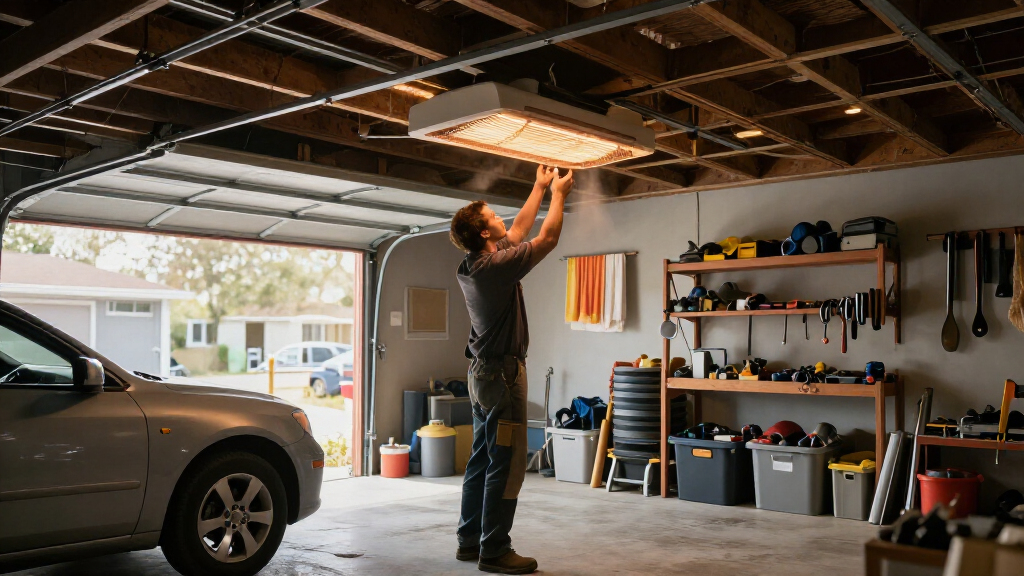
How We Picked
I ranked these heaters around the needs behind a low-ceiling installation: whether the mounting style can keep the unit out of the way, how much heat the listed wattage suggests it can supply, and how realistic the electrical requirements are for a typical garage. I also weighed control features, placement flexibility, radiant versus fan-forced heat, and whether the product’s role is whole-space heating or more localized comfort. A heater’s wattage alone cannot establish room coverage; ceiling height, insulation, air leakage, and local electrical capacity all affect the result.
The order favors practical fit over maximum output. The 5,000W Comfort Zone hardwired ceiling heater leads as a balanced higher-output choice; remote-equipped VEVOR and flexible-mount CTSC options follow for buyers with distinct control or placement priorities. Higher-powered 7,500W models rank lower for general use because they place greater demands on the circuit, while 120V radiant and 1,500W options are reserved for smaller, targeted needs. I do not treat any product as suitable for a specific ceiling clearance or room size without checking its current manufacturer instructions.
| garage heater for low ceiling | Mounting |
|---|---|
| Comfort Zone 5,000-Watt Hardwi | — |
| VEVOR 5000W Electric Garage He | Wall-mounted or ceiling-hung |
| Comfort Zone 5000W Ceiling-Mou | Ceiling-mounted |
| Omberr 4000W 240V Graphene Ele | Ceiling mount |
| Mr. Heater 5,000/4,000/3,000W | Ceiling mount |
| Tempware 240V Hardwired Electr | — |
| Shinic 120V Ceiling-Mounted Ra | Ceiling mount |
| CTSC 5600W 240V Fan-Forced Gar | Ceiling or wall mount |
| Shinic 2-Pack 120V Ceiling-Mou | — |
| 1500W Electric Space Heater wi | — |
| VEVOR 7500W Electric Garage He | Wall-mounted or ceiling-mounted |
| Beyond Heat Electric Garage He | Ceiling mount |
Factors to Consider When Choosing Garage Heater For Low Ceiling
Choosing a garage heater for a low ceiling is a placement and power decision, not just a wattage contest. I’d first work out where the unit can safely sit, what electrical service is available, and whether you need warmth across the room or mainly at a workbench. These checks can rule out mismatched options before you compare convenience features.
Measure Clearances Before Choosing a Mount
Measure from the proposed heater location to the floor, vehicles, shelving, doors, and any combustible materials. Use the heater’s manual for required clearances; a low ceiling does not make a product safe to mount closer than its listed minimum. Allow room for the heater’s airflow and for aiming or adjustment where the design calls for it. A ceiling-mounted unit can free floor space, but it may still conflict with an open garage door or stored items. If no listed mounting position meets the instructions, choose a different location or heater style rather than improvising a bracket.
Match the Heater to Your Electrical Service
Many 5,000W and 7,500W garage heaters use 240V power, and hardwired models may need a dedicated circuit and electrical work. Check the nameplate, installation manual, breaker capacity, wiring, and local code before buying; a remote control does not make a high-output heater compatible with an ordinary outlet. By comparison, 120V models can be easier to power, but their lower output may not keep a large, drafty garage comfortable. Avoid relying on extension cords unless the manufacturer specifically permits the exact setup. If circuit capacity is uncertain, ask a qualified electrician to assess it before selecting a heater.
Choose Between Fan-Forced and Radiant Heat
Fan-forced heaters move warm air around, which can make more sense when you want to raise the temperature across a work area. Radiant models direct warmth toward people and objects, so they can be useful at a bench even when heating the full room is impractical. In a low-ceiling garage, airflow direction and fan noise may affect comfort near the unit. Radiant heat can feel immediate in its target area, but it does not remove drafts or warm every corner equally. Choose based on where you spend time, not on the assumption that one technology is always more efficient.
Treat Wattage as One Clue, Not a Coverage Promise
A higher wattage generally indicates greater electrical draw and heating output, but it does not guarantee a particular room temperature or coverage area. Insulation, ceiling height, outside temperature, air leaks, and how often the garage door opens all change the heating load. A 7,500W heater may be excessive for a small, insulated garage or unsuitable for a circuit that cannot support it. A 1,500W heater may work for a small enclosed area or spot heating yet fall short in a large garage. Use any manufacturer sizing guidance as a starting point, then factor in the building’s condition.
Decide Whether You Need Whole-Room Heat or Spot Comfort
Before paying for more output, decide whether you need the entire garage warm or just a regular work zone. A ceiling-mounted fan heater may better serve shared space, while a radiant heater can make a nearby bench more comfortable without trying to condition every corner. Portable or adjustable-angle designs can offer placement flexibility, but they may occupy floor or shelf space and need careful positioning. The two-unit Shinic set may let you distribute localized warmth, though each unit remains a 120V, lower-wattage option. Pick the heating pattern that suits your routine rather than buying several small heaters to compensate for a poor match.
Check Controls, Installation, and Ongoing Use
Remote controls and adjustable output can make daily use easier, especially when a ceiling-mounted heater is inconvenient to reach. They do not replace checking the unit’s controls, thermostat behavior, installation instructions, or safety features before purchase. Hardwired products may create an upfront installation task, while plug-in models can be simpler only if the outlet and circuit meet the manufacturer’s requirements. Think about how often you will heat the garage and whether you need quick spot warmth or longer operating periods. Compare convenience against installation complexity and electrical demand, not as a substitute for either.
Frequently Asked Questions
Can a 7,500W heater work in a garage with a low ceiling?
It can work only if the heater’s specified mounting clearances and the garage’s electrical supply both support the installation. Low ceiling height does not by itself rule out a high-output model, but it can limit safe placement and airflow. The Tempware and VEVOR 7,500W options also draw more power than the 5,000W models, so confirm circuit requirements before choosing one. Do not infer a safe mounting height from another heater’s instructions. Check the exact model manual and have a qualified electrician review uncertain wiring.
Is a 120V heater enough to warm an entire garage?
It may be enough for a small, insulated space, but the 120V products in this roundup are generally better framed as localized or modest heating options. The Shinic radiant units warm the people and surfaces in their path rather than distributing heat like a higher-output fan-forced heater. A 1,500W unit is more likely to suit a workbench or limited area than a large, drafty garage. Room size alone is not the whole story; insulation and air leakage matter too. Compare the heater’s manufacturer guidance with your garage conditions before expecting whole-room warmth.
Should I choose radiant heat or a fan-forced heater for a workbench?
If you spend most of your time in one spot, radiant heat may be a sensible way to warm that area without aiming to heat the whole garage. A fan-forced model can be a better fit if you want warm air distributed across a wider work area. Think about whether moving air, fan noise, or a direct line of warmth would bother you while working. The Shinic quartz models favor targeted radiant warmth, while Comfort Zone, VEVOR, and CTSC offer fan-forced styles. Check installation clearances and the manufacturer’s intended use before deciding where to aim the heat.
Do I need an electrician to install a ceiling-mounted garage heater?
That depends on the model and the existing electrical setup. Several higher-output heaters in this roundup are hardwired 240V units, which may call for a suitable dedicated circuit and work best handled by a qualified electrician. Even a heater with a remote still has the same power and mounting requirements. Plug-in 120V models avoid some hardwiring needs, but they still must be connected to an outlet and circuit approved by the manufacturer. Read the installation instructions and check local code before starting work.
How should I choose between a 5,000W and a 7,500W heater?
Start with your garage’s heating needs and electrical capacity rather than assuming the larger number is automatically better. A 7,500W model may suit a higher heat demand, but it also places greater demands on the electrical service and may be excessive for a smaller or better-insulated space. The 5,000W Comfort Zone and VEVOR options offer a lower-output step while still targeting more substantial heating than the 120V choices. Check the circuit requirements, manual, room conditions, and manufacturer sizing guidance for each exact model. When the right capacity remains unclear, get an electrician’s input on the circuit and a heating professional’s advice on the space.
Conclusion
For most buyers seeking a ceiling-mounted, higher-output option, I’d choose the Comfort Zone 5,000-Watt Hardwired Ceiling-Mount Garage Heater as best overall. My best value pick is the Comfort Zone 5000W Ceiling-Mounted Garage Heater for shoppers who want a similar wattage class without prioritizing a remote; compare the exact model’s mounting and control details before buying. For best premium, I’d look at the Tempware 7,500W if the garage needs more output and its 240V electrical requirements are supported. Beginners who want localized warmth and a simpler power setup may prefer the Shinic 120V Ceiling-Mounted Radiant Quartz Heater, while buyers wanting remote operation should compare the VEVOR 5000W. For flexible placement, the CTSC 5600W wall-or-ceiling model stands apart; for a small spot rather than whole-garage heating, consider a 1,500W option. My final check would be the manual’s clearance rules and the circuit capacity, since neither a low ceiling nor a higher wattage changes those requirements.