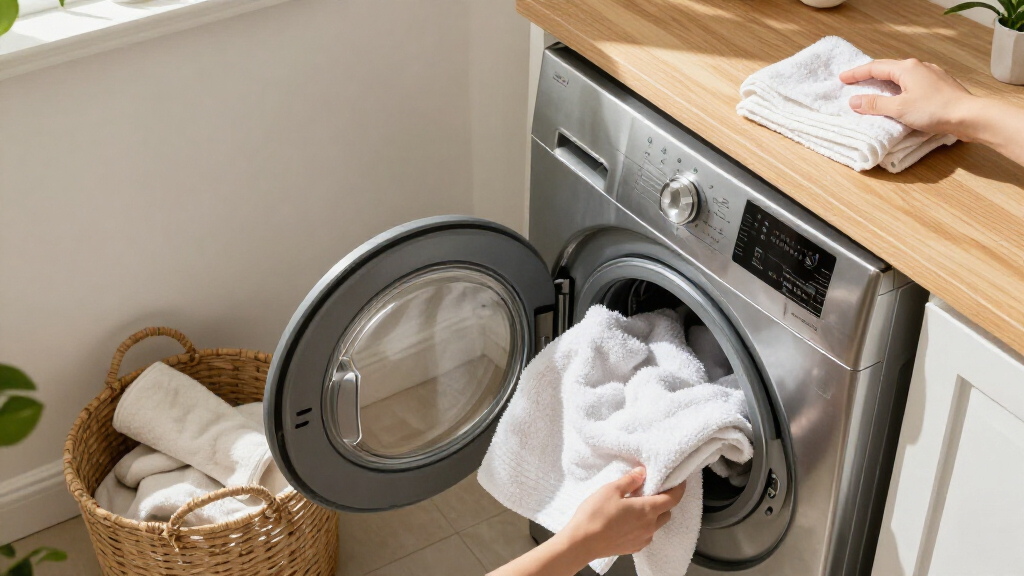

Soft towels depend on more than heat: a dryer needs room for air to move through the load, a suitable cycle, and enough tumbling to keep terry loops from drying into a stiff bundle. For a compact vented setup, I’d start with the COSTWAY 1.5 cu. ft. dryer, whose reverse tumbling and everyday programs suit small towel loads. The Effidry S3 is my pick for the most cycle flexibility and sensor controls, while the 2.8 cu. ft. portable dryer makes more sense when you want to fit a larger load into a compact footprint.

Get home appliances delivered free with Prime
- Fast, free delivery on millions of items
- Prime Video, Amazon Music and more included
- Member-only deals all year
These are not full-size laundry-room machines, and the tradeoffs matter: a small drum can leave towels crowded, hanging dryers handle towels differently from tumbling models, and compact appliances may require more than one cycle for a household’s towel laundry. I’ve ranked the options by how well their stated features support practical towel drying, while accounting for capacity, fabric-care controls, installation needs, and whether the design can handle bulky terry fabric without making the routine awkward.
Complete the kit


Key Takeaways
- COSTWAY is the strongest all-around towel pick here because its 1.5 cu. ft. drum, reverse tumbling, and five modes balance towel care with a compact vented design.
- Effidry S3 offers the widest cycle choice, including sensor controls and reversible tumbling, but its 1.06 cu. ft. drum is better suited to small towel loads.
- The 2.8 cu. ft. model has the largest stated capacity at 16 lb, making it the most sensible choice when several towels need to dry together.
- Kiseely is a hanging wardrobe, not a conventional tumbler; it may suit wrinkle-prone garments, but bulky towels can take up the rack and need room to hang.
- MOJOCO favors portability over towel throughput: its foldable 600 W design can help with occasional drying, but its garment-based capacity is less convenient for regular towel loads.
| COSTWAY 1.5 Cu. Ft. Portable Clothes Dryer, 8 lb, 850 W |  | Best Overall for Small Towel Loads | Capacity: 1.5 cu. ft.; 8 lb load capacity | Power and voltage: 850 W; 120 V | Drying modes: 5 | VIEW LATEST PRICE | See Our Full Breakdown |
| Effidry S3 Compact Portable Clothes Dryer, 1.06 cu. ft., 110V, 1050W |  | Best for Cycle Flexibility and Sensor Control | Capacity: 1.06 cu. ft. | Power and voltage: 1050 W; 110 V | Drying modes: 8 | VIEW LATEST PRICE | See Our Full Breakdown |
| 2.8 cu. ft. Portable Electric Clothes Dryer, 1400W, 6 Drying Modes |  | Best for the Largest Towel Loads | Capacity: 2.8 cu. ft.; 16 lb (approximately 7 kg) | Power: 1400 W | Drying modes: 6 | VIEW LATEST PRICE | See Our Full Breakdown |
| Kiseely Portable Clothes Dryer with Timer, 60-Inch Drying Wardrobe, Blue |  | Best for Hanging Garments Alongside Light Towels | Type: Portable electric drying wardrobe and rack | Drying capacity: 15 kg | Rack load capacity: Up to 18 kg | VIEW LATEST PRICE | See Our Full Breakdown |
| MOJOCO Portable Clothes Dryer, 600W |  | Best Fold-Away Option for Occasional Drying | Power: 600 W | Drying modes: 2 heat settings | Capacity: Up to 9 garments; maximum load 22 lb | VIEW LATEST PRICE | See Our Full Breakdown |
| clothes dryers for soft towel | Capacity | Drying modes | Dimensions |
|---|---|---|---|
| COSTWAY 1.5 Cu. Ft. Portable C | 1.5 cu. ft.; 8 lb load capacity | 5 | — |
| Effidry S3 Compact Portable Cl | 1.06 cu. ft. | 8 | 20.11 × 16.81 × 21.21 in (D × W × H) |
| 2.8 cu. ft. Portable Electric | 2.8 cu. ft.; 16 lb (approximately 7 kg) | 6 | 23 × 20 × 27 in |
| Kiseely Portable Clothes Dryer | — | — | 17.7 in D × 27.6 in W × 60 in H |
| MOJOCO Portable Clothes Dryer | Up to 9 garments; maximum load 22 lb | 2 heat settings | — |
More Details on Our Top Picks
COSTWAY 1.5 Cu. Ft. Portable Clothes Dryer, 8 lb, 850 W
The COSTWAY 1.5 cu. ft. dryer earns my top spot because it gives towel care a sensible mix of drum movement and basic cycle choice without asking for a full laundry-room installation. Its reverse tumbling is the feature I value most for towels: reversing direction is intended to help reduce tangling, which can matter when thick terry fabric twists together instead of moving freely. Five modes cover everyday and bulky drying as well as cooling, refresh, and anti-wrinkle needs, so it offers more useful flexibility than the two-setting MOJOCO.
Its 8 lb load capacity makes this a small-load appliance, not a replacement for a full-size family dryer. A couple of towels may be a more comfortable fit than a tightly packed batch, depending on their size and thickness. Compared with the 2.8 cu. ft. model, COSTWAY has less listed capacity, but its reverse tumble and explicit bulky mode give it a more persuasive towel-care case. The three-layer lint filter is another practical touch, although it needs cleaning after every use.
The vented design has a tradeoff: I would choose it only if I can route the included L-shaped exhaust hose appropriately. It can sit freestanding, stack, or mount on a bracket, but that bracket is sold separately. Its stainless steel drum and built-in door-open, overheat, and over-current protections add reassurance for a compact machine; the listed six-month warranty is shorter than Effidry’s one-year coverage. For buyers who can accommodate venting and do laundry in modest batches, it is the most balanced match in this group.
Pros:- Reverse tumbling is intended to reduce tangling in bulky towel loads.
- Five modes include everyday and bulky options.
- Stainless steel drum and three-layer lint filter suit regular small loads.
- Freestanding, stacked, or bracket-mounted installation gives placement flexibility.
Cons:- The 8 lb capacity can limit how many thick towels fit comfortably.
- Requires venting, and the optional installation bracket is not included.
- Lint filter needs cleaning after every use; listed warranty is six months.
Best for: Small households that dry a few towels at a time and can vent a compact dryer.
Not ideal for: Families with frequent large towel loads, or renters without a practical exhaust route or mounting setup.
- Capacity:1.5 cu. ft.; 8 lb load capacity
- Power and voltage:850 W; 120 V
- Drying modes:5
- Drum:Stainless steel; 17.5 in diameter
- Peak working temperature:140°F
- Ventilation:Vented; L-shaped exhaust hose included
- Installation:Freestanding, stacked, or bracket-mounted; bracket sold separately
- Warranty:6 months
Our verdict“I’d choose COSTWAY first for compact towel drying when reverse tumbling and a vented setup matter more than fitting a large household load.”
Effidry S3 Compact Portable Clothes Dryer, 1.06 cu. ft., 110V, 1050W
The Effidry S3 is the most appealing choice when I want more control over a small load rather than maximum towel capacity. It has eight drying modes, adjustable temperature settings, timed drying, and sensor controls that stop a cycle when clothes are dry. Those features give it a more adjustable approach than COSTWAY’s five modes and make it easier to select a gentler or more specific program instead of treating every fabric the same way.
For towels, the useful combination is reversible tumbling and sensor control. The tumbling feature is intended to help fluff clothes, while the sensor stop may help avoid needlessly extending a cycle. These are helpful design choices, not a promise that towels will emerge soft regardless of load size. The 1.06 cu. ft. drum is the limiting factor: compared with COSTWAY’s 1.5 cu. ft. capacity and the 2.8 cu. ft. model’s larger stated load, this dryer is best kept to a few towels or mixed small loads. Crowding a compact drum works against the freedom of movement that bulky terry needs.
Effidry is also one of the easier options to place: it is freestanding, needs no installation or drainage, and measures 20.11 by 16.81 by 21.21 inches. Its shoe rack and non-rotating shoe mode broaden its use, but that extra function does little for towel buyers. The one-year warranty is longer than COSTWAY’s listed six months. I’d pick the S3 over COSTWAY when cycle flexibility and sensor controls matter more than drum volume; I’d reverse that choice if towels are the main job and I regularly dry several at once.
Pros:- Eight modes and adjustable temperature settings offer broad cycle choice.
- Sensor controls stop the cycle when clothes are dry.
- Reversible tumbling is intended to help fluff clothes and limit tangling.
- Freestanding design needs no installation or drainage; shoe rack is included.
Cons:- The 1.06 cu. ft. capacity is restrictive for bulky towel loads.
- Shoe-drying mode does not rotate shoes and is not a towel-care advantage.
- Compact capacity may require separate cycles for multiple towels.
Best for: Apartment or dorm residents who dry small towel loads and want sensor control, varied modes, and a no-installation setup.
Not ideal for: Households that regularly dry several large bath towels together or want a larger drum above all else.
- Capacity:1.06 cu. ft.
- Power and voltage:1050 W; 110 V
- Drying modes:8
- Drum:Stainless steel
- Dimensions:20.11 × 16.81 × 21.21 in (D × W × H)
- Weight:33 lb
- Special functions:Sensor control; reversible tumbling; non-rotating shoe-drying mode
- Warranty:1 year
Our verdict“I’d choose Effidry for the most adjustable small-load routine, but not when towel capacity is the deciding factor.”
2.8 cu. ft. Portable Electric Clothes Dryer, 1400W, 6 Drying Modes
Among these five options, the 2.8 cu. ft. portable dryer is the clearest choice when fitting more laundry into each cycle matters most. Its listed capacity is 16 lb, double COSTWAY’s 8 lb figure, and its six programs include cotton, wool, down, and blended fabrics. That combination gives it a better starting point for households that do not want to split every towel wash into several very small batches. Its 23 × 20 × 27 in dimensions are still aimed at compact living spaces, including apartments, dorms, and RVs.
Capacity alone does not establish towel softness, and this model’s product details do not specify reverse tumbling or sensor controls. That leaves it behind COSTWAY and Effidry on features directly tied to movement or cycle stopping, even though it has the largest stated load. I see it as the throughput pick: more room can make towel loads less cramped, while the fabric programs and maximum air temperature of 140°F give users a range of choices. Its six modes are more varied than MOJOCO’s two heat settings, but the available description does not identify each program beyond the listed fabrics.
The LED panel, eight-hour delay start, and child lock add day-to-day convenience, and quieter-operation design may appeal in shared spaces. The main compromise is that 16 lb is still a compact-dryer load, not an unrestricted family-sized capacity; thick, oversized towels can quickly consume that room. I would put this ahead of Effidry for buyers prioritizing batch size, but behind it for anyone who values sensor stopping and reversible tumbling. Choose it when capacity and a compact footprint lead your checklist, and verify the space and power setup before buying.
Pros:- Largest stated load capacity in this lineup at 16 lb.
- Six programs include cotton, wool, down, and blended clothing.
- Compact dimensions suit apartments, dorms, and RVs.
- Delay start, LED controls, and child lock add scheduling and household convenience.
Cons:- Product details do not specify reverse tumbling or sensor controls.
- A 16 lb limit may still be restrictive for bulky, oversized towels.
- The listed description does not detail all six programs or installation requirements.
Best for: Small households that want to dry a larger batch of towels in one compact machine.
Not ideal for: Buyers who prioritize sensor drying or reverse tumbling, or who need full-size laundry capacity.
- Capacity:2.8 cu. ft.; 16 lb (approximately 7 kg)
- Power:1400 W
- Drying modes:6
- Maximum air temperature:140°F (approximately 60°C)
- Dimensions:23 × 20 × 27 in
- Loading type:Front load
- Controls:LED panel; delay start up to 8 hours
- Safety:Child lock
Our verdict“I’d choose this model when fitting more towels per cycle matters more than having the clearest stated anti-tangle or sensor features.”
Kiseely Portable Clothes Dryer with Timer, 60-Inch Drying Wardrobe, Blue
The Kiseely drying wardrobe differs from the other picks: it dries clothes on a hanging rack rather than tumbling them in a rotating drum. That format can help reduce wrinkles and may suit delicate or wrinkle-prone garments, but it makes Kiseely a less direct match for soft towels. Towels are dense and bulky; hanging them takes up substantial rack space, and they do not receive the same tumbling action that sets the COSTWAY and Effidry apart for fluffy towel care.
The rack is designed to support up to 18 kg, while the stated drying capacity is 15 kg. Those figures suggest room for a broader clothing load than MOJOCO’s nine-garment design, but they should not be read as a guarantee that several thick towels will hang with enough space to dry as desired. A timer gives control over the drying period, and the product is designed for quieter, lower-energy operation than a conventional dryer. The product information does not provide a power rating, heat range, or cycle count, so I would not rank it above the drum dryers for predictable towel-specific controls.
Its biggest practical requirement is height: at 60 inches tall, the wardrobe needs vertical clearance as well as room for its 27.6-inch width. Reinforced metal poles are a useful support feature, yet the hanging form is less convenient than a compact tabletop-style dryer if storage space is tight. Compared with Effidry, Kiseely gives garments more room to hang but lacks a stated sensor stop and tumbling action. I’d choose it for a mixed routine centered on hanging clothes, with towels as an occasional use—not for a household whose main reason for buying a dryer is frequent, fluffy bath towels.
Pros:- Hanging format is intended to reduce wrinkles and odors.
- Timer allows a set drying period.
- Reinforced rack is rated to support up to 18 kg.
- Designed for quieter operation and lower energy use than a conventional dryer.
Cons:- A hanging rack does not tumble or fluff towels like the drum models.
- The 60-inch height requires substantial vertical clearance.
- Product details do not list power, temperature settings, or named drying programs.
Best for: People who mostly dry hanging clothes and want to add occasional towel drying without a rotating drum.
Not ideal for: Towel-focused households, buyers short on vertical space, or anyone wanting clearly specified temperature and fabric programs.
- Type:Portable electric drying wardrobe and rack
- Drying capacity:15 kg
- Rack load capacity:Up to 18 kg
- Dimensions:17.7 in D × 27.6 in W × 60 in H
- Timer:Yes
- Construction:Reinforced metal poles and rack
- Color:Blue
Our verdict“I’d select Kiseely for hanging garments first and occasional towels second, not as my primary route to fluffy terry.”
MOJOCO Portable Clothes Dryer, 600W
The MOJOCO 600 W dryer is the easiest of these picks to frame as an occasional-use machine. Its foldable, lightweight design is attractive when permanent floor space is scarce, and it offers two heat settings, a timer, and automatic overheat protection. The included dryer bag and capacity of up to nine garments point to a garment-focused setup rather than a conventional rotating drum built around towel loads.
For towels, its main strength is flexibility of placement, not a demonstrated advantage in fluffing. Unlike COSTWAY and Effidry, the listed features do not include a rotating drum or reverse tumbling. The 22 lb maximum load figure looks substantial beside the nine-garment limit, but garment count and weight do not tell me how easily bulky towels will fit or how freely they can move. I would treat the stated drying time of as little as 50 minutes as variable, as the product details themselves say drying time depends on load and fabric. A thick towel load may not match the quickest stated timing.
Two heat settings are straightforward and may be enough for a simple, portable routine, though they offer less cycle choice than COSTWAY’s five modes, Effidry’s eight, or the 2.8 cu. ft. model’s six programs. The LED UV sanitizing feature is an added function, but it does not answer the central towel question of whether a load will dry evenly and feel soft. I’d place MOJOCO fifth for towel-focused buying because the other tumbling dryers provide more directly relevant capacity or motion features. It makes more sense for occasional small loads, travel, and buyers who need a dryer that can fold away than for frequent bath-towel laundry.
Pros:- Foldable and lightweight design supports storage and portability.
- Two heat settings offer a basic choice for different fabrics.
- Timer and automatic overheat protection are built in.
- Includes a dryer bag and LED UV sanitizing feature.
Cons:- Capacity is limited to up to nine garments, despite the stated 22 lb maximum load.
- No rotating or reverse-tumbling feature is listed for towel fluffing.
- Drying time varies by load and fabric, and two settings offer fewer options than the drum dryers.
Best for: Someone who needs a foldable, portable dryer for occasional garment loads and limited space.
Not ideal for: Households that dry towels often, want tumbling to help fluff fabric, or need a large conventional drum.
- Power:600 W
- Drying modes:2 heat settings
- Capacity:Up to 9 garments; maximum load 22 lb
- Drying time:As little as 50 minutes; varies by load and fabric
- Controls:Built-in timer
- Features:LED UV sanitizing
- Safety:Automatic overheat protection
- Included components:Dryer and dryer bag
Our verdict“I’d choose MOJOCO for portability and occasional drying, but not if soft towels are the main reason for buying a dryer.”
How We Picked
I ranked these five dryers around one specific job: drying towels with a better chance of staying soft and comfortable in a small-home setup. That means I looked beyond a list of modes. Towels are bulky, absorbent, and prone to clumping when there is little room for them to move, so I gave weight to stated load capacity, drum or rack design, tumbling behavior, temperature and cycle controls, and the practical constraints of installation and space.
Capacity and movement came first. A larger stated load can help prevent towels from being packed tightly, while reverse or reversible tumbling may help reduce tangling and distribute drying more evenly. Neither feature guarantees softness, and a capacity figure does not say exactly how many bath towels will fit comfortably; towel thickness and size vary. Still, these details make the COSTWAY and 2.8 cu. ft. models more compelling for towel routines than a dryer designed chiefly for a few garments.
I also considered how each machine gives the owner control over drying. Sensor controls, adjustable temperatures, timers, and fabric-specific programs can help avoid running a load longer or hotter than needed. The Effidry S3 earns credit for its sensor controls and eight modes; the 2.8 cu. ft. model has six programs, including cotton; COSTWAY combines five modes with reverse tumbling. By contrast, MOJOCO’s two heat settings are simpler, and Kiseely’s hanging format changes the drying approach altogether.
Fit and upkeep shaped the order, too. I accounted for listed dimensions, ventilation, portability, included accessories, and maintenance details rather than treating every compact design as equally convenient. COSTWAY needs an exhaust route and its bracket is sold separately; Effidry requires no installation or drainage but has a much smaller drum. The Kiseely wardrobe needs vertical clearance, while MOJOCO folds away but offers limited garment capacity. I used the supplied product information only and did not treat any feature as proof that towels will always emerge soft; load size, cycle choice, airflow, and towel condition still affect results.
Factors to Consider When Choosing Best Clothes Dryers For Soft Towels
When I compare compact dryers for towels, I start with how the machine moves a bulky load and how much room that load has. A dryer’s mode count can help, but capacity, motion, airflow, and the way you use the machine are more directly tied to whether towel drying feels manageable in a small home.
Give towels room to move
Towels hold a lot of water and can bunch together, so the stated load limit should not be treated as a target to fill to the last pound. A crowded drum leaves less room for fabric to separate and tumble. In this group, the 2.8 cu. ft. model has the largest stated capacity at 16 lb, COSTWAY lists 8 lb, and Effidry’s drum is only 1.06 cu. ft. If your regular laundry includes several thick bath towels, the larger model is the strongest capacity choice. If you typically dry one or two towels with a small household load, COSTWAY’s smaller drum may be enough.
I would also distinguish a stated weight limit from usable towel space. A set of thin hand towels and a pair of oversized bath sheets can weigh similarly while occupying very different amounts of room. Leave space for movement rather than using maximum load figures as a packing instruction. If a towel sits tightly compressed or the drum barely turns freely, splitting the load may be more helpful than selecting a more elaborate program.
Look for movement and cycle control
Tumbling can help towels separate, and reverse or reversible action is a useful feature to look for in compact models. COSTWAY and Effidry explicitly list reverse or reversible tumbling; the 2.8 cu. ft. dryer’s supplied details do not specify it. Effidry adds sensor controls that stop a cycle when clothes are dry, while COSTWAY offers five named modes, including bulky and anti-wrinkle options. Those features give each a different advantage: Effidry gives more cycle choice and sensor stopping, while COSTWAY combines a larger listed drum with reverse tumbling.
More settings do not automatically mean better towel care. I would favor the ability to choose a suitable cycle or temperature and avoid leaving towels in heat longer than needed. Effidry’s adjustable temperature and sensor stop are useful on that front; the 2.8 cu. ft. model offers six programs and lists a maximum air temperature of 140°F, but its supplied description does not identify a sensor. Follow the appliance’s instructions for fabric and load selection, particularly when washing towels with items that need a different treatment.
Decide whether venting and setup fit your home
A compact dryer still needs an appropriate place to operate. COSTWAY is a vented model with an included exhaust hose, so I would check whether the hose can be routed safely before choosing it. Its bracket is sold separately if you plan to mount it that way. Effidry is freestanding and listed as needing no installation or drainage, which may simplify placement, though its smaller drum makes it a small-load choice. The 2.8 cu. ft. model is described as suitable for apartments, dorms, and RVs, but the supplied details do not spell out its ventilation requirements; I would confirm those with the product documentation before settling on an installation spot.
For the Kiseely wardrobe, measure vertical clearance as carefully as floor space: it stands 60 inches high. MOJOCO’s folding design may be easier to store between occasional uses, but its garment-based capacity makes it less attractive as a dedicated towel machine. A dryer that fits the room and can be used as directed is a better match than a nominally larger choice that cannot be installed or operated appropriately.
Match the design to your real laundry routine
For frequent towel washing, a drum model is the more natural fit because it tumbles the load. COSTWAY is my balanced pick for modest batches, the 2.8 cu. ft. dryer is the capacity-led option, and Effidry suits buyers who want the most listed cycle flexibility in a very small appliance. Each choice involves a different compromise: COSTWAY requires venting and frequent filter cleaning, the larger model has less detail about tumbling and sensor controls, and Effidry’s small capacity can mean more cycles.
A hanging wardrobe can be practical if you mostly dry shirts or other clothes on hangers, but it is not interchangeable with a tumbling dryer for towels. MOJOCO’s fold-away form serves people who need portability and occasional drying, not those who want to process a steady stack of bath towels. Before choosing, think about how many towels you wash at once, where the dryer will sit, and whether you want a permanent appliance or one you can put away. Those answers will often matter more than an extra mode or a headline power figure.
Keep the lint filter and load routine in mind
Maintenance is part of the day-to-day decision. COSTWAY’s three-layer lint filter needs cleaning after every use, a small repeated task that should factor into your routine. Effidry lists dual filters for collecting lint and dust, while the supplied details do not describe a comparable filter-cleaning schedule for every other model. Read the manufacturer’s maintenance instructions for the dryer you choose and clear filters as directed; lint care supports normal operation and airflow.
How towels enter the dryer also matters. Avoid stuffing damp, heavy items into a compact appliance, and keep towel loads separate from delicate fabrics when their care needs differ. Use the cycle and settings recommended by the manufacturer and remove towels when the cycle ends rather than leaving them packed in the drum. No particular dryer can promise softness on every load, but a suitable load size, appropriate cycle, free movement, and routine maintenance give you a more considered starting point.
Frequently Asked Questions
Which dryer in this comparison is the best starting point for soft towels?
I’d start with the COSTWAY for small towel loads because it combines a 1.5 cu. ft. drum with reverse tumbling and a bulky mode. That gives it a more towel-focused feature mix than MOJOCO’s garment-oriented foldable design, while it offers more drum space than the Effidry S3. If you regularly dry many towels at once, the 2.8 cu. ft. model’s larger stated capacity may be the better fit, even though its supplied details do not list reverse tumbling.
Does a larger capacity automatically make towels softer?
No. A larger drum can give towels more room to move, which may help avoid a tightly packed load, but capacity alone does not guarantee softness. Towel size, load weight, cycle choice, temperature, and how the dryer moves the laundry all matter. I would leave room in the drum rather than treating the maximum load figure as a recommended target, and I’d follow the appliance’s instructions for towel loads.
Is the Kiseely drying wardrobe a good choice for bath towels?
It can be used as part of a drying routine, but I would not choose it as my first option for a towel-focused purchase. Its hanging design is aimed at reducing wrinkles and odors and is better suited to clothes that benefit from hanging. Unlike COSTWAY and Effidry, it does not tumble towels, and hanging bulky terry items can use a large share of the rack. It makes more sense when hanging garments are the main job and towels are occasional.
Should I choose Effidry or the 2.8 cu. ft. portable dryer?
I’d choose Effidry if sensor controls, adjustable temperature, reversible tumbling, and a broad selection of modes matter most for small loads. I’d choose the 2.8 cu. ft. model if fitting a larger batch of towels is the main concern: its stated capacity is 16 lb, compared with Effidry’s 1.06 cu. ft. drum. The tradeoff is that Effidry lists features tied to cycle control and movement, while the larger model gives less detail about sensor drying and tumbling.
What should I check before placing a compact dryer in an apartment?
I would check the dryer’s actual dimensions, electrical requirements, ventilation instructions, and clearance around the unit before buying. COSTWAY is vented and includes an exhaust hose, so the route for that hose matters; its mounting bracket is separate. Effidry is listed as needing no installation or drainage, while Kiseely requires enough vertical room for its 60-inch frame. For the 2.8 cu. ft. model, I would verify ventilation and setup requirements in the manufacturer’s documentation because they are not detailed in the supplied specifications.
Conclusion
For the best balance of compact size and towel-relevant movement, I’d choose COSTWAY if an exhaust route works in my home and I mainly dry small loads. For larger batches, I’d look first at the 2.8 cu. ft. portable model, while accepting that its listed features do not specify reverse tumbling or sensor stopping. For small loads with more cycle control, Effidry S3 is the better match; for a routine centered on hanging clothes, Kiseely makes more sense than a drum dryer. I’d reserve MOJOCO for buyers who value fold-away storage and occasional use over towel capacity. Whichever I choose, I’d avoid crowding the load and match the cycle to the towels and the manufacturer’s instructions.