The best smart air conditioners pair room-appropriate cooling with useful app and voice controls, but the right pick depends on your space and installation limits. I rank the Midea 12,000 BTU U-Shaped Smart Inverter Window Air Conditioner as the best overall for its inverter design and window-friendly form, while the Whynter ARC-1230WN stands out for dual-hose portable cooling and the LG 6,000 BTU Wi-Fi Window Air Conditioner suits smaller rooms. The main tradeoffs are window versus portable installation, cooling capacity versus room size, and smart convenience versus added setup and maintenance. Read on for the full breakdown of all 15 models, plus guidance on matching capacity and format to your home.

Get home appliances delivered free with Prime
- Fast, free delivery on millions of items
- Prime Video, Amazon Music and more included
- Member-only deals all year
Complete the kit


Key Takeaways
The Midea 12,000 BTU U-Shaped Smart Inverter earns the top spot by combining a window format with inverter operation; buyers who cannot use a window unit should look instead at the Whynter dual-hose portable model.
Portable models solve installation constraints, not every cooling problem: Whynter and Midea Duo offer flexibility, while window units generally avoid the floor space and exhaust-hose setup portable units require.
The lineup’s inverter options cluster around useful mid-to-large room capacities, including Midea, LG, and Hisense models; the best match still depends on the room, not the biggest BTU figure.
Small-room buyers have a distinct choice: Windmill Lite targets rooms up to 150 square feet, while LG’s 6,000 BTU Wi-Fi model offers a connected option for modest spaces.
Heating changes the use case: Midea Duo and Alphaappliance add heat to portable cooling, but those extra functions make most sense when a single unit must serve more than one seasonal need.
| Whynter ARC-1230WN Dual-Hose Smart Portable Air Conditioner, 14,000 BTU |  | Best High-Capacity Portable | Cooling capacity: 14,000 BTU | Coverage area: 600 sq. ft. | Dehumidification capacity: 87 pints | VIEW LATEST PRICE | See Our Full Breakdown |
| Midea 12,000 BTU U-Shaped Smart Inverter Window Air Conditioner |  | Best for Quiet Smart Window Cooling | Cooling capacity: 12,000 BTU | Coverage: Up to 550 sq. ft. | Noise level: As low as 32 dBA | VIEW LATEST PRICE | See Our Full Breakdown |
| Midea Duo 14,000 BTU Portable Air Conditioner with Heat | 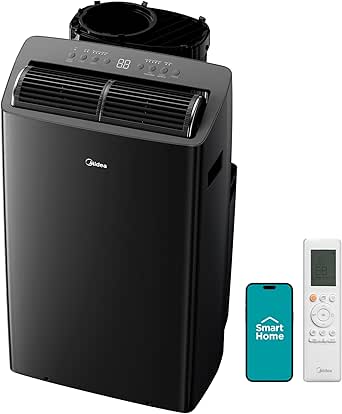 | Best Portable for Heating and Cooling | Cooling capacity: 14,000 BTU (12,000 BTU SACC) | Coverage area: Up to 550 sq. ft. | Heating and cooling: Yes | VIEW LATEST PRICE | See Our Full Breakdown |
| LG 6,000 BTU Wi-Fi Window Air Conditioner with Remote, White (LW6024RSMX) |  | Best for Small Rooms | Cooling capacity: 6,000 BTU | Coverage area: Up to 250 sq. ft. | Connectivity: Wi-Fi; LG ThinQ app | VIEW LATEST PRICE | See Our Full Breakdown |
| Hisense 8,000 BTU Window Air Conditioner with Wi-Fi and Remote, for Rooms up to 350 Sq. Ft. |  | Best for Flexible Everyday Controls | Cooling capacity: 8,000 BTU | Recommended room size: Up to 350 sq. ft. | Modes: Cooling, fan, dehumidifier | VIEW LATEST PRICE | See Our Full Breakdown |
| GE 8,000 BTU Smart Window Air Conditioner, White |  | Best for Straightforward Smart Controls | Cooling capacity: 8,000 BTU | Recommended room size: Up to 350 sq. ft. | Noise level: 58 dB | VIEW LATEST PRICE | See Our Full Breakdown |
| Windmill Lite 5,000 BTU Window Air Conditioner for Rooms up to 150 sq ft |  | Best Compact Smart Pick | Cooling capacity: 5,000 BTU | Recommended room area: Up to 150 sq. ft. | Noise level: 51 dB | VIEW LATEST PRICE | See Our Full Breakdown |
| Midea 10,000 BTU Smart Inverter Window Air Conditioner, 115V, for Rooms up to 450 Sq. Ft. |  | Best Overall for Quiet, Efficient Smart Cooling | Cooling capacity: 10,000 BTU | Coverage area: Up to 450 sq. ft. | Noise level: As low as 41 dB | VIEW LATEST PRICE | See Our Full Breakdown |
| Hisense 12,000 BTU Inverter Window Air Conditioner with Wi-Fi |  | Best for Large Rooms | Cooling capacity: 12,000 BTU | Room coverage: Up to 550 sq. ft. | Noise level: 35 dB | VIEW LATEST PRICE | See Our Full Breakdown |
| Hisense 10,000 BTU Window Air Conditioner with Wi-Fi Smart App Control | | Best for App-Controlled Dehumidifying | Cooling capacity: 10,000 BTU | Coverage area: Up to 450 sq. ft. | Noise level: 53 dB | VIEW LATEST PRICE | See Our Full Breakdown |
| LG LW1022FVSM 10,000 BTU Dual Inverter Window Air Conditioner with Wi-Fi |  | Best for Quiet Smart Cooling | Cooling power: 10,000 BTU | Coverage: Up to 450 sq. ft. | Noise level: As low as 44 dB in sleep mode | VIEW LATEST PRICE | See Our Full Breakdown |
| Midea 12,000 BTU U-Shaped Window Air Conditioner, 550 sq. ft. |  | Best for Open-Window Quiet | Cooling capacity: 12,000 BTU | Coverage: Up to 550 sq. ft. | Noise level: As low as 32 dBA | VIEW LATEST PRICE | See Our Full Breakdown |
| LG 10,000 BTU Smart Dual Inverter Window Air Conditioner |  | Best for Flexible Airflow | Cooling capacity: 10,000 BTU | Coverage: Up to 450 sq. ft. | Noise level: As low as 44 dB in sleep mode | VIEW LATEST PRICE | See Our Full Breakdown |
| Alphaappliance 10,000 BTU Portable Air Conditioner with Heating and Wi-Fi |  | Best Portable All-Season Pick | Cooling capacity: 10,000 BTU | Coverage: Up to 450 sq. ft. | Modes: Cooling, heating, fan, and dehumidifier | VIEW LATEST PRICE | See Our Full Breakdown |
| GE 14,000 BTU Smart Window Air Conditioner |  | Best for Large Rooms | Cooling capacity: 14,000 BTU | Recommended room size: Up to 700 sq. ft. | Energy certification: ENERGY STAR | VIEW LATEST PRICE | See Our Full Breakdown |
| smart air conditioner | Noise level | Cooling capacity | Dimensions and weight | Controls |
|---|---|---|---|---|
| Whynter ARC-1230WN Dual-Hose S | 42.5 dB | 14,000 BTU | 16.75 × 19.5 × 32.5 in; 77.3 lb | Digital panel, remote, Wi-Fi app, voice control |
| Midea 12,000 BTU U-Shaped Smar | As low as 32 dBA | 12,000 BTU | 19.17 × 21.97 × 13.46 in; 58.9 lb | MSmartHome app, Alexa, Google Assistant |
| Midea Duo 14,000 BTU Portable | As low as 42 dB | 14,000 BTU (12,000 BTU SACC) | 16.73 × 19.53 × 34.48 in; 77.2 lb | App, push buttons, remote, voice |
| LG 6,000 BTU Wi-Fi Window Air | 52 dB | 6,000 BTU | — | — |
| Hisense 8,000 BTU Window Air C | 49 dB | 8,000 BTU | 16.1 × 18.5 × 13 in; 45.4 lb | ConnectLife app, remote, electronic touch panel |
| GE 8,000 BTU Smart Window Air | 58 dB | 8,000 BTU | 15.31 × 18.56 × 12.63 in.; 46.2 lb. | — |
| Windmill Lite 5,000 BTU Window | 51 dB | 5,000 BTU | — | App and voice control |
| Midea 10,000 BTU Smart Inverte | As low as 41 dB | 10,000 BTU | — | App, remote, voice, and buttons |
| Hisense 12,000 BTU Inverter Wi | 35 dB | 12,000 BTU | 20.5 × 20.3 × 14.6 in.; 63.9 lb. | ConnectLife app and remote control |
| Hisense 10,000 BTU Window Air | 53 dB | 10,000 BTU | 17.52 × 18.5 × 12.99 in. (D × W × H); 50.7 lb. | Wi-Fi app, remote control, and touch panel |
| LG LW1022FVSM 10,000 BTU Dual | As low as 44 dB in sleep mode | — | — | — |
| Midea 12,000 BTU U-Shaped Wind | As low as 32 dBA | 12,000 BTU | 21.97 × 19.17 × 13.46 in. (D × W × H); 56.9 lb | — |
| LG 10,000 BTU Smart Dual Inver | As low as 44 dB in sleep mode | 10,000 BTU | 24.5 × 19.6 × 12.5 in. (D × W × H); 63 lb | — |
| Alphaappliance 10,000 BTU Port | 46 dB | 10,000 BTU | 11.02 × 12.99 × 26.97 in.; 39.7 lb | — |
| GE 14,000 BTU Smart Window Air | 63 dB | 14,000 BTU | — | SmartHQ app, voice control, and remote control |
More Details on Our Top Picks
Whynter ARC-1230WN Dual-Hose Smart Portable Air Conditioner, 14,000 BTU
The Whynter ARC-1230WN is the portable pick for larger rooms where window-unit installation is not practical. Its 14,000 BTU cooling capacity and dual-hose design are intended to cool up to 600 square feet while reducing the exchange of indoor and outdoor air. Wi-Fi app and voice controls add remote operation, and the built-in dehumidifier, auto drain, sleep mode, and timer give it more day-to-day flexibility than the window-mounted LG 6,000 BTU Wi-Fi. The tradeoff is physical: at 77.3 pounds, it is a substantial unit to reposition, and the listed window opening requirement may rule it out in some rooms. Compared with the heat-and-cool Midea Duo, this Whynter is focused on cooling and moisture removal rather than year-round temperature control.
Pros:- 14,000 BTU capacity is specified for spaces up to 600 square feet.
- Dual-hose design and inverter technology support efficient cooling.
- Wi-Fi app and voice control supplement the remote and digital panel.
- Dehumidifying mode includes auto drain, with sleep mode and a programmable timer.
Cons:- At 77.3 pounds, it is cumbersome to relocate.
- Requires a window opening that meets the listed minimum dimensions.
- Unlike the Midea Duo, it does not provide a heating mode.
Best for: Renters or homeowners who need strong smart cooling in a large room but cannot install a window air conditioner.
Not ideal for: People who need to move an air conditioner between rooms often, or whose available window opening does not meet the listed installation dimensions.
- Cooling capacity:14,000 BTU
- Coverage area:600 sq. ft.
- Dehumidification capacity:87 pints
- Noise level:42.5 dB
- Modes:Cool, dehumidify, fan
- Controls:Digital panel, remote, Wi-Fi app, voice control
- Hose configuration:Dual hose
- Dimensions and weight:16.75 × 19.5 × 32.5 in; 77.3 lb
Our verdict“Choose the Whynter for smart, high-capacity portable cooling and dehumidification, but skip it if portability or added heating matters more.”
Midea 12,000 BTU U-Shaped Smart Inverter Window Air Conditioner
The Midea 12,000 BTU U-Shaped makes its case with a combination that is uncommon in this lineup: 32 dBA operation and a window design that lets you open the sash while the unit is installed. That can make it a better fit for buyers who want fresh-air flexibility and less outdoor noise than the more conventional Hisense 8,000 BTU window model. Wi-Fi control through the MSmartHome app, Alexa, and Google Assistant also covers remote adjustments without relying on the included remote. Its 550-square-foot coverage suits larger rooms, though the unit weighs 58.9 pounds and only fits windows within specified dimensions. The portable Whynter ARC-1230WN offers more stated coverage and avoids a permanently occupied window, but it is much heavier and uses a floor-standing setup.
Pros:- U-shaped design allows the window to open while the unit remains installed.
- Rated as low as 32 dBA, with a design intended to reduce outdoor and compressor noise.
- Wi-Fi app control works with Alexa and Google Assistant.
- Cooling capacity is specified for spaces up to 550 square feet.
Cons:- Compatibility is limited to windows 22–36 inches wide with at least 13.75 inches of opening height.
- At 58.9 pounds, installation and removal may take two people.
- Window-mounted installation is less flexible than the portable Whynter ARC-1230WN.
Best for: Light sleepers and smart-home users cooling a larger room who want a quieter window unit and the option to open the window.
Not ideal for: Buyers with narrow or short windows, or anyone who wants an air conditioner that can be moved between rooms without reinstalling it.
- Cooling capacity:12,000 BTU
- Coverage:Up to 550 sq. ft.
- Noise level:As low as 32 dBA
- Cooling power:1,140 W
- Energy savings claim:Over 35% compared with traditional units
- Controls:MSmartHome app, Alexa, Google Assistant
- Window compatibility:22–36 in wide; minimum opening height 13.75 in
- Dimensions and weight:19.17 × 21.97 × 13.46 in; 58.9 lb
Our verdict“Pick this Midea if quiet operation, app control, and an openable window matter more than easy installation or room-to-room mobility.”
Midea Duo 14,000 BTU Portable Air Conditioner with Heat
The Midea Duo is the most versatile portable option here because it pairs cooling with a heat-pump heating mode. That gives it a role the cooling-focused Whynter ARC-1230WN cannot fill, making it appealing where one portable appliance needs to serve across more of the year. Its dual-hose design and inverter technology are intended to support efficient cooling, while app, voice, remote, and button controls let buyers choose how to operate it. The stated coverage is up to 550 square feet, slightly less than the Whynter’s 600-square-foot figure, and its 77.2-pound weight makes moving it a chore despite the portable format. The 42 dB noise rating is also worth weighing for bedrooms, especially against the quieter Midea U-shaped window unit.
Pros:- Provides both heating and cooling in one portable unit.
- Dual-hose design and inverter technology support efficient operation.
- App and voice control work alongside physical buttons and a remote.
- Airflow is specified to reach up to 26 feet.
Cons:- At 77.2 pounds, it is difficult to move or store.
- Its 42 dB rating is higher than the Midea U-shaped window unit’s stated 32 dBA.
- Coverage is listed at up to 550 square feet, below the Whynter ARC-1230WN’s 600-square-foot rating.
Best for: Renters or homeowners who need a portable smart unit for both summer cooling and heating in a room up to 550 square feet.
Not ideal for: People seeking a lightweight portable unit, the quietest available option, or a solution for spaces larger than its stated coverage.
- Cooling capacity:14,000 BTU (12,000 BTU SACC)
- Coverage area:Up to 550 sq. ft.
- Heating and cooling:Yes
- Noise level:As low as 42 dB
- Controls:App, push buttons, remote, voice
- Smart-home compatibility:Alexa and Google Assistant
- Airflow distance:Up to 26 ft.
- Dimensions and weight:16.73 × 19.53 × 34.48 in; 77.2 lb
Our verdict“Choose the Midea Duo if you need portable smart heating as well as cooling, and accept the weight and higher noise rating as the tradeoff.”
LG 6,000 BTU Wi-Fi Window Air Conditioner with Remote, White (LW6024RSMX)
For a bedroom, office, or other compact space, the LG 6,000 BTU Wi-Fi keeps the feature set straightforward: app and voice control, a remote, two cooling speeds, and a washable filter with a cleaning reminder. Its stated reach of up to 250 square feet makes it a better-scaled choice for small rooms than the Hisense 8,000 BTU, which is rated for up to 350 square feet. That lower capacity also means buyers should not expect it to handle a large, open living area. Compared with the more capable Midea 12,000 BTU U-Shaped, this LG is less suited to expansive rooms and lacks the window-opening design, but its 37-pound weight is easier to handle. It still requires a compatible double-hung window, so smart controls do not make installation universal.
Pros:- Sized for rooms up to 250 square feet, suiting compact spaces.
- Works with the LG ThinQ app, Amazon Alexa, and Google Assistant.
- Washable reusable filter includes a cleaning reminder.
- Includes a remote and EZ Mount installation kit.
Cons:- Its 6,000 BTU capacity is not suited to larger rooms.
- Requires a compatible double-hung window.
- Two cooling and fan speeds offer fewer settings than some larger models.
Best for: People cooling a small bedroom, home office, or similar room who want app and voice controls with simple filter maintenance.
Not ideal for: Households cooling rooms larger than 250 square feet or buyers without a compatible double-hung window.
- Cooling capacity:6,000 BTU
- Coverage area:Up to 250 sq. ft.
- Connectivity:Wi-Fi; LG ThinQ app
- Voice assistants:Amazon Alexa, Google Assistant
- Cooling and fan speeds:2
- Timer:24-hour digital on/off timer
- Noise level:52 dB
- Window fit:21–35 in wide; minimum height 12 in
Our verdict“Choose the LG for a small room where smart control and manageable installation matter more than high cooling capacity.”
Hisense 8,000 BTU Window Air Conditioner with Wi-Fi and Remote, for Rooms up to 350 Sq. Ft.
The Hisense 8,000 BTU is a practical middle ground for rooms that need more capacity than the small-room LG 6,000 BTU but not the reach of the 12,000 BTU Midea. Its listed coverage of up to 350 square feet is paired with ConnectLife app control, a remote, and a touch panel, so operating it does not depend on a phone. Cooling, fan, and dehumidifier modes cover more than temperature changes alone, while four-way air direction helps aim airflow around a room. The tradeoff is that it has no inverter, unlike the Midea 12,000 BTU U-Shaped, which is specifically built around inverter operation and a quieter design. At 49 dB, the Hisense also is not the lineup’s quietest choice, and window installation is required.
Pros:- 8,000 BTU capacity is specified for rooms up to 350 square feet.
- ConnectLife app, remote, and electronic touch panel provide multiple control options.
- Cooling, fan, and dehumidifier modes suit varied room conditions.
- Four-way air direction helps distribute airflow; the mesh filter is washable and removable.
Cons:- Does not have inverter technology, unlike the Midea U-shaped model.
- Its 49 dB noise rating is higher than the Midea U-shaped unit’s stated 32 dBA.
- Requires window installation and is less flexible than a portable model.
Best for: Buyers cooling a medium-sized bedroom or living space who want app, remote, and panel controls plus a dehumidifying mode.
Not ideal for: People prioritizing inverter technology or especially quiet operation, or anyone unable to install a window-mounted unit.
- Cooling capacity:8,000 BTU
- Recommended room size:Up to 350 sq. ft.
- Modes:Cooling, fan, dehumidifier
- Air direction:Four-way
- Controls:ConnectLife app, remote, electronic touch panel
- Noise level:49 dB
- Power:115 V; 690 W
- Dimensions and weight:16.1 × 18.5 × 13 in; 45.4 lb
Our verdict“Pick the Hisense for medium rooms and flexible controls, but choose the Midea U-shaped if quieter inverter operation is the priority.”
GE 8,000 BTU Smart Window Air Conditioner, White
The GE is a practical middle-capacity choice for rooms up to 350 sq. ft., with SmartHQ app control plus Alexa and Google Assistant compatibility. That makes it easier to adjust cooling remotely or use voice commands without stepping up to a larger, more complex unit. Compared with the Midea 10,000 BTU Smart Inverter, it gives up inverter operation and lower listed noise, but its 8,000 BTU capacity can suit a smaller room without buying more cooling than the space calls for. Eco Mode, a remote, and a washable slide-out filter cover everyday basics. The tradeoffs are a 58 dB noise level and a fixed-chassis installation that fits double-hung windows only, so check the opening before choosing it.
Pros:- SmartHQ app works with Alexa and Google Assistant
- 8,000 BTU capacity suits rooms up to 350 sq. ft.
- Eco Mode, three cooling modes, and three fan speeds offer useful control
- Washable slide-out filter and EZ Mount kit are included
Cons:- Listed noise level is 58 dB, higher than the Midea and Hisense inverter options here
- Window fit is limited to specified double-hung openings
- Non-inverter design lacks the steadier compressor operation of inverter models
Best for: People cooling a medium-size bedroom or living area who want app and voice control without needing inverter technology.
Not ideal for: Buyers with casement or other non-double-hung windows, or those prioritizing quieter operation and inverter cooling.
- Cooling capacity:8,000 BTU
- Recommended room size:Up to 350 sq. ft.
- Noise level:58 dB
- Smart control:Wi-Fi via SmartHQ; Alexa and Google Assistant compatible
- Cooling modes and fan speeds:3 modes; 3 speeds
- Window fit:Double-hung; 24.5–36 in. wide × 13.375 in. high
- Dimensions and weight:15.31 × 18.56 × 12.63 in.; 46.2 lb.
- Power:115 V; 710 W
Our verdict“Choose the GE for app-connected cooling in a medium room if your window fits and inverter performance is not a priority.”
Windmill Lite 5,000 BTU Window Air Conditioner for Rooms up to 150 sq ft
For a small bedroom, office, or studio, the Windmill Lite keeps its job focused: cool up to 150 sq. ft. and add app and voice control without the capacity of the larger units in this group. Its listed 51 dB airflow is quieter than the GE 8,000 BTU model, though the Hisense 12,000 BTU inverter is the stronger pick for larger rooms and lower listed noise. Three modes and three fan speeds give you room to adjust between cooling and simple air circulation, while the washable filter and auto-dimming LEDs suit regular bedroom use. The main compromise is capacity: this is not a good fit for an open-plan space or a room that regularly runs hot. Its window kit also requires a specific opening size.
Pros:- Compact 5,000 BTU capacity is sized for rooms up to 150 sq. ft.
- App and voice control add remote adjustment options
- Three cooling modes and three fan speeds support different uses
- Washable filter, auto-dimming LEDs, and installation kit are included
Cons:- Limited cooling capacity makes it unsuitable for medium or large rooms
- Requires a single- or double-hung window opening 14.5 in. high and 23–34 in. wide
- Listed 51 dB noise level is not as low as the Hisense 12,000 BTU inverter’s 35 dB
Best for: Renters or homeowners cooling a compact bedroom, nursery, or home office who want app and voice controls.
Not ideal for: People cooling rooms larger than 150 sq. ft. or whose window opening does not match the listed dimensions.
- Cooling capacity:5,000 BTU
- Recommended room area:Up to 150 sq. ft.
- Noise level:51 dB
- Controls:App and voice control
- Modes and fan speeds:Cool, eco, and fan; 3 speeds
- Window fit:Single- and double-hung; 14.5 in. minimum height; 23–34 in. wide
- Dimensions:14.8 × 17.8 × 15.1 in. (D × W × H)
- Power:115 V; 460 W
Our verdict“Pick the Windmill Lite for a small room where smart controls and a washable filter matter more than high capacity.”
Midea 10,000 BTU Smart Inverter Window Air Conditioner, 115V, for Rooms up to 450 Sq. Ft.
The Midea earns the strongest all-around spot by combining 10,000 BTU capacity for rooms up to 450 sq. ft. with inverter operation and a listed noise level as low as 41 dB. That gives it a more compelling balance for a bedroom or living room than the non-inverter GE 8,000 BTU, while the 12,000 BTU Hisense is better suited to spaces that need more capacity. App, remote, voice, and button controls let buyers choose how they operate it; eco mode and a 24-hour timer help shape a cooling schedule. The washable front-access filter also makes routine cleaning less awkward. Its cost in practical terms is the window footprint: installation needs a suitable standard window and can obstruct some of the opening.
Pros:- Inverter technology paired with a listed noise level as low as 41 dB
- 10,000 BTU capacity covers rooms up to 450 sq. ft.
- App, remote, voice, and button controls provide flexible operation
- 24-hour timer, eco mode, and front-access washable filter support daily use
Cons:- Window-mounted installation obstructs some of the window
- Requires a suitable standard window opening
- At 1,019 W, it draws more listed wattage than the smaller Windmill Lite
Best for: Households cooling a medium-to-large bedroom or living room that want inverter operation, quieter running, and several control options.
Not ideal for: People without a suitable standard window or those who need to keep the full window opening available.
- Cooling capacity:10,000 BTU
- Coverage area:Up to 450 sq. ft.
- Noise level:As low as 41 dB
- Inverter:Yes
- Controls:App, remote, voice, and buttons
- Modes:Auto, cool, dry, fan, and eco
- Timer and filter:24-hour timer; washable filter
- Power:115 V; 1,019 W
Our verdict“Choose the Midea for smart, inverter-driven cooling in a medium-to-large room where a window unit is workable.”
Hisense 12,000 BTU Inverter Window Air Conditioner with Wi-Fi
The Hisense is the capacity pick for buyers cooling up to 550 sq. ft., with inverter operation aimed at keeping temperatures steadier than a conventional on-off compressor. Its listed 35 dB noise level is the lowest among these five models, a useful distinction for rooms where the unit may run while people sleep or work. The ConnectLife app and included remote cover both away-from-home adjustments and straightforward local control, while four-way air direction helps distribute airflow around a larger room. Compared with the Midea 10,000 BTU, this model covers more area and lists lower noise, but it is also heavier at 63.9 lb. The added capacity comes with a tougher installation task, so it is a less comfortable choice for solo installers.
Pros:- 12,000 BTU capacity covers rooms up to 550 sq. ft.
- Inverter compressor supports steadier temperature control
- Listed 35 dB noise level is the lowest in this batch
- ConnectLife app, remote, four-way airflow, and washable filter add useful convenience
Cons:- At 63.9 lb., installation may require help
- Window installation is required and the unit is larger than the Midea 10,000 BTU
- Its higher capacity may be more than needed for compact rooms
Best for: Households with a large bedroom or living area up to 550 sq. ft. who want inverter cooling and app control.
Not ideal for: Buyers cooling a small room, installing the unit alone, or unable to use a window-mounted air conditioner.
- Cooling capacity:12,000 BTU
- Room coverage:Up to 550 sq. ft.
- Noise level:35 dB
- Inverter:Yes
- Controls:ConnectLife app and remote control
- Modes:Cooling, fan, and dehumidifier
- Dimensions and weight:20.5 × 20.3 × 14.6 in.; 63.9 lb.
- Power:115 V; 1,120 W
Our verdict“Choose the Hisense for a large room where quiet inverter cooling matters and you can manage the heavier window installation.”
Hisense 10,000 BTU Window Air Conditioner with Wi-Fi Smart App Control
This Hisense pairs 10,000 BTU cooling for rooms up to 450 sq. ft. with ConnectLife app control, a remote, and a touch panel. Its cooling, fan, and dehumidifier modes make it a flexible option for buyers who want more than temperature adjustment from a window unit. Four-way air direction is another point in its favor for spreading airflow, while the washable mesh filter keeps recurring maintenance simple. Compared with the Midea 10,000 BTU Smart Inverter, this model offers similar stated room coverage and app-based control, but the Midea adds inverter operation and a lower listed noise level. The Hisense is a more basic compressor choice at 53 dB, so it is less suited to noise-sensitive rooms or buyers focused on inverter performance.
Pros:- 10,000 BTU capacity is rated for rooms up to 450 sq. ft.
- ConnectLife app, remote, and touch panel offer three control methods
- Cooling, fan, and dehumidifier modes support different room conditions
- Four-way air direction and washable mesh filter simplify airflow adjustment and upkeep
Cons:- Listed noise level is 53 dB, above the Midea 10,000 BTU inverter’s 41 dB
- Non-inverter design is a drawback for buyers seeking inverter operation
- At 50.7 lb., installation may be difficult to handle alone
Best for: People cooling a room up to 450 sq. ft. who want app control, dehumidifying, and adjustable airflow without needing an inverter.
Not ideal for: Light sleepers or energy-conscious buyers who prefer inverter operation and quieter listed performance.
- Cooling capacity:10,000 BTU
- Coverage area:Up to 450 sq. ft.
- Noise level:53 dB
- Controls:Wi-Fi app, remote control, and touch panel
- Modes:Cooling, fan, and dehumidifier
- Air direction:Four-way
- Dimensions and weight:17.52 × 18.5 × 12.99 in. (D × W × H); 50.7 lb.
- Power:115 V; 870 W
Our verdict“Choose this Hisense if you want app control and dehumidifying for a medium-to-large room and can accept non-inverter operation.”
LG LW1022FVSM 10,000 BTU Dual Inverter Window Air Conditioner with Wi-Fi
The LG LW1022FVSM suits buyers who want app-controlled cooling without a louder, basic compressor. Its dual inverter design is rated as low as 44 dB in sleep mode, and 10,000 BTU capacity is intended for rooms up to 450 square feet. That gives it a quieter-room focus than the higher-capacity GE 14,000 BTU Smart Window Air Conditioner, which covers more space but is listed at 63 dB. LG ThinQ and voice-assistant support add convenient remote adjustments, while the washable filter keeps routine upkeep simple. The tradeoff is a fixed window installation: unlike the portable Alphaappliance, it cannot move between rooms, and its 62.8-pound weight may make fitting it a two-person job. Choose it for a suitable window and moderate-sized room, not flexible placement.
Pros:- Dual inverter design with sleep-mode noise as low as 44 dB.
- Wi-Fi control through LG ThinQ and compatibility with Alexa and Google Assistant.
- Rated for rooms up to 450 square feet.
- Washable filter and filter-cleaning reminder support routine maintenance.
Cons:- Window-only installation limits placement and portability.
- At 62.8 pounds, positioning it in a window can be difficult.
- Its 10,000 BTU capacity is less suited to large rooms than the 14,000 BTU GE model.
Best for: People cooling a bedroom or living space up to 450 square feet who want quiet sleep-mode operation and app or voice control.
Not ideal for: Renters who cannot install a window unit, buyers who need to move cooling between rooms, or anyone who cannot manage a heavy installation.
- Cooling power:10,000 BTU
- Coverage:Up to 450 sq. ft.
- Noise level:As low as 44 dB in sleep mode
- Compressor:Dual inverter
- Smart features:Wi-Fi, LG ThinQ app, Amazon Alexa and Google Assistant compatibility
- Voltage and wattage:115 V; 970 W
- Dimensions:26.97 × 19.57 × 12.36 in. (D × W × H)
- Weight and installation:62.8 lb; fixed-chassis window installation with included EZ Mount kit
Our verdict“Pick this LG for smart, quieter cooling in a medium-sized room if you can accommodate its heavy window installation.”
Midea 12,000 BTU U-Shaped Window Air Conditioner, 550 sq. ft.
The Midea 12,000 BTU U-shaped model is the standout for shoppers who want a window unit that can still leave the window partly open. Its U-shaped layout helps separate the compressor from the room, and the listed 32 dBA minimum is lower than the 44 dB sleep-mode rating of the LG LW1022FVSM. With capacity for up to 550 square feet, it also covers a larger area than either 10,000 BTU LG model. Wi-Fi, the SmartHome app, Alexa, and Google Assistant provide flexible control, while the included bracket and anti-theft lock address installation and security. Those benefits depend on having a compatible window: check the stated opening dimensions before buying. At 56.9 pounds, it is still a substantial unit to position, and its distinctive shape may not suit every window setup.
Pros:- U-shaped design helps reduce outside noise and allows the window to open.
- Inverter operation is rated as low as 32 dBA.
- Wi-Fi works with the SmartHome app, Alexa, and Google Assistant.
- Includes an installation bracket and anti-theft window lock.
Cons:- Requires a compatible window opening, listed as 22–36 inches wide and at least 13.75 inches high.
- At 56.9 pounds, it can be awkward to position during installation.
- Its 12,000 BTU capacity is less suited to the largest spaces than the 14,000 BTU GE model.
Best for: Households with compatible single- or double-hung windows that want quieter operation, a partly open window, and smart control for a larger room.
Not ideal for: Buyers with windows outside the listed dimensions, or people who want a simple fit without checking a U-shaped unit’s bracket and opening requirements.
- Cooling capacity:12,000 BTU
- Coverage:Up to 550 sq. ft.
- Noise level:As low as 32 dBA
- Inverter and refrigerant:Inverter; R-32 refrigerant
- Smart features:Wi-Fi, SmartHome app, Alexa, and Google Assistant
- Window compatibility:Single- or double-hung; 22–36 in. wide; minimum 13.75 in. high
- Voltage and wattage:115 V; 1,140 W
- Dimensions and weight:21.97 × 19.17 × 13.46 in. (D × W × H); 56.9 lb
Our verdict“Choose the Midea U-shaped unit if your window fits and low-noise operation with a partly open window matters more than straightforward installation.”
LG 10,000 BTU Smart Dual Inverter Window Air Conditioner
This LG 10,000 BTU Smart Dual Inverter is a good fit for buyers who want more control over where cool air goes, not a bigger capacity than the LG LW1022FVSM. Both LG units cover up to 450 square feet, offer ThinQ and voice control, and list sleep-mode noise at 44 dB. This model adds four-way air deflection and four cooling and fan speeds, which can help direct airflow around furniture or across a room. A 24-hour timer and auto restart make scheduled use and recovery after a power outage more convenient. The tradeoffs are familiar: it is a fixed window unit, weighs 63 pounds, and needs an opening 22–36 inches wide and 13 inches high. Choose it over the LW1022FVSM for its stated airflow and restart features, not for extra cooling capacity.
Pros:- Four-way air deflection helps direct airflow where it is needed.
- LG ThinQ, Alexa, and Google Assistant support app and voice control.
- Four cooling and fan speeds plus a 24-hour timer offer operating flexibility.
- Washable filter and auto restart simplify routine use.
Cons:- Window installation requires a 22–36-inch-wide opening at least 13 inches high.
- Its 63-pound weight can make installation difficult.
- Like the LG LW1022FVSM, it is rated for up to 450 square feet rather than larger spaces.
Best for: People cooling a medium-sized room who want adjustable airflow, multiple fan settings, app control, and automatic restart.
Not ideal for: Buyers needing portable cooling, a room larger than 450 square feet, or a lighter and easier-to-install window unit.
- Cooling capacity:10,000 BTU
- Coverage:Up to 450 sq. ft.
- Noise level:As low as 44 dB in sleep mode
- Smart features:LG ThinQ, Amazon Alexa, and Google Assistant
- Fan and airflow:Four cooling and fan speeds; four-way air deflection
- Timer and restart:24-hour timer; auto restart
- Window opening:22–36 in. wide; 13 in. high
- Dimensions and weight:24.5 × 19.6 × 12.5 in. (D × W × H); 63 lb
Our verdict“Pick this LG over its close LW1022FVSM sibling if four-way airflow and auto restart matter more to you than a different feature mix.”
Alphaappliance 10,000 BTU Portable Air Conditioner with Heating and Wi-Fi
The Alphaappliance portable AC makes the most sense when a window unit is not practical or cooling needs to move from room to room. Unlike the fixed-window LG LW1022FVSM, this unit has wheels and side handles, plus cooling, heating, fan, and dehumidifier modes for year-round use. Wi-Fi control through Tuya and compatibility with Alexa and Google Assistant add remote operation, while the washable filter and programmable timer help with everyday upkeep. Its stated coverage tops out at 450 square feet, so it is not the choice for a large open-plan area; the GE 14,000 BTU model is rated for up to 700 square feet. Portability also has limits: at 39.7 pounds it can be rolled but is still heavy to lift, and the description does not specify an installation hose or window-kit setup.
Pros:- Combines cooling, heating, fan, and dehumidifier modes.
- Tuya app and Alexa and Google Assistant compatibility provide smart control.
- Wheels and side handles make room-to-room movement easier than with fixed window units.
- Removable washable filter and two-way programmable timer support routine use.
Cons:- Coverage is limited to rooms up to 450 square feet.
- At 39.7 pounds, it is still cumbersome to lift or carry upstairs.
- The listed product details do not specify an included window installation kit.
Best for: Renters or households without a suitable window installation who want one movable unit for cooling, heating, and dehumidifying up to 450 square feet.
Not ideal for: People cooling large open rooms, buyers who want the quieter 32 dBA performance of the Midea U-shaped unit, or anyone expecting a lightweight unit to carry between floors.
- Cooling capacity:10,000 BTU
- Coverage:Up to 450 sq. ft.
- Modes:Cooling, heating, fan, and dehumidifier
- Smart connectivity:Wi-Fi, Tuya app, Amazon Alexa, and Google Assistant compatibility
- Noise level:46 dB
- Timer and filter:24-hour two-way programmable timer; removable washable filter
- Voltage and wattage:120 V; 1,104 W
- Dimensions and weight:11.02 × 12.99 × 26.97 in.; 39.7 lb
Our verdict“Choose this portable model if you need movable, multi-mode smart climate control and can accept its room-size limit and lifting weight.”
GE 14,000 BTU Smart Window Air Conditioner
When coverage matters more than hush, the GE 14,000 BTU Smart Window Air Conditioner has the broadest stated reach in this batch: up to 700 square feet. That makes it a better match for a large living area than the 10,000 BTU LG models, which are rated for 450 square feet. SmartHQ, voice control, and a remote give you several ways to adjust settings, while ENERGY STAR certification, Eco Mode, and a 24-hour timer support scheduled operation. The compromise is noise: its listed 63 dB rating is well above the 44 dB sleep-mode figures for the LG units and the Midea U-shaped model’s 32 dBA minimum. It also needs a specified double-hung window, and the standard washable filter requires regular cleaning. This is a capacity-first choice, not a quiet-bedroom pick.
Pros:- 14,000 BTU capacity is rated for rooms up to 700 square feet.
- ENERGY STAR certification and Eco Mode support energy-conscious operation.
- SmartHQ app, voice control, and included remote offer multiple control options.
- Washable slide-out filter and 24-hour timer simplify regular operation.
Cons:- Listed noise level of 63 dB is higher than the LG and Midea options in this batch.
- Fits only double-hung windows within the specified dimensions.
- Standard washable filter needs regular cleaning.
Best for: Households cooling a large room up to 700 square feet that want app and voice control through a fixed window unit.
Not ideal for: Light sleepers, buyers with windows outside the specified double-hung dimensions, or shoppers seeking a smaller, quieter unit for a bedroom.
- Cooling capacity:14,000 BTU
- Recommended room size:Up to 700 sq. ft.
- Energy certification:ENERGY STAR
- Controls:SmartHQ app, voice control, and remote control
- Cooling and fan settings:Three cooling modes; three fan speeds
- Noise level:63 dB
- Window fit:Double-hung windows; 25–36.625 in. wide × 14.563 in. high
- Voltage and wattage:115 V; 1,220 W
Our verdict“Choose the GE if you need smart cooling for a large room and can accept more noise and strict window-fit requirements.”
How We Picked
I compared these 15 models on the factors that most affect a smart-air-conditioner purchase: cooling format and room fit, smart-control usefulness, operating design, installation demands, and everyday upkeep. Capacity claims help narrow options, but they do not replace checking room dimensions, ceiling height, sunlight, insulation, and the manufacturer’s stated coverage. I also weighed practical distinctions such as inverter operation, dual-hose portable designs, window compatibility, and whether heating expands a model’s role.
The ranking favors models with a strong balance of cooling capability, connected controls, and suitability for a clearly defined buyer, rather than the highest capacity alone. The Midea U-shaped inverter window unit leads as a well-rounded fit for buyers who can install a window model; Whynter ranks highly for those who need a portable format. More specialized or less clearly differentiated options sit lower, while small-room and heating picks rank for their narrower use cases rather than broad appeal.
Factors to Consider When Choosing Best Smart Air Conditioners
Smart controls can make cooling easier, but they do not fix a mismatch between the unit, the room, and the installation. I would settle those practical questions before choosing an app ecosystem or chasing extra features.
Match Capacity to the Room, Not the Biggest Number
BTU capacity is a starting point, not a shortcut to choosing a unit. A room exposed to strong afternoon sun, frequent cooking, or several occupants may need more cooling than a shaded, lightly used room of the same size. An oversized unit can cool the air quickly without running long enough to manage humidity well, while an undersized one may run persistently without reaching a comfortable temperature. Check the maker’s room-size guidance, then account for the room’s layout and heat sources. For open-plan spaces, think about whether cooled air can reach the far end rather than relying on a single square-foot figure. I would not buy a larger model just to cover adjacent rooms unless the layout supports airflow between them.
Choose Window or Portable Before Comparing Apps
A window unit usually keeps the main appliance out of the room, while a portable model can work when a window opening, lease rule, or building design prevents a conventional installation. Portable units still need an exhaust hose routed to a window, and they take up floor space; a dual-hose design can address air exchange differently from a single-hose setup. Window units require a compatible opening, enough support, and a secure fit, so measure before ordering. Also check whether the window opens vertically or horizontally and whether the sash can close around the unit or its bracket. If moving the appliance between rooms matters, portability may be worth the setup tradeoff. If it will stay put, the window format may be less intrusive.
Treat Smart Features as a Convenience Layer
App control is most useful when you will actually use schedules, remote shutoff, or temperature changes before arriving home. Check the product’s app requirements and whether it works with your preferred voice assistant before choosing based on a smart-home badge. Wi-Fi coverage near the installation spot matters too; a unit in a weak-signal corner may be harder to control remotely. A physical remote or onboard controls remain valuable if the network is down or another household member does not use the app. Smart functions do not change the unit’s cooling capacity, and they should not outweigh room fit or noise priorities. I would favor simple, dependable controls over a longer feature list that does not solve a real routine.
Know What Inverter Operation Can and Cannot Do
Inverter models adjust compressor output rather than relying only on repeated full-power starts and stops. That can support steadier temperature control and quieter operation under some conditions, but outcomes vary with room load, settings, insulation, and how the unit is installed. Inverter design is not a substitute for correct capacity: a poorly matched unit can still struggle. Compare the manufacturer’s energy information and operating details instead of assuming every inverter model will perform identically. If the air conditioner runs for long stretches, efficiency and sound may matter more than a small difference in peak capacity. If you cool a room only briefly, room fit and fast, convenient controls may matter more to your routine.
Check Installation, Drainage, and Seasonal Upkeep
Installation affects both comfort and performance, so review the included mounting approach, unit weight, window dimensions, and any need for a second person to lift it. Portable models need an exhaust connection and may require attention to condensate handling, while window units need a stable seal to limit warm air and rain intrusion. Filters need regular cleaning; a clogged filter can restrict airflow and make cooling less effective. Before buying, locate the filter access point and read the maker’s cleaning and storage guidance. If the unit will be removed in winter, consider where it can be stored and whether the window will need repair or resealing. A model that fits your maintenance habits can be a better choice than one with extra features you rarely use.
Pay for Heating or Extra Capacity Only When You Need It
Portable models with heating can consolidate seasonal comfort equipment, but the heating function is only useful if its output and operating limits suit the space. Read the manufacturer’s specifications rather than treating a heat label as a promise that one unit will replace a home’s primary heating system. Extra cooling capacity also adds little if the room is small or the unit cannot be installed appropriately. Buyers with one large, open room may benefit from a higher-capacity option, while a bedroom or office often calls for a smaller, quieter fit. Consider how often you will use each added function and whether one appliance is easier to maintain than separate devices. Paying for versatility makes sense when it solves a recurring space or storage problem.
Frequently Asked Questions
Should I choose a portable smart air conditioner or a window unit?
I would choose a window unit when the opening is compatible and a semi-permanent installation is acceptable; it keeps the appliance from taking up floor space. A portable model makes more sense when building rules or window design prevent that setup, or when you need to move cooling between rooms. Portable units still need an exhaust hose fitted to a window, so they are not installation-free. Compare dual-hose designs such as the Whynter with other portable options if air exchange is a concern. Measure the opening and check the venting method before deciding.
Is an inverter model worth choosing for a bedroom?
It can be a good fit if the air conditioner will run for long stretches and you value steadier cooling or potentially quieter operation at lower output. Inverter construction alone does not guarantee a quiet room, so check the maker’s sound specifications and read the installation guidance carefully. A unit that is too large for the bedroom may still cycle awkwardly or create uncomfortable airflow. Match capacity to the room first, then compare inverter models such as the Midea, LG, and Hisense options in this roundup. Placement and window sealing also affect how noticeable the appliance feels.
Can I use a smart air conditioner if my Wi-Fi goes down?
App and remote access depend on the unit’s connectivity, but many models also include onboard controls or a handheld remote for basic operation. Check the product details for exactly which functions remain available without a network connection; schedules and voice commands may behave differently. If household members need dependable manual control, do not select a unit based only on its app features. A physical remote can be especially handy in bedrooms or rooms where the appliance is hard to reach. Treat Wi-Fi as a convenience layer, not the only way to operate the unit.
How do I tell whether a smart air conditioner is too powerful for my room?
Start with the manufacturer’s recommended room coverage, then account for direct sun, ceiling height, insulation, and how many people use the room. A model with much more capacity than needed may cool the air quickly but provide less consistent humidity control if it shuts off before running long enough. Room shape matters as well: a large open area may need more capacity than a similarly sized enclosed room. Avoid using BTU alone to compare models without checking the conditions behind each coverage claim. When the room sits between two size ranges, the home’s heat load and the unit’s operating design should guide the choice.
Does a smart air conditioner with heat replace a dedicated heater?
Not automatically. A heating function can add seasonal flexibility, but its output, suitable room size, and operating limits determine whether it can meet your needs. Check the manufacturer specifications and local conditions before relying on it as the main heat source. The Midea Duo and Alphaappliance models are worth comparing when a portable unit with both functions would simplify a room setup. For whole-home heating or very cold conditions, a dedicated system may still be needed. Think of the added heat as a feature to verify for your use case, not a guarantee of full replacement.
Conclusion
For most buyers who can install a window unit, I recommend the Midea 12,000 BTU U-Shaped Smart Inverter as the best overall balance in this group. The best value pick is the Midea 10,000 BTU Smart Inverter Window Air Conditioner for shoppers who need a connected inverter model at a more modest capacity. If you want a higher-capacity or more feature-led option, compare the LG 10,000 BTU Smart Dual Inverter and GE 14,000 BTU Smart Window Air Conditioner as premium-leaning choices, while checking room fit and installation first. For beginners cooling a compact room, the LG 6,000 BTU Wi-Fi model is a straightforward starting point; the Windmill Lite is a lower-capacity alternative for very small spaces. Choose the Whynter ARC-1230WN when portable dual-hose cooling matters most, or the Midea Duo and Alphaappliance when portable cooling with heating better matches your needs. Before committing, confirm the room coverage, window fit, controls, and upkeep requirements for the specific model.