Complete the kit



Get home appliances delivered free with Prime
- Fast, free delivery on millions of items
- Prime Video, Amazon Music and more included
- Member-only deals all year
Key Takeaways
- Self-emptying bases are no longer a luxury but a standard expectation for mid-range models, significantly reducing maintenance frequency.
- High suction power specifications (above 10,000 Pa) often yield diminishing returns on hard floors compared to mid-range units with better brush designs.
- AI obstacle avoidance in premium models like the Shark AV2501AE effectively eliminates the need for pre-cleaning floor clutter, unlike older LiDAR-only systems.
- Budget models with random navigation strategies remain viable for small, cluttered apartments where detailed mapping is less critical than basic coverage.
- Mopping integration is improving, but only models with vibrating or rotating mop pads show meaningful improvement over static drag mops in this lineup.
| Shark AV2501AE AI Robot Vacuum with XL HEPA Self-Empty Base |  | Best for Allergy-Conscious Homes | Navigation: 360° LiDAR with Matrix Clean | Self-empty capacity: Up to 60 days | Filter: HEPA; captures 99.97% of dust and allergens down to 0.3 microns | VIEW LATEST PRICE | See Our Full Breakdown |
| LVKANGDA D17S MAX Robot Vacuum and Mop with Self-Emptying Base |  | Best for Multi-Floor Homes | Suction: Up to 12,000 Pa | Navigation: dToF LiDAR | Map storage: Up to 5 maps | VIEW LATEST PRICE | See Our Full Breakdown |
| iMartine D16S MAX Robot Vacuum and Mop with 18,000 Pa Suction and Self-Emptying Base |  | Best for High-Suction Cleaning | Maximum suction: 18,000 Pa | Self-empty base capacity: 1.3 liters | Water tank capacity: 150 ml | VIEW LATEST PRICE | See Our Full Breakdown |
| ILIFE V2 Robot Vacuum Cleaner |  | Best for Simple, Low-Profile Cleaning | Profile height: 2.99 inches | Runtime: Up to 120 minutes | Dust capacity: 300 ml | VIEW LATEST PRICE | See Our Full Breakdown |
| iRobot Roomba 105 Combo Robot Vacuum and Mop |  | Best for Carpet-Safe Mopping | Cleaning modes: Vacuum, mop, or vacuum and mop | Navigation: ClearView LiDAR | Carpet detection: Avoids carpets while mopping | VIEW LATEST PRICE | See Our Full Breakdown |
| Roborock Q7 M5+ Robot Vacuum and Mop, Up to 7-9 Weeks Hands-Free Self-Empty, 10000 Pa |  | Best for Pet Hair with Less Upkeep | Suction power: 10,000 Pa | Dust bag capacity: 2.7 liters | Battery life: 150 minutes | VIEW LATEST PRICE | See Our Full Breakdown |
| ROPVACNIC Robot Vacuum and Mop Combo, 5200Pa |  | Best for Flexible, Simple Controls | Suction power: 5,200 Pa | Battery life: 120 minutes | Surface recommendation: Hardwood floors and low-pile carpets | VIEW LATEST PRICE | See Our Full Breakdown |
| iMartine BR151 Robot Vacuum and Mop |  | Best for Compact, Basic 2-in-1 Cleaning | Model: BR151 | Battery life: 100 minutes | Dustbin capacity: 200 ml | VIEW LATEST PRICE | See Our Full Breakdown |
| Roborock Q7 L5 Robot Vacuum and Mop Combo – 8,000 Pa Suction |  | Best for Mapped Cleaning Without a Self-Empty Base | Suction power: 8,000 Pa | Navigation: 360° LiDAR laser mapping | Water tank capacity: 270 ml | VIEW LATEST PRICE | See Our Full Breakdown |
| Shark AV2501S AI Ultra Robot Vacuum with Self-Empty Base |  | Best for Allergy-Focused, Bagless Self-Emptying | Navigation: Matrix Clean with 360° LiDAR mapping | Base capacity: Up to 30 days of dirt and debris | Runtime: Up to 120 minutes | VIEW LATEST PRICE | See Our Full Breakdown |
| Tikom L8000 Plus Robot Vacuum and Mop with Self-Emptying Base |  | Best Self-Emptying Value | Suction Power: Up to 6000 Pa | Navigation: 360° LiDAR | Dustbag Capacity: 3 L | VIEW LATEST PRICE | See Our Full Breakdown |
| iRobot Roomba Plus 575 Robot Vacuum and Mop Combo |  | Best Premium Compact | Suction Power: 25,000 Pa | Size Reduction: 46% smaller than previous models | Auto-Empty Duration: Up to 90 days | VIEW LATEST PRICE | See Our Full Breakdown |
| ILIFE A30s Robot Vacuum, 10,000 Pa Max Suction, White |  | Best Pure Vacuum Performance | Suction Power: 10,000 Pa | Navigation: LiDAR + SLAM | Dustbin Capacity: 500 ml | VIEW LATEST PRICE | See Our Full Breakdown |
| Lefant M210 Robot Vacuum Cleaner |  | Best Budget Starter | Diameter: 11 inches | Noise Level: 52 dB | Battery Life: 120 minutes (low mode) | VIEW LATEST PRICE | See Our Full Breakdown |
| Tikom G8000 Max Robot Vacuum and Mop Combo |  | Best Simultaneous Cleaner | Suction Power: 5000 Pa | Height: 2.99 inches | Dustbin Capacity: 450 ml | VIEW LATEST PRICE | See Our Full Breakdown |
| robot vacuum cleaner | Navigation | Battery life |
|---|---|---|
| Shark AV2501AE AI Robot Vacuum | 360° LiDAR with Matrix Clean | — |
| LVKANGDA D17S MAX Robot Vacuum | dToF LiDAR | — |
| iMartine D16S MAX Robot Vacuum | — | — |
| ILIFE V2 Robot Vacuum Cleaner | — | — |
| iRobot Roomba 105 Combo Robot | ClearView LiDAR | Up to 100 minutes |
| Roborock Q7 M5+ Robot Vacuum a | PreciSense LiDAR | 150 minutes |
| ROPVACNIC Robot Vacuum and Mop | — | 120 minutes |
| iMartine BR151 Robot Vacuum an | Infrared obstacle avoidance | 100 minutes |
| Roborock Q7 L5 Robot Vacuum an | 360° LiDAR laser mapping | 150 minutes |
| Shark AV2501S AI Ultra Robot V | Matrix Clean with 360° LiDAR mapping | — |
| Tikom L8000 Plus Robot Vacuum | 360° LiDAR | Up to 150 minutes |
| iRobot Roomba Plus 575 Robot V | AI PrecisionVision LiDAR | — |
| ILIFE A30s Robot Vacuum | LiDAR + SLAM | 150 minutes |
| Lefant M210 Robot Vacuum Clean | — | 120 minutes (low mode) |
| Tikom G8000 Max Robot Vacuum a | — | Up to 150 minutes |
More Details on Our Top Picks
Shark AV2501AE AI Robot Vacuum with XL HEPA Self-Empty Base
The Shark AV2501AE is the strongest fit here for buyers who want hands-off debris handling without disposable bags. Its XL base stores up to 60 days of debris, and the HEPA filter captures fine dust and allergens, a useful distinction from the simpler filter setup on the ILIFE V2. LiDAR mapping and Matrix Clean navigation support more deliberate coverage than the V2’s basic cleaning modes, while Alexa and Google Assistant add convenient voice control.
The tradeoff is that this is a vacuum-only model, unlike the LVKANGDA D17S MAX and iRobot Roomba 105 Combo, which can mop as well. Its listed runtime is up to 120 minutes and only one power level is specified, so buyers with large homes or varied cleaning needs may prefer a more adjustable robot.
Pros:- Bagless self-empty base holds up to 60 days of debris.
- HEPA filtration captures 99.97% of dust and allergens down to 0.3 microns.
- 360° LiDAR and Matrix Clean navigation support mapped, methodical cleaning.
- Voice control works with Amazon Alexa and Google Assistant.
Cons:- Vacuum-only design lacks the mopping option offered by the LVKANGDA D17S MAX and Roomba 105 Combo.
- Runtime is listed at up to 120 minutes, shorter than the D17S MAX and iMartine D16S MAX.
- Only one power level is listed, limiting cleaning adjustments.
Best for: Households with allergy concerns that want mapped vacuuming and a bagless self-empty base with infrequent debris handling.
Not ideal for: Buyers who want mopping, multiple suction settings, or longer listed runtime for larger floor plans.
- Navigation:360° LiDAR with Matrix Clean
- Self-empty capacity:Up to 60 days
- Filter:HEPA; captures 99.97% of dust and allergens down to 0.3 microns
- Runtime:Up to 120 minutes
- Cleaning path width:5.67 inches
- Surfaces:Carpet and hard floor
- Controls:App and voice control; compatible with Amazon Echo and Google Home
Our verdict“Choose the Shark AV2501AE if allergen filtration and low-contact, bagless debris disposal matter more than mopping or adjustable suction.”
LVKANGDA D17S MAX Robot Vacuum and Mop with Self-Emptying Base
The LVKANGDA D17S MAX earns its place for homes where one robot needs to handle several levels. Its dToF LiDAR stores up to five maps, while no-go zones and app-controlled water flow help tailor cleaning to different rooms and floors. It also combines vacuuming with mopping, and automatic recharging and cleaning resumption help it finish larger jobs. Compared with the Shark AV2501AE, it offers more cleaning modes and map storage, but the Shark has HEPA filtration and a clearly stated 60-day bagless base capacity.
The D17S MAX lists up to 12,000 Pa suction and carpet boost, though its 300 ml water tank may need refilling during extensive mopping. The title claims up to 90 days of self-emptying, but the supplied specs do not state the base capacity. Buyers wanting the larger stated onboard water tank of the Roomba 105 Combo should compare those needs carefully.
Pros:- Stores up to five floor maps and supports no-go zones.
- Combines vacuuming and mopping with adjustable water flow.
- Up to 12,000 Pa suction and automatic carpet boost support varied floor surfaces.
- Automatically recharges and resumes cleaning.
Cons:- The 300 ml water tank may require refills during larger mopping jobs.
- The supplied specs do not give the self-empty base capacity, despite the title’s 90-day claim.
- At 11.9 pounds, it is heavier than the listed ILIFE V2.
Best for: Owners of multi-level homes who want one mapped robot for vacuuming, mopping, and room-specific restrictions.
Not ideal for: Buyers who prioritize a documented large self-empty capacity, a larger water tank, or a simpler vacuum-only setup.
- Suction:Up to 12,000 Pa
- Navigation:dToF LiDAR
- Map storage:Up to 5 maps
- Runtime:Up to 160 minutes
- Dustbox capacity:250 ml
- Water tank capacity:300 ml
- Cleaning coverage:Up to 200 m²
- Dimensions:12.99 × 12.99 × 3.94 inches
Our verdict“Pick the D17S MAX for multi-floor mapping and combined cleaning, but not if a clearly specified large dock or roomy water tank is your priority.”
iMartine D16S MAX Robot Vacuum and Mop with 18,000 Pa Suction and Self-Emptying Base
The iMartine D16S MAX stands out for buyers who want high listed suction and adjustable cleaning in a vacuum-and-mop robot. It offers up to 18,000 Pa, four suction levels, three water-flow settings, and six cleaning modes, giving it more ways to adapt than the ILIFE V2, which has one power level and no mop. Its 5200 mAh battery and up to 180-minute runtime also make it better suited to longer sessions than the Shark AV2501AE’s listed 120 minutes. LiDAR map storage for up to five floors adds flexibility for multi-level homes.
The tradeoff is a small 150 ml water tank, so mopping may call for more frequent refills than with the LVKANGDA D17S MAX’s 300 ml tank. The 1.3-liter self-empty base offers convenient debris collection, but the product requires 2.4 GHz Wi-Fi, and its filter cotton is not washable.
Pros:- Up to 18,000 Pa suction with four selectable levels.
- Stores up to five LiDAR maps and supports six cleaning modes.
- Up to 180 minutes of runtime with automatic recharge and resume.
- Bagless self-empty base has a 1.3-liter capacity.
Cons:- The 150 ml water tank is smaller than the D17S MAX’s 300 ml tank.
- Requires a 2.4 GHz Wi-Fi network for connected controls.
- Filter cotton is not washable.
Best for: Buyers with mixed flooring who want high adjustable suction, long listed runtime, and maps for multiple floors.
Not ideal for: People who need a large-capacity water tank, washable filter components, or a robot that works without 2.4 GHz Wi-Fi.
- Maximum suction:18,000 Pa
- Self-empty base capacity:1.3 liters
- Water tank capacity:150 ml
- Battery capacity:5200 mAh
- Runtime:Up to 180 minutes
- Map storage:Up to 5 floor maps
- Cleaning modes:6
- Connectivity:2.4 GHz Wi-Fi; Tuya Smart or Smart Life app, Alexa, and Google Assistant
Our verdict“Choose the iMartine D16S MAX if suction adjustment and long cleaning sessions matter more than mopping capacity or washable filter parts.”
ILIFE V2 Robot Vacuum Cleaner
The ILIFE V2 is the straightforward pick for buyers who want routine floor pickup without app setup or a self-empty dock. Its 2.99-inch profile can reach under some low furniture, and the tangle-free suction port is designed to handle pet hair. Remote control, scheduled cleaning, and automatic return to the charging dock cover the basics without requiring Wi-Fi. Compared with the Shark AV2501AE, it gives up LiDAR mapping, HEPA filtration, and automatic debris collection; in return, it keeps the controls simple and the design slim.
This is a hard-floor and low-pile-carpet option, not the best match for thick rugs or shoppers seeking adjustable suction. Its sponge filter and 300 ml dust capacity are more basic than the filtration and self-emptying systems on the Shark and iMartine D16S MAX. The 120-minute maximum runtime is useful for everyday upkeep, though it does not match the iMartine’s longer listed runtime.
Pros:- Slim 2.99-inch profile can fit under some beds and sofas.
- Tangle-free suction port is designed for pet hair pickup.
- Remote control and scheduling work without Wi-Fi.
- Automatically returns to its charging dock.
Cons:- Recommended for hard floors and low-pile carpet, limiting use on thicker rugs.
- One power level offers less adjustment than the iMartine D16S MAX.
- Sponge filter and onboard dust capacity lack the allergen-focused filtration and debris storage of the Shark AV2501AE.
Best for: Pet owners in smaller homes with hard floors or low-pile carpet who prefer remote control over app-connected features.
Not ideal for: Homes with thick carpet, allergy-focused buyers who want HEPA filtration, or anyone seeking mopping and self-emptying.
- Profile height:2.99 inches
- Runtime:Up to 120 minutes
- Dust capacity:300 ml
- Cleaning modes:Auto, spot, and edge
- Control:Remote control
- Filter:Sponge
- Noise level:69 dB
- Dimensions:12.2 × 12.2 × 2.99 inches
Our verdict“Pick the ILIFE V2 for simple, slim cleaning on hard floors and low-pile rugs, and skip it if you need mapping, mopping, or deeper feature control.”
iRobot Roomba 105 Combo Robot Vacuum and Mop
The Roomba 105 Combo is a strong match for households that want vacuuming and mopping without wetting rugs. Its carpet detection avoids carpet while mopping, and buyers can choose vacuum-only, mop-only, or combined cleaning. ClearView LiDAR supports room mapping and keep-out zones, giving it more structured navigation than the ILIFE V2’s basic auto, spot, and edge modes. A reusable microfiber pad also avoids relying on disposable mop pads.
Compared with the LVKANGDA D17S MAX, the Roomba offers an explicitly stated 0.5-liter capacity and carpet avoidance during mop runs, while the D17S MAX lists longer runtime and up to five stored floor maps. The Roomba’s battery life is up to 100 minutes, and it requires 2.4 GHz Wi-Fi for connected features. Buyers wanting a self-emptying base should instead look at the Shark AV2501AE or iMartine D16S MAX.
Pros:- Carpet detection avoids rugs while the robot is mopping.
- Offers vacuum-only, mop-only, and combined cleaning modes.
- ClearView LiDAR supports mapping, room targeting, and keep-out zones.
- Reusable microfiber mop pad supports repeated use.
Cons:- Up to 100 minutes of battery life is shorter than the D17S MAX and iMartine D16S MAX.
- Requires 2.4 GHz Wi-Fi for connected operation.
- No self-emptying base is listed, unlike the Shark AV2501AE and iMartine D16S MAX.
Best for: Homes with a mix of rugs and hard floors where owners want one robot to vacuum and mop while keeping carpets dry.
Not ideal for: Buyers who need a self-emptying dock, longer listed runtime, or Wi-Fi compatibility beyond 2.4 GHz.
- Cleaning modes:Vacuum, mop, or vacuum and mop
- Navigation:ClearView LiDAR
- Carpet detection:Avoids carpets while mopping
- Battery life:Up to 100 minutes
- Capacity:0.5 liters
- Connectivity:2.4 GHz Wi-Fi
- Controls:App, buttons, and voice control
- Surfaces:Carpet and hard floor
Our verdict“Choose the Roomba 105 Combo if carpet-safe mopping and three cleaning modes matter more than self-emptying or longer runtime.”
Roborock Q7 M5+ Robot Vacuum and Mop, Up to 7-9 Weeks Hands-Free Self-Empty, 10000 Pa
I’d choose the Roborock Q7 M5+ when pet hair and fewer dustbin chores matter more than having the most hands-off setup in the group. Its 10,000 Pa suction and dual anti-tangle brushes are aimed at lifting hair from carpets while reducing brush cleanup; the RockDock Plus adds up to 7–9 weeks of self-emptying. Compared with the Roborock Q7 L5, this model adds that self-emptying convenience, while the L5 offers LiDAR mapping and mopping without a listed self-empty base. PreciSense LiDAR helps it follow mapped routes, and its mop is useful for routine hard-floor maintenance rather than a replacement for scrubbing. The tradeoffs are 2.4 GHz-only Wi-Fi, noticeable 65 dB operation, and a 150-minute runtime that may not cover a larger home in one session.
Pros:- RockDock Plus holds a 2.7-liter dust bag and supports up to 7–9 weeks of hands-free emptying.
- 10,000 Pa suction and dual anti-tangle brushes suit homes with pet hair and carpets.
- PreciSense LiDAR maps rooms for organized cleaning routes.
- Vacuuming and mopping are combined in one cleaning routine.
Cons:- Wi-Fi connectivity is limited to 2.4 GHz.
- The listed 65 dB noise level may be noticeable during cleaning.
- 150 minutes of battery life may require a recharge in larger homes.
Best for: Pet owners with a mix of carpet and hard flooring who want mapped cleaning and less frequent dustbin emptying.
Not ideal for: People with large homes that need longer uninterrupted runs, or households whose Wi-Fi setup depends on 5 GHz only.
- Suction power:10,000 Pa
- Dust bag capacity:2.7 liters
- Battery life:150 minutes
- Navigation:PreciSense LiDAR
- Noise level:65 dB
- Power levels:4
- Cleaning path width:12.8 inches
- Floor types:Wood, tile, marble, and carpet
Our verdict“Choose the Q7 M5+ if you want strong pet-hair pickup, mapped routes, and a self-empty base without stepping up to a more elaborate setup.”
ROPVACNIC Robot Vacuum and Mop Combo, 5200Pa
The ROPVACNIC Robot Vacuum and Mop Combo is the control-flexible pick for homes that want basic vacuuming and adjustable mopping without relying on one app. It supports an app, remote, touchpad, and voice control, plus three suction levels and four-stage water adjustment. That makes it easier to tailor a cleaning run to hardwood or low-pile carpet than the more specialized Roborock Q7 L5, whose appeal leans on LiDAR mapping and customizable no-go zones. ROPVACNIC’s obstacle navigation and automatic return-to-charge support routine maintenance, and its tangle-resistant design is useful around pet hair. The tradeoff is that its 5,200 Pa suction and low-pile carpet recommendation make it a less convincing choice for thick carpet or heavy debris. No self-emptying base is listed, so bin upkeep stays with you.
Pros:- Offers app, remote, touchpad, and voice control.
- Four-stage water adjustment and three suction levels allow basic cleaning customization.
- Obstacle navigation and automatic return to recharge support scheduled upkeep.
- Tangle-resistant design and dual side brushes help collect pet hair.
Cons:- Low-pile carpet is the stated carpet fit, limiting its appeal for carpet-heavy homes.
- No self-emptying feature is listed, so the dustbin needs manual attention.
- 5,200 Pa suction is lower than the Roborock Q7 M5+ and Q7 L5.
Best for: Households with mostly hardwood or other hard floors that want multiple control options and adjustable water flow.
Not ideal for: Owners of thick-carpeted homes or buyers who want LiDAR mapping, no-go zones, or a self-emptying base.
- Suction power:5,200 Pa
- Battery life:120 minutes
- Surface recommendation:Hardwood floors and low-pile carpets
- Control methods:App, remote, touchpad, and voice
- Voice compatibility:Amazon Echo and Google Home
- Suction levels:3
- Water adjustment:4 stages
- Filter:Multi-layer high-efficiency filtration
Our verdict“Pick ROPVACNIC for adaptable controls and routine hard-floor cleaning, but skip it if carpet performance or mapped room control is your priority.”
iMartine BR151 Robot Vacuum and Mop
The iMartine BR151 makes the most sense for a smaller, hard-floor-focused home that needs straightforward vacuuming and mopping in one pass. Its 200 ml dustbin and 230 ml water tank keep the machine compact, while Auto, Spot, Edge, and Zig-zag modes cover common cleaning jobs. Compared with the ROPVACNIC Robot Vacuum and Mop Combo, the BR151 lists a longer 100-minute run and washable three-layer filtration, but ROPVACNIC offers more control methods and a longer stated runtime. The BR151’s infrared obstacle avoidance is less precise on paper than the Roborock Q7 L5’s LiDAR mapping, so it is better suited to simpler layouts than homes that need carefully mapped routes. Its low-pile carpet limit and a non-washable filter-cotton component also mean it is not a low-maintenance choice for every surface.
Pros:- Can vacuum and mop simultaneously to cover routine hard-floor cleanup in one run.
- Supports Alexa, Google Assistant, and the Tuya Smart App.
- Offers Auto, Spot, Edge, and Zig-zag cleaning modes.
- Automatic recharge and resume support help it continue a cleaning task.
Cons:- Infrared obstacle avoidance is less precise than the LiDAR mapping on the Roborock Q7 L5.
- Recommended for hard floors and low-pile carpets, limiting its use on thicker carpet.
- The filter-cotton component is not washable.
Best for: Apartment dwellers with mostly hard floors who want an entry-level vacuum-and-mop routine, app scheduling, and voice-assistant support.
Not ideal for: People with thick carpets, complex floor plans, or a preference for fully washable filtration and more precise mapping.
- Model:BR151
- Battery life:100 minutes
- Dustbin capacity:200 ml
- Water tank capacity:230 ml
- Navigation:Infrared obstacle avoidance
- Cleaning modes:Auto, Spot, Edge, and Zig-zag
- Suction levels:3 adjustable levels
- Water control:2 levels
- Connectivity:Tuya Smart App, Alexa, and Google Assistant
Our verdict“Choose the BR151 for basic, compact hard-floor maintenance, but favor a LiDAR model if your rooms need more deliberate navigation.”
Roborock Q7 L5 Robot Vacuum and Mop Combo – 8,000 Pa Suction
I’d put the Roborock Q7 L5 ahead of simpler combo robots when room mapping and targeted cleaning matter more than reducing bin chores. Its 360° LiDAR mapping, multi-floor support, and customizable no-go zones help direct cleaning around furniture and restricted areas; the 8,000 Pa suction and dual anti-tangle brushes give it a stronger pet-hair profile than the ROPVACNIC Combo. It also vacuums and mops in the same routine, with a 270 ml water tank. Unlike the Roborock Q7 M5+, though, the L5 has no listed self-emptying dock, so you’ll empty its bin yourself. Its 150-minute battery life and washable filter add practical value, but 2.4 GHz-only Wi-Fi may complicate setup for some networks, and 60 dB operation can be heard while it cleans.
Pros:- LiDAR mapping supports multi-floor navigation and customizable no-go zones.
- 8,000 Pa suction and dual anti-tangle brushes suit homes with pet hair.
- Vacuums and mops simultaneously with a 270 ml water tank.
- Washable filter and 150-minute battery life support ongoing routine use.
Cons:- No self-emptying base is listed, so the robot’s dustbin requires manual emptying.
- Wi-Fi requirement is limited to 2.4 GHz.
- Listed noise level of 60 dB may be noticeable during a cleaning run.
Best for: Pet owners in multi-floor homes who want mapped routes, no-go zones, and combined vacuuming and mopping without a self-empty dock.
Not ideal for: Buyers who want dustbin emptying automated, or households using a 5 GHz-only Wi-Fi network.
- Suction power:8,000 Pa
- Navigation:360° LiDAR laser mapping
- Water tank capacity:270 ml
- Battery life:150 minutes
- Noise level:60 dB
- Filter:Washable
- Wi-Fi requirement:2.4 GHz
- Surface recommendation:Carpet, laminate, tile, vinyl, wood, and marble
Our verdict“Choose the Q7 L5 if precise mapping and pet-hair pickup matter more than the hands-free emptying offered by the Q7 M5+.”
Shark AV2501S AI Ultra Robot Vacuum with Self-Empty Base
The Shark AV2501S AI Ultra is the strongest fit here for buyers who want a self-emptying vacuum and prioritize HEPA filtration on both carpets and hard floors. Its Matrix Clean navigation pairs with 360° LiDAR mapping to organize coverage, while the self-cleaning brushroll is designed to handle pet hair with less wrap. Compared with the Roborock Q7 M5+, Shark lists a bagless base that holds up to 30 days of debris rather than a sealed 2.7-liter dust bag with a longer stated emptying interval. That can suit shoppers who prefer avoiding disposable bags, though the stated 0.09-liter capacity and 120-minute runtime make this less compelling for extended, uninterrupted cleaning. It is a vacuum-focused option, unlike the Roborock models here that also offer mopping.
Pros:- HEPA filtration is designed to capture dust and allergens.
- Self-emptying base holds up to 30 days of dirt and debris.
- 360° LiDAR mapping and Matrix Clean support organized coverage.
- Self-cleaning brushroll is suited to pet-hair pickup.
Cons:- Up to 120 minutes of runtime may not cover larger homes in one run.
- The listed capacity is 0.09 liters, a limitation for debris storage.
- Unlike the Roborock Q7 M5+ and Q7 L5, it does not offer mopping.
Best for: Pet-owning households with carpets and hard floors that want HEPA filtration and a bagless self-emptying base.
Not ideal for: Buyers who need a mop, longer cleaning runs, or a clearly large onboard dustbin for debris between base emptying.
- Navigation:Matrix Clean with 360° LiDAR mapping
- Base capacity:Up to 30 days of dirt and debris
- Runtime:Up to 120 minutes
- Filtration:HEPA
- Base type:Bagless self-emptying base
- Brushroll:Self-cleaning
- Surface compatibility:Carpets and hard floors
- Control:App and voice control
- Voice compatibility:Amazon Alexa and Google Home
Our verdict“Pick the AV2501S if HEPA filtration and bagless self-emptying are your priorities, but choose a Roborock option if you also need mopping.”
Tikom L8000 Plus Robot Vacuum and Mop with Self-Emptying Base
This model stands out for offering LiDAR navigation and a 3L self-emptying base at a price point significantly lower than premium competitors like the Roborock Q7 M5+. While the Roborock offers more refined obstacle avoidance, the Tikom delivers solid mapping capabilities that prevent the random bumping seen in cheaper bots. The 6000 Pa suction is adequate for hard floors and low-pile carpets, though it lacks the raw power of the iRobot Roomba Plus 575. A key tradeoff is the mop management; you must manually remove the mop pad for carpet cleaning, which is less convenient than auto-lifting systems. However, for users wanting hands-free dust disposal without paying for AI vision, this is a strong contender.Pros:- LiDAR navigation creates accurate maps for up to 5 floors
- Self-emptying base holds 3L of dust for weeks of hands-free use
- Dual-band Wi-Fi support (2.4/5 GHz) improves connection stability
Cons:- Mop pad must be manually removed before vacuuming carpets
- 150-minute runtime drops significantly on max suction mode
Best for: Pet owners on a budget who want LiDAR accuracy and self-emptying convenience
Not ideal for: Users with thick shag carpets who need automatic mop lifting
- Suction Power:Up to 6000 Pa
- Navigation:360° LiDAR
- Dustbag Capacity:3 L
- Battery Life:Up to 150 minutes
- Wi-Fi Connectivity:2.4 GHz and 5 GHz
- Saved Maps:Up to 5 floors
- Noise Level:60 dB
- Filter Type:HEPA
Our verdict“A balanced choice for those prioritizing mapping and self-emptying over advanced obstacle avoidance.”
iRobot Roomba Plus 575 Robot Vacuum and Mop Combo
The Roomba Plus 575 redefines compact power with 25,000 Pa suction and a body that is 46% smaller than previous models. This size reduction allows it to clean under furniture where bulkier units like the Lefant M210 might struggle or miss edges. The SmartScrub DualClean system actively scrubs dried spills, a feature the Tikom L8000 Plus lacks entirely. While the AutoWash dock offers up to three months of autonomy, the advanced tech comes at a premium. It is the superior choice for small, cluttered homes needing deep cleaning, but those with open floor plans and lower budgets should look at the ILIFE A30s for similar suction power without the dock complexity.Pros:- Ultra-compact design fits under low-clearance furniture easily
- 25,000 Pa suction provides exceptional deep-cleaning power
- AutoWash dock washes and dries mop pads automatically
Cons:- Higher price point compared to standard LiDAR models
- Advanced features may be overkill for simple hard-floor homes
Best for: Owners of small, cluttered homes needing high suction and compact size
Not ideal for: Budget-conscious buyers who don’t need auto-washing mop pads
- Suction Power:25,000 Pa
- Size Reduction:46% smaller than previous models
- Auto-Empty Duration:Up to 90 days
- Mop Pad Lift Height:10 mm
- Threshold Climbing:35 mm
- Edge Coverage:18% increase
- Navigation:AI PrecisionVision LiDAR
Our verdict“A high-end compact solution for those who need maximum power in a small footprint.”
ILIFE A30s Robot Vacuum, 10,000 Pa Max Suction, White
For users who prioritize vacuuming over mopping, the ILIFE A30s offers 10,000 Pa suction that rivals many combo units. It lacks the water tank found in the Tikom G8000 Max, but this simplifies maintenance and reduces the risk of wet carpets. The LiDAR + SLAM mapping ensures efficient coverage, avoiding the chaotic patterns of older bump-style bots. Compared to the Lefant M210, the ILIFE provides smarter navigation and stronger suction, making it better for mixed flooring. However, the 500 ml dustbin requires more frequent emptying than self-emptying bases like the Shark AV2501AE. It is an ideal middle-ground for tech-savvy users who want smart mapping without paying for mopping features they won’t use.Pros:- 10,000 Pa suction effectively handles pet hair and debris
- LiDAR and SLAM mapping ensures systematic and efficient cleaning
- Dual anti-tangle brush prevents hair wrap issues
Cons:- No mopping function limits versatility on hard floors
- 500 ml dustbin requires manual emptying more often than self-empty models
Best for: Households with mixed flooring who prefer a dedicated vacuum over a combo
Not ideal for: Users who need mopping capabilities or hands-free dust disposal
- Suction Power:10,000 Pa
- Navigation:LiDAR + SLAM
- Dustbin Capacity:500 ml
- Battery Life:150 minutes
- Noise Level:72 dB
- Wi-Fi Band:2.4 GHz only
- Control Methods:App, Voice, Remote
- Surface Compatibility:Hard Floor, Carpet
Lefant M210 Robot Vacuum Cleaner
The Lefant M210 is an entry-level option defined by its 11-inch diameter and 52 dB noise level, making it unobtrusive and capable of fitting under tight spaces. Unlike the ILIFE A30s, it uses random navigation rather than LiDAR, which means it misses spots and requires more passes to clean a room fully. It is significantly quieter than the Tikom G8000 Max but lacks the suction power (1100 ft max suction vs 5000 Pa) needed for deep carpet cleaning. This model is best for small apartments with mostly hard floors where occasional spot cleaning is sufficient. It serves as a low-risk introduction to robot vacuums, but users with larger homes or pets should upgrade to the Tikom L8000 Plus for better coverage and power.Pros:- Compact 11-inch size accesses tight spaces under furniture
- Ultra-quiet 52 dB operation is suitable for daytime use
- Affordable entry point into robot vacuum ownership
Cons:- Random navigation misses spots and cleans less efficiently than LiDAR models
- Lower suction power struggles with embedded pet hair on carpets
Best for: Small apartment dwellers with hard floors who need a quiet, compact bot
Not ideal for: Large homes or carpeted areas requiring systematic mapping and high suction
- Diameter:11 inches
- Noise Level:52 dB
- Battery Life:120 minutes (low mode)
- Dustbin Capacity:500 ml
- Navigation Type:Random/Obstacle Avoidance
- Control Method:App, Alexa, Google Home
- Surface Recommendation:Wood, Hard Floor, Low Pile Carpet
Our verdict“A quiet, compact starter bot for small hard-floor spaces, but lacks smart navigation.”
Tikom G8000 Max Robot Vacuum and Mop Combo
The Tikom G8000 Max distinguishes itself by vacuuming and mopping simultaneously, a feature that saves time compared to the sequential cleaning often required by basic models. With 5000 Pa suction and a slim 2.99-inch profile, it navigates under furniture better than taller units like the Roomba Plus 575. However, it lacks the self-emptying base found in the Tikom L8000 Plus, meaning you must manually empty the 450 ml dustbin after every run. The 45 dB noise level is impressive for a combo unit, quieter than the ILIFE A30s. This model is ideal for users who want a true two-in-one experience without the bulk of a dock, but those who dislike manual maintenance will find the lack of auto-emptying a significant drawback compared to premium options.Pros:- Simultaneous vacuuming and mopping reduces cleaning time
- Slim 2.99-inch height fits under most standard furniture
- Quiet 45 dB operation allows for cleaning during activities
Cons:- No self-emptying base requires manual dustbin emptying
- Smaller 450 ml dustbin fills up quickly on large jobs
Best for: Users who want one-pass cleaning and don’t mind manual dustbin emptying
Not ideal for: Busy households that require hands-free self-emptying capabilities
- Suction Power:5000 Pa
- Height:2.99 inches
- Dustbin Capacity:450 ml
- Water Tank Capacity:300 ml
- Battery Life:Up to 150 minutes
- Noise Level:45 dB
- Cleaning Modes:Spot, Edge, Zig-zag, Manual
- Filter Type:HEPA
Our verdict“A slim, quiet combo unit for one-pass cleaning, minus the convenience of a self-emptying dock.”
How We Picked
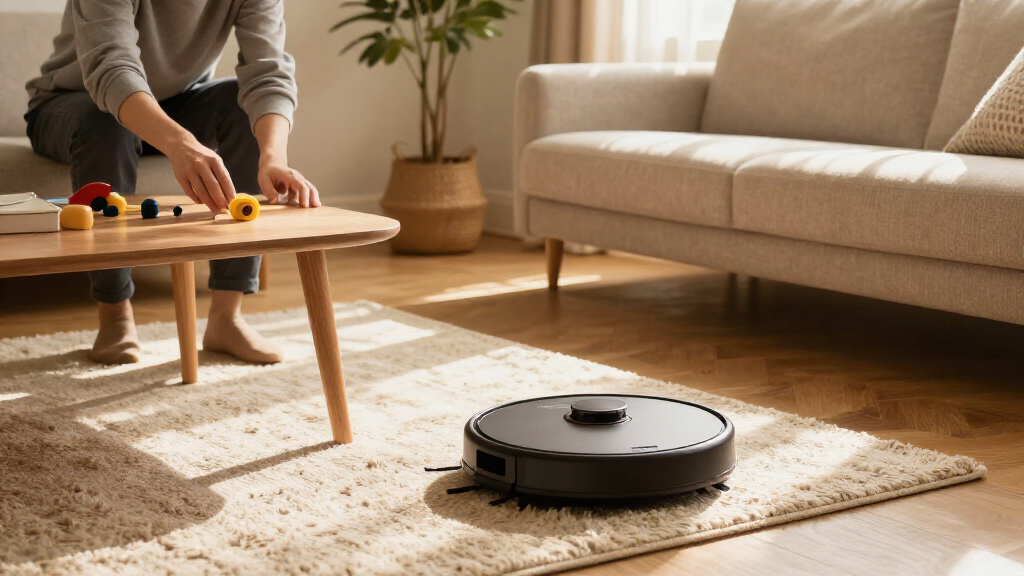
I evaluated these fifteen models by focusing on three core pillars: navigation intelligence, maintenance burden, and cleaning efficacy. Navigation was assessed by looking at the sensor suite—whether the unit uses LiDAR, vSLAM, or AI-powered cameras—to determine how well it handles complex layouts and avoids common hazards like pet waste or cables. Maintenance burden was judged by the ease of emptying the dustbin, cleaning the brushes, and the capacity of the self-emptying base, as these factors dictate how often you actually touch the device.
Cleaning efficacy was compared based on suction power ratings, brush design, and mopping mechanism. I prioritized models that offer a balance between raw power and smart execution, recognizing that a vacuum with lower suction but better edge cleaning often outperforms a high-power unit that misses corners. The ranking reflects a hierarchy where autonomous reliability and hands-off convenience take precedence over marginal gains in raw suction power.
Factors to Consider When Choosing Robot Vacuum Cleaners
Selecting a robot vacuum is not just about picking the highest number on the spec sheet. It involves matching the technology to your specific living environment and lifestyle habits. Here are the critical factors that should drive your decision.Navigation Technology and Mapping Accuracy
Navigation determines whether your robot cleans efficiently or wanders aimlessly. LiDAR systems use laser sensors to create precise maps, making them ideal for large, open spaces with consistent layouts. In contrast, vSLAM cameras are more affordable but struggle in dark rooms or low-contrast environments. AI-powered vision, found in premium picks like the Shark AV2501AE, adds object recognition, allowing the robot to dodge pet toys and cables rather than just avoiding walls. If your home has many obstacles, investing in AI navigation saves time spent rescuing the vacuum. For empty, open floors, LiDAR remains the most reliable and cost-effective choice.
Suction Power vs. Brush Design
Manufacturers often highlight Pa (Pascal) ratings, but raw suction is only half the story. A vacuum with 10,000 Pa suction will fail on carpet if it lacks a stiff bristle brush to agitate fibers. Look for models with rubber extractors or dual-brush systems, which prevent hair tangles and provide consistent pickup. On hard floors, suction matters less than the seal of the vacuum head against the surface. Do not overspend on extreme suction numbers if you primarily have hard floors; instead, prioritize a well-designed brush roll that can handle fine dust and larger debris equally well.
Maintenance Requirements and Self-Emptying Bases
The biggest friction point in robot vacuum ownership is maintenance. Self-emptying bases are a game-changer, allowing the robot to transfer dust to a larger bagged or bagless bin, extending hands-free time to weeks or even months. Without this feature, you must empty the small onboard bin after every run. Consider the cost of replacement bags or filters when calculating long-term value. If you have allergies, look for bases with HEPA filtration to trap fine particles during the emptying process. This feature is worth the premium for most users, as it removes the most unpleasant part of the cleaning cycle.
Mopping Capabilities and Water Management
Most robot vacuums include a mop function, but the quality varies drastically. Static drag mops, found on budget models, merely smear dust around unless you manually dampen them. Better options feature electronic water control and vibrating pads, which scrub surfaces more effectively. Premium models may offer rotating mops or automatic washing and drying, which eliminates the smell of wet mop pads. If you have mostly carpet, mopping is a secondary feature; however, if you have tile or hardwood, investing in a model with active mopping or a separate mop module yields noticeably cleaner floors.
App Usability and Smart Home Integration
The app is the primary interface for controlling your device, so its stability and features matter. Zone cleaning and no-go zones are essential for keeping the robot away from fragile items or messy areas. Check if the app supports multiple floor maps if you live in a multi-story home. Integration with voice assistants like Alexa or Google Home adds convenience, but the app should still be intuitive on its own. Poorly designed apps can turn a smart device into a frustrating experience, so prioritize brands with a track record of software updates and user-friendly interfaces.
Frequently Asked Questions
Do robot vacuums work well on thick carpet?
Robot vacuums can work on thick carpet, but performance depends heavily on suction power and brush design. Models with high suction ratings (above 5,000 Pa) and rubber brushes or specialized carpet boost modes perform best. However, even the best robot vacuum may struggle with very high-pile rugs, often requiring manual vacuuming for a deep clean. If your home is mostly thick carpet, look for models with adjustable suction or specific carpet detection features, such as the Shark AV2501AE, which lifts the mop pad to prevent wetting carpets while boosting suction for debris pickup.
How often do I need to replace filters and brushes?
Filter replacement typically occurs every 1-3 months depending on usage and air quality, while brushes may last 6-12 months. Some models offer washable filters, which reduce ongoing costs but may lose efficiency over time compared to disposable ones. Regular maintenance is key; cleaning the filter weekly with a brush or tapping it out can extend its life. Always check the manufacturer’s guidelines, as running a clogged filter can damage the motor and reduce suction power significantly. High-pet-hair households will likely need to replace these components more frequently due to faster accumulation of debris.
Is AI obstacle avoidance worth the extra cost?
AI obstacle avoidance is worth the investment if you have pets, children, or a cluttered home. Traditional LiDAR vacuums map the room but cannot distinguish between a wall and a pile of socks, often pushing objects around or getting tangled in cables. AI-powered models use cameras to identify and avoid specific objects like pet waste, shoes, and cords. For a tidy, empty home, this feature is less critical. However, if you frequently find your robot stuck or spreading messes, the premium for AI navigation pays off in reduced frustration and cleaner floors.
Can I use third-party cleaning solutions with robot mops?
Most manufacturers strictly advise against using third-party cleaning solutions in robot vacuum mops. These devices are designed to use plain water, and detergents can clog the internal pump, damage seals, or leave sticky residues on floors. If you need to clean spills, it is better to wipe the area manually before running the robot. Some premium models have specific detergent dispensers in their self-cleaning bases, but these require proprietary solutions. Using unauthorized chemicals typically voids the warranty and can lead to costly repairs, so stick to water or manufacturer-approved cleaning agents.
Do robot vacuums work in multi-story homes?
Yes, but you need a model that supports multiple map storage. Most mid-to-high-end robots, such as the Roborock Q7 M5+, can save maps for different floors in the app. You simply carry the robot upstairs, and it recognizes the new environment, loading the correct map and cleaning schedule. Basic models with random navigation or single-map storage will struggle, as they will treat each new floor as a completely unknown space, leading to inefficient cleaning paths. Always verify that the specific model supports multi-level mapping before using it in a multi-story home.
Conclusion
Choosing the right robot vacuum cleaner comes down to balancing your budget with your need for autonomy. For the best overall experience, the Shark AV2501AE AI Robot Vacuum offers the perfect blend of AI navigation, powerful suction, and low-maintenance design, making it ideal for busy households with pets or clutter. If you are seeking the best value, the Roborock Q7 M5+ provides reliable LiDAR navigation and long-term hands-free cleaning at a more accessible price point, suited for tech-savvy users who want efficiency without the premium cost. For beginners or those in small apartments, the iRobot Roomba 105 Combo is a dependable, user-friendly option that handles daily messes effectively without complex setup. Those needing a compact solution for hard floors should consider the Lefant M210, which excels in tight spaces. Finally, for users who want a comprehensive cleaning system with mopping and self-emptying, the iMartine D16S MAX offers high suction and robust features for a complete home care solution.