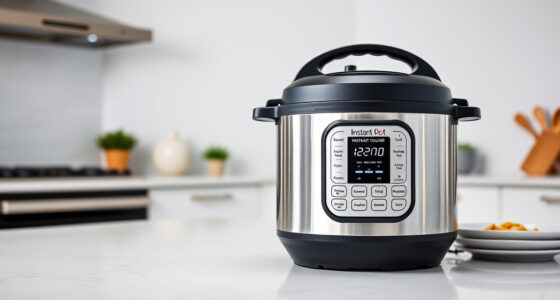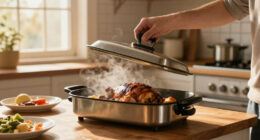

An electric roasting pan and a conventional oven can both cook a turkey, roast, or large batch of food, but they suit different kitchens and cooking habits. The real choice is whether a separate countertop roaster’s portability and ability to free the main oven justify its cost, storage space, and narrower cooking range. For holiday hosts who need another cooking space, the electric roaster can be useful; for most households, the conventional oven is the more versatile default.

Get home appliances delivered free with Prime
- Fast, free delivery on millions of items
- Prime Video, Amazon Music and more included
- Member-only deals all year

28-Quart Stainless Steel Electric Roaster Oven with Self-Basting Lid
- ✔ Capacity: 28 quarts
- ✔ Temperature range: 150°F–450°F
- ✔ Wattage: 1450 watts

SUNVIVI 24-Quart Roaster Oven with 3 Buffet Trays
- ✔ Capacity: 24 quarts
- ✔ Turkey capacity: Up to 28 pounds, as stated in the product description
- ✔ Temperature range: 150°F–450°F
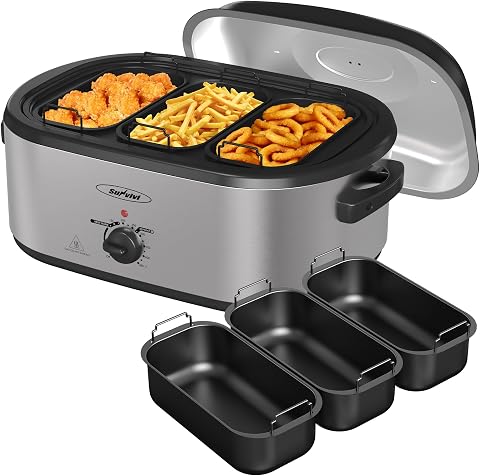
Sunvivi 24-Quart Electric Roaster Oven with 3-Compartment Buffet Server
- ✔ Capacity: 24 quarts
- ✔ Temperature range: 150°F–450°F
- ✔ Wattage: 1450 watts
The differences matter most when you cook large meals, need the oven for several dishes at once, or have limited counter and storage space. Heat distribution, capacity, cleanup, and the types of cookware you can use also affect results. The comparison below assumes a typical covered electric roaster and a standard home oven; exact capacity and features vary by model.
At a Glance
| Criteria | Electric roasting pan | Conventional oven | Winner |
|---|---|---|---|
| Cooking capacity | Often sized for a large roast or turkey; usable dimensions vary by model. | Typically handles a large roast, with capacity determined by oven size and pan. | Depends |
| Heat and cooking control | Compact heating element and covered chamber; temperature accuracy and browning vary. | Broad, adjustable heat with room for different rack positions and cookware. | B |
| Freeing the main oven | Runs separately, leaving the kitchen oven available for side dishes. | Uses the main oven, which can create scheduling conflicts during big meals. | A |
| Versatility | Best suited to roasting and similar covered cooking; functions vary. | Supports baking, broiling, roasting, and many other cooking tasks. | B |
| Cleanup and storage | Removable insert can simplify washing, but the unit takes storage space. | No extra appliance to store; oven and cookware still need cleaning. | B |
| Purchase value | Extra cost makes sense mainly when the separate cooking space will see repeated use. | Usually the better value if already installed and adequate for household needs. | B |
28-Quart Stainless Steel Electric Roaster Oven with Self-Basting Lid
This is the most adaptable roaster in the group for cooks who want one appliance to cover a large roast, baking, slow cooking, and serving. Its 28-quart capacity is four quarts larger than the two buffet-server models, and the stated 150°F–450°F range gives us low-temperature warming and hotter roasting settings in the same unit. A warm function is specifically listed, which makes it easier to keep food ready between cooking and serving.Compared with the SUNVIVI models, this roaster prioritizes cooking space and flexibility over built-in side-dish service: it does not list buffet trays. Its removable pan and rack still support serving and cleanup, while the self-basting visible lid is designed to circulate moisture. The stainless steel construction is another straightforward advantage for buyers who prefer that material to an enamel roasting pan. The tradeoff is substantial: its listed 27 × 22 × 23-inch dimensions and larger capacity may be awkward in a small kitchen or excessive for routine meals. Choose it for broad utility; skip it if you mainly want a dedicated buffet setup or a compact appliance.
Pros:
- 28-quart capacity offers more room than either 24-quart alternative.
- 150°F–450°F controls support roasting, baking, and slow cooking.
- Warm function helps hold food between cooking and serving.
- Removable pan and rack simplify handling and cleanup.
Cons:
- Listed dimensions require substantial counter and storage space.
- Larger capacity may be unnecessary for smaller everyday meals.
- No buffet trays are listed among the included components.
Best for: Cooks who regularly prepare large meals and want roasting, baking, slow cooking, and a warm function in one appliance.
Not ideal for: Small households with limited counter or storage space, or hosts who want included buffet trays for serving side dishes.
Bottom line: We recommend this as the most versatile pick for cooks who can accommodate its larger footprint and want more than a dedicated holiday roaster.
“We recommend this as the most versatile pick for cooks who can accommodate its larger footprint and want more than a dedicated holiday roaster.”
SUNVIVI 24-Quart Roaster Oven with 3 Buffet Trays
For a meal where several sides need to stay ready at the same time, this SUNVIVI makes a stronger serving case than our top pick. Along with a 24-quart roasting pan, it includes three buffet trays with a divider pan, so hosts can keep side dishes warm while the main course occupies the roaster. The product description states that it fits a turkey up to 28 pounds, a useful capacity cue for holiday planning that the other two listings do not provide.Like the 28-quart model, it offers a 150°F–450°F thermostat and self-basting lid, but it gives up four quarts of stated capacity and does not list the other model’s warm function. Its 25-inch width also means the buffet-oriented design still demands room; the listed 12-inch depth is less than the 28-quart model’s listed depth, but check your counter and storage area before choosing it. The removable roasting pan and dishwasher-safe trays simplify cleanup, although using several serving pieces also means more components to wash and put away. We would choose it over the other 24-quart Sunvivi when the stated turkey capacity is important; choose the shallower listed footprint of the sibling model if depth is the bigger constraint.
Pros:
- Three buffet trays and a divider pan support serving multiple sides.
- Product description states capacity for a turkey up to 28 pounds.
- Adjustable 150°F–450°F thermostat supports several cooking and warming uses.
- Removable roasting pan and buffet trays are listed as dishwasher safe.
Cons:
- 24-quart capacity is smaller than the 28-quart overall pick.
- Listed 25-inch width needs ample counter or storage space.
- Multiple removable trays and pans add cleanup and storage tasks.
Best for: Hosts who want a mid-size electric roaster and included compartments for keeping several side dishes warm.
Not ideal for: Buyers who need the largest capacity in this comparison, have little room for a 25-inch-wide appliance, or prefer fewer pieces to clean.
Bottom line: We’d choose this model for holiday hosting when three side-dish compartments and a stated 28-pound turkey fit matter more than maximum roasting capacity.
“We’d choose this model for holiday hosting when three side-dish compartments and a stated 28-pound turkey fit matter more than maximum roasting capacity.”
Sunvivi 24-Quart Electric Roaster Oven with 3-Compartment Buffet Server
This model combines a 24-quart roaster with a three-compartment buffet server, much like the other SUNVIVI option. Its listed dimensions set it apart: at 10 inches deep and 25 inches wide, it is shallower than the sibling model’s listed 12-inch depth, while retaining the same stated 150°F–450°F temperature range. That may make placement easier where front-to-back counter space is tight, though width remains considerable.The product details list an aluminum removable enamel pan and stainless steel exterior, plus a liftable rack and dishwasher-safe pan and buffet server. Compared with the stainless steel 28-quart pick, it offers less capacity and adds buffet service, but the coated pan calls for more careful maintenance: avoid steel wool and dry the unit after cleaning to help protect its coating. The supplied description does not give this model a turkey weight limit, so we would not assume it matches the other SUNVIVI’s stated 28-pound fit. It makes sense for cooks who want a buffet setup and value its shallower listed depth; skip it if durable, low-fuss pan care or a documented turkey capacity is a priority.
Pros:
- Three buffet compartments can keep side dishes warm during serving.
- Listed 10-inch depth is shallower than the other 24-quart model’s 12 inches.
- 150°F–450°F thermostat covers a broad range of roasting and warming tasks.
- Removable pan and buffet server are listed as dishwasher safe.
Cons:
- Enamel coating requires gentle cleaning and thorough drying.
- At 25 inches wide, it still needs significant counter or storage space.
- No turkey weight capacity is provided in the supplied product details.
Best for: Hosts who want a 24-quart roaster with buffet compartments and need to limit its front-to-back depth.
Not ideal for: Cooks who use abrasive cleaning tools, want stainless steel throughout the roasting pan, or need a stated turkey capacity.
Bottom line: We’d pick this buffet model when its shallower listed depth solves a placement problem and the enamel-pan care routine is acceptable.
“We’d pick this buffet model when its shallower listed depth solves a placement problem and the enamel-pan care routine is acceptable.”
As an Amazon Associate we earn from qualifying purchases.
Key Differences
The electric roaster’s strongest advantage is extra cooking capacity outside the kitchen oven. During a holiday meal, it can cook the main roast while the oven handles vegetables, rolls, or dessert. That separation can make timing easier, particularly in a small kitchen with only one oven. The benefit is practical rather than automatic: the roaster needs a stable, heat-safe surface, an outlet, and somewhere to live when it is not in use.
The conventional oven is more adaptable. It accommodates different pans and cooking methods, and its size and rack setup may provide more room to arrange food. A countertop roaster can cook effectively, but the enclosed space, heating pattern, and ability to brown food depend on the model and recipe. It is not a direct replacement for every oven task. If the household rarely hosts large meals, a second appliance may add storage and cleanup without solving a regular problem.
Cost follows the same divide. An oven you already own has no additional purchase price, while a roaster adds an upfront expense. Paying for one is sensible when it gets regular use or prevents meaningful crowding during large meals. If it will come out once a year and the oven can handle the menu, keeping the money and cupboard space is usually the better decision.
Detailed Comparison
Cooking capacity (moderate difference)
Winner: Depends; the gap is moderate. A large electric roaster may fit a substantial bird or roast, but its stated capacity does not tell the whole story: interior dimensions and shape determine what actually fits. A conventional oven can also handle large pans, and its racks may make it easier to arrange multiple dishes. Choose by checking the size of your usual roast and cookware against the appliance dimensions, rather than relying on a capacity label alone.
Heat and cooking control (Conventional oven wins — moderate)
Winner: Conventional oven; the gap is moderate. Home ovens offer flexible rack placement and work with a wider range of roasting and baking methods. Electric roasters have a smaller covered chamber, and their temperature accuracy and browning performance differ by model. A roaster can handle straightforward roasting, but cooks who depend on a particular recipe’s browning or precise oven setup have more room to adapt with a conventional oven.
Freeing the main oven (Electric roasting pan wins — major)
Winner: Electric roasting pan; the gap is major for large gatherings. It operates separately, so the oven stays available for the rest of the meal. That can ease a crowded holiday schedule and let dishes finish at the same time. For routine dinners or households that do not prepare several oven dishes together, this advantage is small because there is little competition for oven space.
Versatility (Conventional oven wins — major)
Winner: Conventional oven; the gap is major. An oven can roast, bake, broil, and accommodate a wide range of pans and recipes. Most electric roasters are built around roasting and covered cooking, although some models offer additional settings. The roaster earns its place by adding a cooking station, not by matching an oven across every task.
Cleanup and storage (Conventional oven wins — moderate)
Winner: Conventional oven; the gap is moderate. A roaster’s removable insert may be easier to lift and wash than cleaning an oven cavity, but the appliance itself needs storage and its lid and rack may need washing too. An existing oven adds no storage burden, though spills still require cleaning. In a compact kitchen, the roaster’s footprint can outweigh a simpler cleanup after occasional use.
Purchase value (Conventional oven wins — moderate)
Winner: Conventional oven for most households; the gap is moderate. If the oven already meets your cooking needs, it is hard for an additional appliance to beat its value. Paying for an electric roaster makes sense when separate capacity is used often enough to justify the purchase and storage. For a yearly holiday meal, borrowing or renting one may be more economical than buying.
Electric roasting pan: Pros and Cons
Pros:
- Adds a separate cooking space for large meals.
- Can leave the main oven free for sides and desserts.
- Removable cooking insert may simplify washing.
Cons:
- Costs extra and occupies storage space.
- Cooking capacity and temperature performance vary by model.
- Less adaptable than a conventional oven for varied recipes.
Conventional oven: Pros and Cons
Pros:
- Handles a broad range of cooking methods and cookware.
- Already available in most kitchens, with no extra appliance purchase.
- Rack positions and interior layout offer flexibility.
Cons:
- Large meals can create competition for oven space.
- Oven spills and bulky cookware still need cleaning.
- May not fit unusually large pans or roasts in smaller kitchens.
Who Should Choose What
Choose Electric roasting pan if:
- You host large holiday meals and regularly need the main oven for side dishes.
- Your kitchen has counter space and storage for a second cooking appliance.
- You often roast large items and value having a separate cooking schedule.
Choose Conventional oven if:
- You already own an oven that fits your usual pans and roasts.
- You bake, broil, and roast a varied mix of foods.
- You want to avoid extra cost, storage, and appliance cleanup.
Skip both if: Neither fits if your cooking needs are occasional and small, or if neither appliance can safely fit your cookware and available space; use a suitable smaller roasting setup instead.
Value for Money
For most households, the conventional oven is the better value because it is already part of the kitchen and performs more kinds of cooking. The electric roaster’s purchase price is justified when its separate capacity solves a recurring bottleneck, especially for frequent hosting or a kitchen with one heavily used oven. Pay more only if you expect to use that extra cooking space often enough to make the cost and storage worthwhile. If the need is limited to one annual gathering, borrowing a roaster is often better value.
Final Verdict
Choose the conventional oven if you want one flexible appliance for everyday cooking and occasional large roasts; it is the clear choice for most households. Choose an electric roasting pan if hosting routinely leaves you short of oven space and you have room to store and use a second appliance. The deciding factor is how often you need a separate cooking chamber. If that need is rare, skip the purchase; if it recurs with every major gathering, the roaster can earn its place.
Frequently Asked Questions
Can an electric roasting pan replace a conventional oven?
No. It can handle many roasting tasks, but it does not offer the same flexibility for baking, broiling, rack placement, or different cookware. Treat it as an additional cooking appliance rather than a full oven replacement.
Is an electric roaster useful for Thanksgiving?
It can be, especially when the turkey or roast would occupy the oven needed for side dishes. Check the roaster’s interior dimensions against the bird and account for the space and outlet it needs on the day.
Which option is better for a small kitchen?
The conventional oven is usually better if it already meets your needs, since an electric roaster adds counter use and storage demands. A roaster may still help if oven capacity is the main constraint and you have a safe place to set it up.
Is an electric roasting pan worth buying for one big meal a year?
Usually not if your oven can handle the menu. Borrowing or renting one can cover a rare need without the purchase cost and year-round storage; buying makes more sense when you will use the extra cooking space regularly.