
TL;DR

Get home appliances delivered free — and shop member deals
- Fast, free delivery on millions of items
- Access to Prime Big Deal Days deals on October 6–7
- Prime Video, Amazon Music and more included
You can mow soon after aerating, but waiting at least a few days is generally recommended to give turf time to recover. If you plan to overseed, wait about two weeks before mowing; mowing over core-aeration plugs may break them up but could damage mower blades.
Mowing immediately after lawn aeration is possible, but it is generally better to wait at least a few days so grass can recover, according to a Hunker report drawing on lawn-care guidance. The schedule changes if you plan to overseed: the report advises waiting about two weeks before mowing, while noting that mowing can help break up plugs left by core aeration.
There is no single waiting period for every lawn. The report says timing depends on grass height, whether seed will be spread, and whether the homeowner wants to break apart the soil plugs produced by a core aerator. A few days’ rest is presented as a general starting point, not a guarantee that every lawn is ready.
For overseeding, the sequence matters: aerate first, then overseed, and avoid mowing immediately after seeding. The report recommends allowing roughly a couple of weeks before mowing. It also cites Angi’s guidance to mow a few weeks after aeration or when turf reaches about 2 to 3 inches tall; the appropriate height can vary with the grass and lawn conditions.
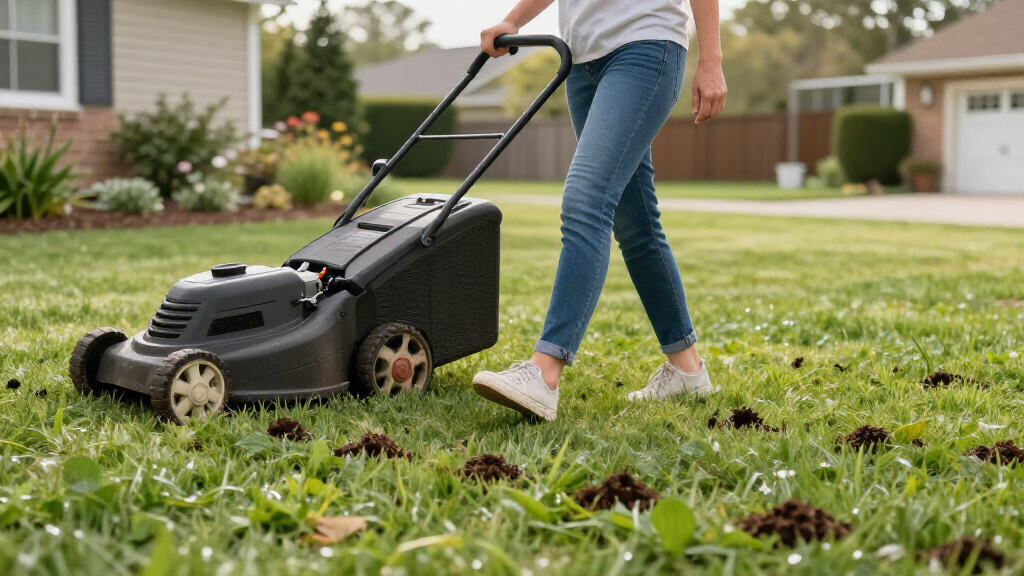
Core aeration leaves soil plugs on the surface. They usually break down naturally, so homeowners generally do not need to remove them. Mowing may speed up their breakup and can be useful for appearance or to address a potential nuisance, but the report warns that hard plugs may damage mower blades. That possibility is one reason not to treat mowing right away as the default.
Aeration Changes the Mowing Schedule
Getting the timing wrong can work against the purpose of aerating. Freshly aerated grass needs time to recover, and mowing too soon may interrupt that recovery. If seed is part of the plan, mowing before it has had time to establish can also conflict with the recommended care sequence.
The decision affects more than the next cut. Soil compaction can recur, and the report notes that some mowing habits may contribute to it. For homeowners, the practical takeaway is to coordinate aeration, seeding and mowing rather than treating each task as unrelated. Waiting also avoids running blades over firm plugs unless breaking them up is a deliberate choice.
As an affiliate, we earn on qualifying purchases.
Why Aeration Leaves Soil Plugs
Aeration is used to relieve compacted soil and improve conditions for turfgrass, including access to oxygen. The report says lawns with compaction or substantial foot traffic may need aeration more than once a year, though it gives no universal schedule for every property.
Core aerators remove small soil cores and leave them on the lawn. Those plugs decompose over time. The cited guidance distinguishes that routine process from mowing: mowing can break plugs apart sooner, but is not required for them to disappear. The report also cites Clemson Cooperative Extension advice to alternate mowing directions and avoid heavy equipment on heavier soil to help limit compaction.
“Waiting a few days gives the grass time to recover.”
— Ask Extension Foundation, as cited in the Hunker report
As an affiliate, we earn on qualifying purchases.
Timing Depends on Lawn Conditions
The cited advice does not establish one precise wait time for every lawn. Grass type, current height, soil condition and weather can affect recovery, and the report does not provide a tailored schedule for individual yards. Its suggestions range from waiting a few days to several weeks, depending on whether the lawn will be overseeded and what height the grass reaches.
The report also does not quantify how likely mower blades are to be damaged by hard plugs or how quickly plugs will break down under different conditions. Its guidance is general lawn-care information, not a diagnosis of a particular lawn. Homeowners unsure about timing may need advice suited to their grass and local growing conditions.
As an affiliate, we earn on qualifying purchases.
Check Height Before the Next Cut
After aeration, homeowners should follow the intended plan: if overseeding, leave the lawn uncut for about two weeks and allow the seed time to establish. If not overseeding, wait at least a few days, then check how the grass is recovering and whether it has reached a suitable mowing height. The cited Angi guidance uses 2 to 3 inches as one cue, while also suggesting a wait of a few weeks.
If core-aeration plugs are left behind, they can be allowed to decompose naturally. Anyone who chooses to mow to break them up should account for the report’s warning that hard plugs can pose a risk to mower blades. The next cut should also avoid repeatedly following the same direction, particularly where soil compaction is a concern.
As an affiliate, we earn on qualifying purchases.
Key Questions
Can I mow immediately after aerating?
You technically can, but the cited guidance generally recommends waiting at least a few days to give the grass time to recover. The right interval depends on lawn conditions and whether you plan to overseed.
How long should I wait to mow after overseeding?
The Hunker report recommends aerating before overseeding and then waiting about two weeks before mowing. Conditions and grass growth may affect the timing.
Do I need to remove the soil plugs after core aeration?
No. The plugs generally decompose on their own. Mowing can break them up sooner, but the report says hard plugs may damage mower blades.
What grass height can signal that it is time to mow?
The report cites Angi’s guidance to mow when turf is around 2 to 3 inches tall, or a few weeks after aeration. That is a general reference, not a rule for every grass type.
Can mowing habits contribute to soil compaction?
They can. The report cites Clemson Cooperative Extension advice to alternate mowing directions and avoid heavy equipment on heavier soil to help reduce compaction.
Source: rss
Fall yard work Picks
leaf blowers
As an affiliate, we earn on qualifying purchases.