
TL;DR

Get home appliances delivered free with Prime
- Fast, free delivery on millions of items
- Prime Video, Amazon Music and more included
- Member-only deals all year
A Hunker report describes DIYers disguising wall thermostats with picture frames, open-weave baskets and small boxes. The approaches can soften the look of a prominent control, but coverings should not block access or airflow, which can affect temperature readings.
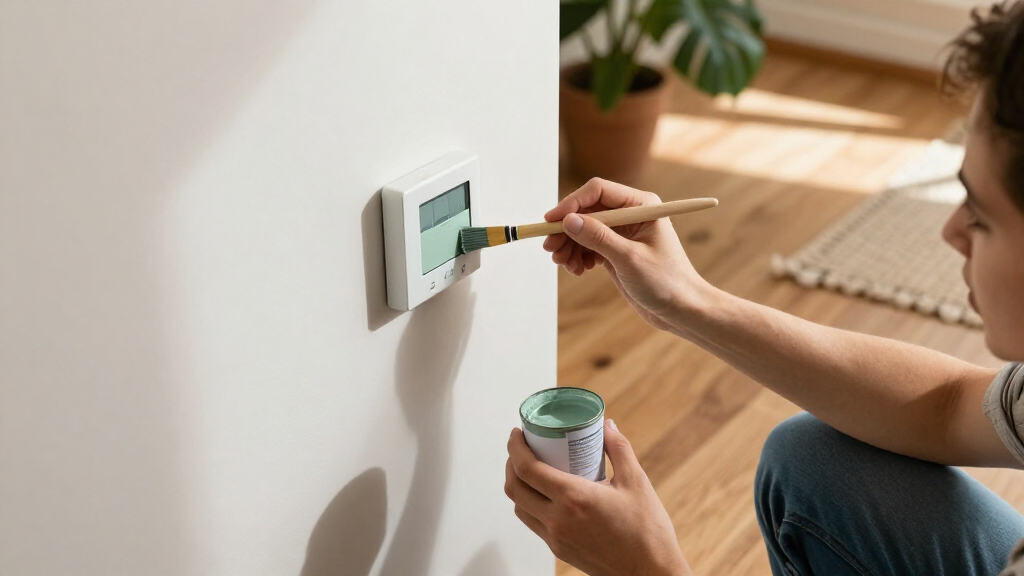
Home DIYers are using picture frames, baskets and small boxes to make wall thermostats blend into room decor, according to a report by Hunker. The ideas aim to make a frequently visible household control less prominent while leaving it accessible and usable—a practical consideration because some coverings may interfere with airflow and affect a thermostat’s temperature reading.
One of the simplest approaches is to place a frame around the thermostat, making the device part of a wall display or gallery wall. Hunker describes choosing a frame to fit the unit’s shape and removing the frame’s glass before attaching it. The report says some versions can be secured with double-sided adhesive fasteners, avoiding the need to drill into the wall, though the appropriate fixing method will depend on the wall and the frame.
The report gives a round rattan frame listed on Amazon for $32 as an example for a compatible circular thermostat, and says rectangular units need a frame with a matching shape. That example is not a universal fit: homeowners need to check the dimensions and layout of their own device before choosing a surround. The thermostat should remain visible and reachable rather than being sealed behind glass or an opaque panel.
Other ideas cited by Hunker include an open-weave basket with a hole cut into its back to fit around the control, and a small trinket box used as a door-like casing. The report attributes the basket example to the Instagram account brickhomehaven and the box idea to TikTok creator Morgan Geyer. Hunker cautions that a box or other enclosure can restrict airflow, potentially affecting the accuracy of the thermostat’s reading.
Decor That Must Keep Working
The trend addresses a small but familiar home-design problem: thermostats are necessary controls, yet their placement can interrupt a carefully arranged wall. A frame or decorative surround can help the device sit alongside artwork rather than stand out on its own. For people making a hallway or room refresh, the approach offers a way to change the appearance of an existing fixture without replacing the thermostat.
Appearance is not the only concern. A thermostat relies on sensing the temperature around it, so a covering that traps heat or limits airflow could affect its readings. The design must leave the device open enough to sense room conditions and easy for household members to operate. In practice, the most decorative option may not be the best one if it obstructs the controls or sensor.
As an affiliate, we earn on qualifying purchases.
A Simple Wall-Makeover Idea
Hunker presents the ideas as adaptable to different thermostat sizes and shapes, rather than as a single product or standardized installation. A frame can be selected to match the unit, while a basket or box offers a different look. Some homeowners may choose to include the thermostat within a broader gallery wall, where surrounding pictures and objects make it less visually dominant.
The report does not describe a new thermostat product, a formal design standard or a quantified rise in the practice. It is a roundup of examples shared online and a do-it-yourself suggestion. Its central point is that a decorative treatment may be possible without replacing the control, provided that the chosen surround does not compromise access or operation.
As an affiliate, we earn on qualifying purchases.
Fit and Sensor Effects Vary
The source does not provide testing on how particular frames, baskets or boxes affect thermostat performance, nor does it say which designs are suitable for every model. It warns specifically that a trinket-box casing may reduce airflow and affect temperature accuracy, but does not quantify the effect. The right clearance will depend on the device’s design and placement.
It is also unclear how widely homeowners are adopting the idea: the report cites individual social-media examples but gives no survey, sales figures or other measure of its prevalence. The $32 frame is an example cited in the article, not evidence that every thermostat can use that product or that the listed price remains current.
As an affiliate, we earn on qualifying purchases.
Check the Thermostat Before Fitting
Anyone trying the idea should first check the thermostat manufacturer’s instructions for clearance and airflow requirements, then measure the device and choose a surround that leaves controls reachable. A frame should be used without glass, as Hunker advises, and any basket or box should not obstruct the sensor or create a confined space around the unit. After installation, homeowners can monitor whether the thermostat continues to respond normally and remove the covering if readings appear inconsistent.
Hunker does not announce a follow-up test or a scheduled next development. For now, the practical next step for readers is to treat the examples as decor inspiration rather than performance-tested guidance, and prioritize the thermostat’s operation over concealment.
As an affiliate, we earn on qualifying purchases.
Key Questions
How do DIYers disguise a wall thermostat?
Ideas in Hunker’s report include placing a frame around the unit, incorporating it into a gallery wall, fitting an open-weave basket around it, or using a small box as a casing. The thermostat should remain accessible and able to sense room conditions.
Does a thermostat frame need glass?
No. Hunker advises removing the frame’s glass before fitting it around the thermostat. A glass-fronted frame could obstruct access and may interfere with the device’s operation.
Can a cover affect thermostat accuracy?
It can. Hunker cautions that a trinket-box casing may limit airflow and affect the temperature reading. The source does not provide performance tests or a clearance measurement that applies to every model.
Do these ideas work with every thermostat?
Not necessarily. The report says the approach can be customized, but frames and other surrounds need to fit the device’s dimensions and shape without blocking its controls or sensor. Check the thermostat maker’s instructions before adding a covering.
Source: rss
Fall Picks
fall essentials
As an affiliate, we earn on qualifying purchases.