TL;DR

Get home appliances delivered free with Prime
- Fast, free delivery on millions of items
- Prime Video, Amazon Music and more included
- Member-only deals all year
Apartment Therapy writer Laura Wheatman Hill tested a steamer, a portable Bissell cleaner and a homemade vinegar, water and dish soap solution on separate cushions of her sectional. She reported that the homemade mix was the most effective at removing dog odor, based on her own assessment and feedback from her son; the test was informal and limited to one couch.
Apartment Therapy writer Laura Wheatman Hill reported that a homemade mix of white vinegar, warm water and dish soap removed dog odor from her sectional couch more effectively than a steamer or a portable upholstery cleaner in a three-method test. The result comes from an informal trial on one couch, not a controlled comparison, but offers readers a low-cost option to try on suitable upholstery.
Hill tested each method on a different seat cushion or pillow on the same sectional. She vacuumed the cushions first, then tried the methods back-to-back. To assess the odor, she removed each cushion and asked her younger son, whom she described as especially sensitive to smells, to compare before-and-after results. The report does not provide laboratory measurements or a blinded test.
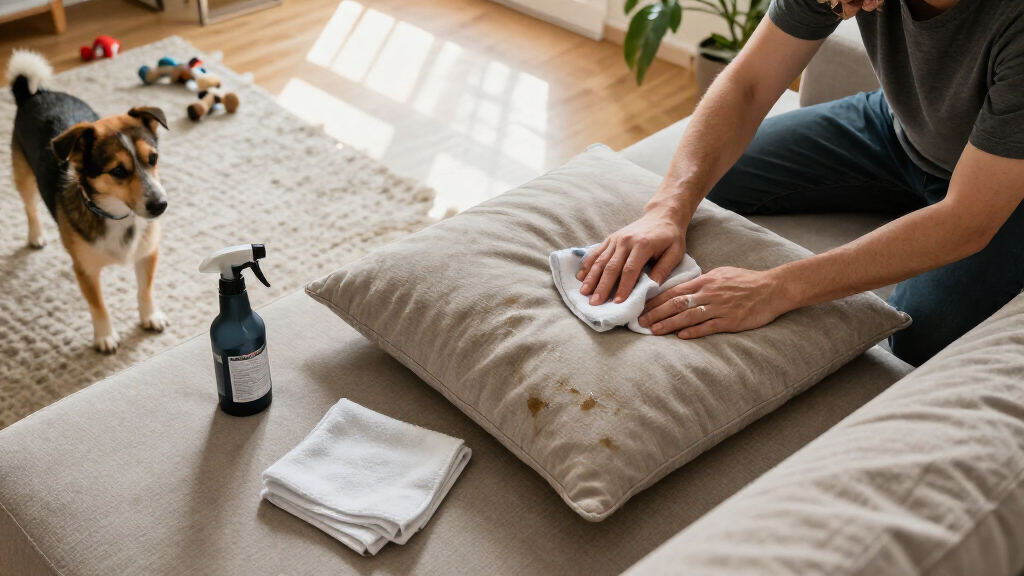
For the homemade method, Hill mixed one-quarter cup white vinegar, three-quarters cup warm water and one tablespoon of dish soap in a spray bottle. She sprayed the cushion, scrubbed it with a microfiber cloth, misted it with plain water, wiped it again and left it to dry. She said this method was the most effective at neutralizing the dog smell for both her and her son, and required the least work.
The portable Bissell Pet Stain Eraser, used with the recommended Pet Pro solution, also removed the odor in Hill’s assessment. However, she said the cushions stayed damp after multiple vacuum passes and a cleaner fragrance lingered the following day. The source includes a 3-out-of-5 rating for this method. It does not provide enough detail about the steamer’s results to compare its performance fully.
A Simple Option for Pet Odor
The test points to a readily available, inexpensive cleaning mixture as a possible first step for people dealing with pet odor on upholstered furniture. Hill said she already had the ingredients and found the method less laborious than using the portable cleaner, which also left the cushions damp and scented.
The finding is useful as one household report, not a guarantee. Results may vary with fabric type, cushion construction, how deeply odor has set in and the amount of cleaning solution used. A solution that works on one sectional may not suit another sofa. Readers should check their upholstery care label and test any cleaner on a hidden area before treating a visible cushion.
Products Worth Considering

Coway Mighty AP-1512HH(W) Air Purifier, White

Bose SoundLink Flex (2nd Gen) Portable Bluetooth Speaker

Shark Navigator Lift-Away Upright Vacuum Cleaner (NV356E)
As an affiliate, we earn on qualifying purchases.
How the Three Methods Were Compared
Hill said she wanted to address a persistent dog smell in her upholstered couch while preparing for holiday visitors. Rather than relying on one cleaning approach, she tried a steamer, a cordless Bissell upholstery and carpet cleaner, and a water, vinegar and dish soap mixture on separate cushions of the same sectional.
The same-couch setup gave the writer a practical way to compare approaches in her home, but the cushions may not have had identical exposure to the dogs or the same level of odor. The report describes a subjective sniff test involving Hill and her son. It does not state the fabric’s care code, how long each cushion was allowed to dry before evaluation, or whether the results were repeated.
“The simplest method ended up being the most effective for removing the dog odor.”
— Laura Wheatman Hill, Apartment Therapy
Limits of a One-Couch Test
The report does not establish whether the vinegar mixture is safe for every upholstery fabric or whether it removes odor from cushions with deeper or older contamination. It also does not give detailed results for the steamer, including how much odor remained or how long the treated cushion took to dry.
Hill’s comparison relied on smell judgments by two people and used separate cushions rather than repeated trials under controlled conditions. The article does not report fabric-care instructions, precise drying times for the homemade solution, or a comparison of long-term odor after several days. The results should be read as one household’s experience, not a universal cleaning recommendation.
Check Fabric Before Cleaning
Hill said she planned to use the steamer on the rest of her couch after trying the winning method, describing that as an additional step for sanitizing. The source does not report the outcome of that follow-up or any later assessment of the couch’s odor.
For readers considering the mixture, the practical next step is to check the sofa’s care label and test the solution on an inconspicuous spot first. Follow the manufacturer’s instructions and let a treated area dry fully before judging the result. No broader testing or follow-up findings are included in the supplied report.
Key Questions
What mixture did Hill say worked best?
She used one-quarter cup white vinegar, three-quarters cup warm water and one tablespoon of dish soap. She sprayed the cushion, scrubbed it with a microfiber cloth, misted it with plain water, wiped again and let it dry.
Which methods did she compare?
Hill tested a steamer, a Bissell Pet Stain Eraser cordless upholstery cleaner with its recommended Pet Pro solution, and the homemade vinegar, water and dish soap mixture. The source gives limited detail about the steamer’s results.
Did the Bissell cleaner remove the dog odor?
Hill said her son confirmed the actual dog smell was gone after she used the cleaner. She also reported that the cushion remained damp longer than she wanted and that a cleaner scent lingered the next day.
Will the vinegar mixture work on any couch?
The report does not establish that. Fabric and manufacturer care instructions differ, so readers should check the upholstery label and test a hidden area before using the mixture on a visible or large area.
Source: apartmenttherapy.com