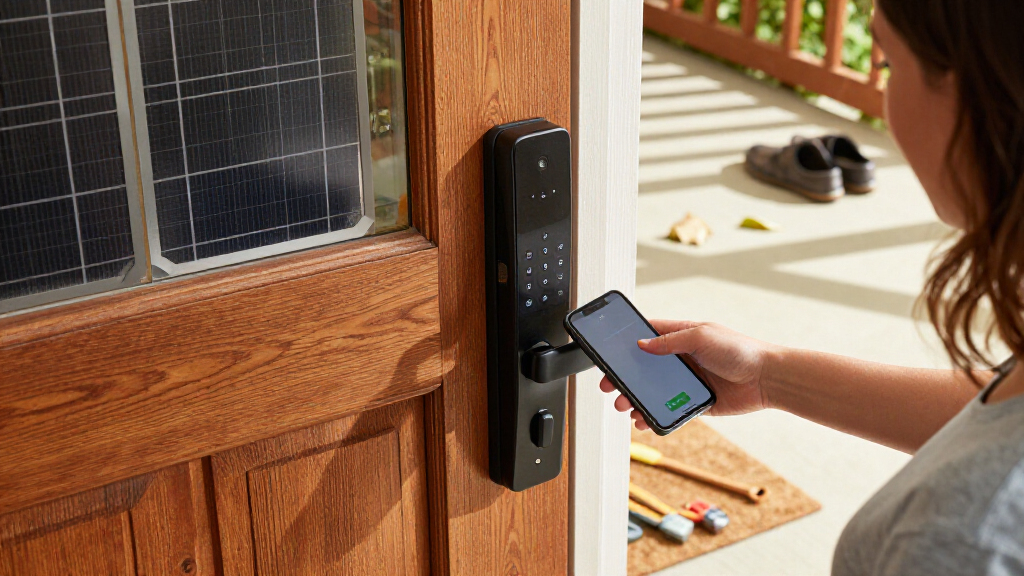

For a solar smart lock that combines ambient-light charging with broad smart-home support, I’d start with the Lockin Veno with Handle. The Lockin Veno Fingerprint & Palm Vein is the more distinctive biometric pick, while the DESLOC V150 Plus offers the strongest stated weather protection and adds face recognition. Those differences matter more than the shared promise of fewer charging interruptions: these locks vary in entry methods, ecosystem compatibility, backup capacity, and how much weather exposure they’re built to handle.

Get home appliances delivered free with Prime
- Fast, free delivery on millions of items
- Prime Video, Amazon Music and more included
- Member-only deals all year
My ranking puts the handle-equipped Veno first for its mix of five access methods and support for Apple Home, Alexa, and Google Home. The fingerprint-and-palm-vein version takes second for shoppers who value touchless entry and Matter, but its IP53 rating calls for a sheltered installation. DESLOC comes third overall, not because it lacks useful features, but because its fit requirements and app-dependent remote access make door compatibility a bigger part of the decision. Its IP65 rating makes it the lineup’s clearest choice for more exposed locations.
One point applies to all three: solar assistance is not the same as guaranteed solar-only operation. Ambient light, door placement, and weather affect charging, so I’d compare the supplied power backup and keep the mechanical-key or USB-C fallback in mind. I’d also check each lock’s security grade, weather rating, and door measurements before choosing based on biometrics alone.
Complete the kit


Key Takeaways
- Best all-around access mix: Lockin Veno with Handle combines fingerprint, PIN, app, voice, and mechanical-key entry with Matter and compatibility for Apple Home, Alexa, and Google Home.
- Best for touchless entry: The other Lockin Veno adds palm-vein scanning and fingerprint access, but its IP53 weather rating favors a sheltered door.
- Best stated weather protection: DESLOC V150 Plus has an IP65 rating, above the two Lockin models’ IP53 splash protection.
- Check the power fallback: The fingerprint-and-palm-vein Lockin lists USB-C backup charging; DESLOC lists a 10,000mAh battery alongside solar assistance.
- Measure before ordering: DESLOC specifies door thickness, bore-hole, and backset limits, so it demands a closer fit check than the supplied Lockin specifications do.
| Lockin Veno Solar Smart Deadbolt with Fingerprint Scanner and Handle |  | Best Overall | Model: Lockin Veno, LKMSD650BL | Power: Perovskite solar panel and 37Wh battery | Entry methods: Fingerprint, PIN, app, voice control, mechanical key | VIEW LATEST PRICE | See Our Full Breakdown |
| Lockin Veno Solar Smart Deadbolt with Fingerprint & Palm Vein Access |  | Best for Touchless Biometrics | Model: Lockin Veno Fingerprint, LKMSD650B | Lock type and material: Deadbolt; aluminum | Power: Perovskite solar panel, 37Wh battery, USB-C backup | VIEW LATEST PRICE | See Our Full Breakdown |
| DESLOC V150 Plus Solar-Powered Wi-Fi Smart Deadbolt with 3D Face Recognition |  | Best for Exposed Doors and Face Recognition | Model: DESLOC V150 Plus | Power: Perovskite solar technology and 10,000mAh lithium battery | Entry methods: 3D face recognition, fingerprint, app, Alexa or Google Assistant, mechanical key | VIEW LATEST PRICE | See Our Full Breakdown |
| solar smart lock | Model | Power | Entry methods | Connectivity |
|---|---|---|---|---|
| Lockin Veno Solar Smart Deadbo | Lockin Veno, LKMSD650BL | Perovskite solar panel and 37Wh battery | Fingerprint, PIN, app, voice control, mechanical key | Built-in Wi-Fi and Matter |
| Lockin Veno Solar Smart Deadbo | Lockin Veno Fingerprint, LKMSD650B | Perovskite solar panel, 37Wh battery, USB-C backup | Fingerprint, palm vein, app, keyless entry | Wi-Fi, Matter, app control |
| DESLOC V150 Plus Solar-Powered | DESLOC V150 Plus | Perovskite solar technology and 10,000mAh lithium battery | 3D face recognition, fingerprint, app, Alexa or Google Assistant, mechanical key | Built-in Wi-Fi; no hub required |
More Details on Our Top Picks
Lockin Veno Solar Smart Deadbolt with Fingerprint Scanner and Handle
I rank this Veno first because it pairs solar-assisted power with the most broadly useful access mix in the group. Fingerprint, PIN, app, voice, and mechanical-key entry give household members alternatives instead of making everyone rely on one biometric method. Compared with the fingerprint-and-palm-vein Veno, it trades the touchless palm scan for a PIN and expressly listed support for Apple Home and Google Home as well as Alexa. That makes it the easier recommendation for a home where people use different devices or may need a temporary code.
Matter and built-in Wi-Fi add flexibility without requiring a separate hub, and the listed compatibility spans major home ecosystems. The product description also says remote access, alerts, and passcode management do not require a monthly subscription. These details make it a practical first choice for buyers who want a connected lock without committing to a single access style or a hub-based setup. The mechanical key is particularly useful as a fallback if the electronics or network are unavailable.
The solar feature should still be treated as assistance rather than a promise of maintenance-free operation. Lockin says ambient light supports charging and notes that optimal performance requires at least 1000 Lux. That qualification makes placement relevant: a dark, enclosed entry may not offer the same charging conditions as a brighter one. Against DESLOC, this Veno has a less protective IP53 rating, so I would favor it for a covered entry rather than a door routinely exposed to heavy rain.
Security is another boundary. The listed BHMA Grade 3 certification is below the Grade 1 standard often sought for higher-security applications. I would choose this model for convenient everyday access and broad smart-home compatibility, not as a substitute for a higher-grade commercial lock. Within this lineup, its blend of entry methods and ecosystem support earns the top slot, while its weather rating and security grade keep the recommendation specific rather than universal.
Pros:- Solar-assisted charging works with a 37Wh battery.
- Five listed access methods include fingerprint, PIN, app, voice control, and mechanical key.
- Built-in Wi-Fi and Matter work with Apple Home, Alexa, and Google Home.
- Remote access, alerts, and passcode management are listed without a monthly subscription.
Cons:- IP53 is basic splash protection, not the IP65 protection listed for the DESLOC.
- Solar performance depends on ambient light, with 1000 Lux noted for optimal performance.
- BHMA Grade 3 is a limitation for buyers seeking a higher security grade.
Best for: Households that want PIN, fingerprint, app, voice, and key access, plus compatibility across Apple Home, Alexa, and Google Home.
Not ideal for: Buyers with an exposed, rain-prone door or those who require a higher security grade than BHMA Grade 3.
- Model:Lockin Veno, LKMSD650BL
- Power:Perovskite solar panel and 37Wh battery
- Entry methods:Fingerprint, PIN, app, voice control, mechanical key
- Connectivity:Built-in Wi-Fi and Matter
- Smart-home compatibility:Apple Home, Amazon Alexa, Google Home
- Fingerprint details:Recognition rate ≥97%; unlock speed ≤1.5 seconds
- Weather resistance:IP53
- Security grade:BHMA Grade 3
Our verdict“I’d choose the handle-equipped Veno for the most adaptable combination of solar assistance, entry options, and smart-home compatibility, provided the door is sheltered.”
Lockin Veno Solar Smart Deadbolt with Fingerprint & Palm Vein Access
This Veno is the more specialized Lockin choice: it combines a fingerprint reader with touchless palm-vein scanning, rather than the PIN-first flexibility of the handle-equipped version. The manufacturer lists fingerprint recognition at 1.5 seconds, making that method the quick everyday option, while palm-vein access gives users another way to enter without presenting a finger to the reader. I’d put it ahead of the other Veno for buyers who actively want both biometric approaches and do not need a PIN code as their preferred backup.
It shares the lineup’s perovskite solar approach and adds a substantial listed 37Wh battery plus USB-C backup charging. That is a meaningful combination for someone thinking about low-light stretches: ambient light may help maintain charge, while USB-C offers a direct fallback if the battery needs attention. Compared with DESLOC, however, this model’s published backup information emphasizes USB-C rather than a stated 10,000mAh battery, and its IP53 rating is less suited to exposed weather than DESLOC’s IP65.
Connectivity is a strong point for a hub-free setup. Native Wi-Fi and Matter support let it join a connected home without a separate hub, and Alexa integration is listed. The supplied details do not name Apple Home and Google Home compatibility for this specific version, unlike the handle-equipped Veno. Buyers who prioritize those ecosystems should check compatibility for their exact model rather than assume the two Veno variants have identical listings.
The tradeoffs make placement important. IP53 offers limited water resistance, and the stated BHMA Grade 3 rating falls short of the higher grades some buyers seek for commercial or elevated-security use. Solar performance can also vary with lighting, especially indoors, so I would not count on ambient light alone in a dim entry. This model earns a distinct second place: it is the lineup’s best match for palm-vein access and a USB-C fallback, but the first-place Veno is more versatile for PIN users and named smart-home ecosystems.
Pros:- Perovskite solar technology can use indoor or outdoor ambient light to help maintain battery charge.
- Fingerprint access is listed at 1.5 seconds, with touchless palm-vein scanning as another biometric option.
- Matter and built-in Wi-Fi provide hub-free connectivity; Alexa is listed.
- USB-C backup charging gives the 37Wh battery an alternate charging route.
Cons:- IP53 offers limited protection compared with the DESLOC’s IP65 rating.
- BHMA Grade 3 may not suit buyers seeking a higher security grade.
- Charging performance varies with available light, and the supplied details do not name the same breadth of smart-home compatibility as the handle-equipped Veno.
Best for: Buyers who want both fingerprint and touchless palm-vein access, Matter connectivity, and USB-C backup charging.
Not ideal for: People who need IP65-level weather protection, a PIN as a listed access method, or a stated higher security grade.
- Model:Lockin Veno Fingerprint, LKMSD650B
- Lock type and material:Deadbolt; aluminum
- Power:Perovskite solar panel, 37Wh battery, USB-C backup
- Entry methods:Fingerprint, palm vein, app, keyless entry
- Fingerprint unlock speed:1.5 seconds
- Connectivity:Wi-Fi, Matter, app control
- Voice assistant:Amazon Alexa
- Weather resistance:IP53
- Security grade:BHMA Grade 3
Our verdict“I’d pick this Veno when touchless palm-vein entry matters more than PIN access, broader named ecosystem support, or stronger weather protection.”
DESLOC V150 Plus Solar-Powered Wi-Fi Smart Deadbolt with 3D Face Recognition
The DESLOC V150 Plus stands out for two reasons the Lockin models do not match in the supplied specifications: IP65 weather resistance and 3D face recognition. It also accepts fingerprints, app control, voice assistants, and a mechanical key, so facial scanning is an added option rather than the only convenient entry method. For a door that sees more weather, I would favor this over either IP53-rated Veno, assuming the door fits its measurements.
Its solar-assisted system works alongside a stated 10,000mAh lithium battery, giving buyers a defined battery capacity to compare against the Lockin models’ 37Wh listings. Those figures use different units and should not be treated as directly interchangeable without more information about voltage and usable capacity. DESLOC also lists local storage for biometric data and liveness detection, features that may appeal to buyers who prefer face and fingerprint information to remain on the lock rather than be stored remotely.
There is a practical access-capacity limit: the lock supports up to 50 facial profiles and 50 fingerprints. That is ample for many homes, but households with more users or frequent access changes should check whether those limits work for them. Built-in Wi-Fi enables remote management without a hub, though remote app control depends on Wi-Fi. By comparison, the handle-equipped Veno names Matter and support for Apple Home, Alexa, and Google Home; the DESLOC description names Alexa and Google Assistant voice support but does not list Matter compatibility.
Fit is the main reason I place DESLOC third overall rather than first. It is specified for doors from 1-3/8 to 2 inches thick, with a 2-1/8-inch bore hole and either a 2-3/8- or 2-3/4-inch backset. I would measure before purchase rather than assume compatibility. Its strong weather rating and facial recognition make it a compelling specialist pick, but those benefits cannot compensate for a mismatched door or a buyer who needs a different smart-home ecosystem.
Pros:- IP65 weather resistance is the strongest stated rating in this comparison.
- Offers 3D face recognition, fingerprint, app, voice assistant, and mechanical-key access.
- Solar-assisted charging works alongside a 10,000mAh lithium battery.
- Biometric data is stored locally; the description also lists liveness detection.
Cons:- Fit is limited to specified door thickness, bore-hole, and backset dimensions.
- Remote app control requires Wi-Fi.
- The supplied description does not list Matter support.
Best for: Buyers with a compatible door who want face recognition, local biometric storage, and stronger stated weather protection.
Not ideal for: People unwilling to measure their door, those needing remote access without Wi-Fi, or shoppers prioritizing listed Matter support.
- Model:DESLOC V150 Plus
- Power:Perovskite solar technology and 10,000mAh lithium battery
- Entry methods:3D face recognition, fingerprint, app, Alexa or Google Assistant, mechanical key
- Biometric capacity:Up to 50 facial profiles and 50 fingerprints
- Connectivity:Built-in Wi-Fi; no hub required
- Biometric data:Stored locally on the lock; liveness detection listed
- Weather resistance:IP65
- Door fit:1-3/8 to 2 inches thick; 2-1/8-inch bore; 2-3/8- or 2-3/4-inch backset
- Operating temperature:-22°F to 158°F (-30°C to 70°C)
Our verdict“I’d choose DESLOC over the Lockin models for a compatible, more weather-exposed door when face recognition and IP65 protection are the priorities.”
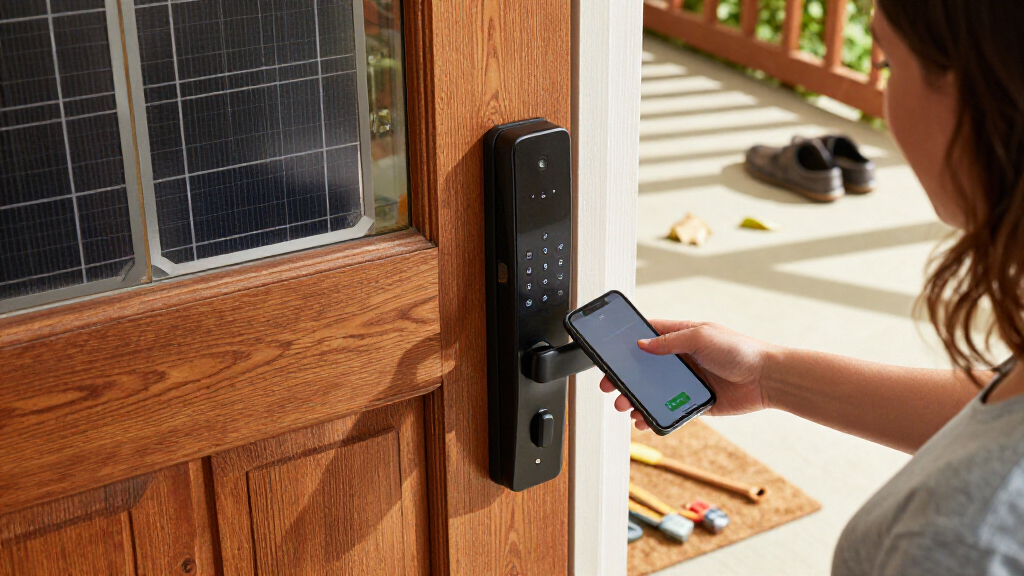
How We Picked
I compared these three products against the needs implied by solar smart lock: solar-assisted power, dependable alternatives when light is limited, useful access methods, smart-home connectivity, and suitability for a real exterior door. A solar panel is only valuable if the lock also has a sensible backup plan, so I paid attention to battery information, USB-C charging, and mechanical-key access where those details were provided.
I ranked the Lockin Veno with Handle first because its listed entry methods and ecosystem support make it the most adaptable choice for households with different preferences. The fingerprint-and-palm-vein Veno follows: its touchless biometric option is distinctive, but the listed IP53 rating and narrower named voice-assistant support make placement and ecosystem fit more relevant. DESLOC ranks third for overall flexibility because its excellent IP65 rating and broad access options come with explicit door-fit limits and app-based remote control. For a door exposed to weather, that IP65 advantage may make it the better personal pick.
I did not treat solar claims as proof that a lock will stay charged in every location. The product details do not give a shared test method for charging performance, so I cannot fairly claim that one solar panel outperforms another. I also weighed the stated BHMA Grade 3 ratings on both Lockin models as a limitation for buyers seeking a higher-grade commercial lock. Finally, I favored concrete fit, weather, and access information over assumptions: where a specification was not supplied, I have not filled the gap with a guess.
| solar smart lock | Model | Power | Connectivity | Weather resistance |
|---|---|---|---|---|
| Lockin Veno Solar Smart Deadbo | Lockin Veno, LKMSD650BL | Perovskite solar panel and 37Wh battery | Built-in Wi-Fi and Matter | IP53 |
| Lockin Veno Solar Smart Deadbo | Lockin Veno Fingerprint, LKMSD650B | Perovskite solar panel, 37Wh battery, USB-C backup | Wi-Fi, Matter, app control | IP53 |
| DESLOC V150 Plus Solar-Powered | DESLOC V150 Plus | Perovskite solar technology and 10,000mAh lithium battery | Built-in Wi-Fi; no hub required | IP65 |
Factors to Consider When Choosing Best Solar Smart Locks
Solar assistance is only one part of choosing a smart deadbolt. I’d match the lock’s power fallback, weather rating, entry methods, and door fit to the entryway before weighing convenience features. The right choice can change if a door is shaded, exposed to rain, used by guests, or connected to a particular smart-home platform.
Treat solar as assistance, not a no-charge guarantee
All three products use perovskite solar technology, but the supplied specifications do not provide a common charging test or guarantee that ambient light will maintain charge in every home. Light levels vary by season, orientation, overhang, and whether the lock sits indoors or outside. The handle-equipped Veno notes that optimal solar performance relies on at least 1000 Lux; the fingerprint-and-palm-vein Veno lists a 37Wh battery and USB-C backup charging. DESLOC pairs solar assistance with a stated 10,000mAh lithium battery. Because the Lockin and DESLOC capacities are expressed in different units, I would not compare their numbers as if they were directly equivalent. Choose a lock with a practical fallback and plan to use it if the entryway receives little light.
Match weather protection to the actual doorway
The two Veno models have IP53 ratings, which the product descriptions characterize as limited or basic splash protection. I would place them at a covered entry rather than a door routinely hit by heavy rain or direct water. DESLOC’s IP65 rating is the strongest stated weather protection here, making it the clearest candidate for a more exposed installation. A rating alone does not answer every question about long-term conditions, so check installation guidance for the precise placement you have in mind. The temperature range listed for DESLOC is also useful for buyers facing wide seasonal swings, while comparable temperature details are not supplied for the Lockin models.
Choose access methods for the people who will use the lock
The handle-equipped Veno offers fingerprint, PIN, app, voice, and mechanical-key access, so it is the most flexible choice for a household that wants different entry options. The other Veno swaps the listed PIN method for palm-vein scanning alongside fingerprint entry, which suits buyers who specifically want touchless biometrics. DESLOC adds 3D face recognition and fingerprint access, with app, voice, and key options; its stored biometric capacity is up to 50 faces and 50 fingerprints. A household with visitors or varied comfort with biometrics may get more use from a PIN or mechanical key than an extra scan method. Compare the access list with the people and routines at your door, not just the number of features.
Check ecosystem support before relying on voice or automation
Built-in Wi-Fi appears across the products, but smart-home compatibility is not identical. The handle-equipped Veno lists Matter and support for Apple Home, Alexa, and Google Home. The fingerprint-and-palm-vein Veno lists Wi-Fi, Matter, app control, and Alexa. DESLOC lists built-in Wi-Fi, no-hub operation, and Alexa or Google Assistant voice support; the supplied details do not name Matter. If automations, platform routines, or voice commands are a core reason for buying, verify compatibility for the exact model and the devices already in your home. Do not assume that two locks in the same product family share every integration.
Measure the door and weigh the security grade
DESLOC supplies specific dimensions: a door thickness from 1-3/8 to 2 inches, a 2-1/8-inch bore hole, and a 2-3/8- or 2-3/4-inch backset. Measure those points before ordering, since a feature-rich lock is not useful if the door is incompatible. The Lockin descriptions supplied here do not provide the same door-fit measurements, so I would check their installation documentation as well. Both Veno listings state BHMA Grade 3; buyers who need a higher security grade should treat that as a limit and look for a product with the grade they require. Convenience features do not replace a security specification that fits the use case.
Plan for network and power interruptions
A connected lock can still have offline moments. DESLOC’s remote app control requires Wi-Fi, while its mechanical key gives the owner a separate way to enter. The Veno with Handle also lists a mechanical key, and the fingerprint-and-palm-vein version lists USB-C backup charging. Keep the relevant physical key accessible outside the locked home, and understand what local access remains available if the router or internet connection is down. Remote management, alerts, and voice features depend on their own connectivity and setup; they should not be treated as replacements for a physical fallback.
Frequently Asked Questions
Will a solar smart lock work in a shaded or dim entryway?
It may still operate using its battery, but the solar contribution can be reduced when the lock receives little light. The handle-equipped Veno lists 1000 Lux as the level for optimal solar performance, while the other Lockin description says efficiency varies with indoor lighting. I would treat solar as a way to help maintain battery charge, not as the sole power source, and check each model’s backup plan for the location you have.
Which of these locks is best for a door exposed to rain?
DESLOC V150 Plus is the strongest match based on the supplied weather ratings: it is listed at IP65, compared with IP53 for both Lockin Veno models. The Lockin ratings are described as basic or limited splash protection, so I would reserve those for a more sheltered entrance. Follow each manufacturer’s installation instructions and confirm that the intended placement is allowed.
Do these smart locks require a hub?
The product details describe built-in Wi-Fi for all three options, and both Lockin models list Matter support; the handle-equipped Veno and DESLOC are expressly described as operating without a hub. The fingerprint-and-palm-vein Veno also has native Wi-Fi and Matter. Smart-home features still depend on the relevant app, network, and supported ecosystem, so check the exact platform you use before buying.
Which lock offers the most entry methods?
The handle-equipped Lockin Veno lists five methods: fingerprint, PIN, app, voice control, and mechanical key. DESLOC also provides a broad set, including face recognition, fingerprint, app, voice assistant, and key access, while the other Veno emphasizes fingerprint and palm-vein biometrics with app and keyless entry. I’d choose by the methods your household will actually use: PIN flexibility favors the handle-equipped Veno, while face recognition or touchless palm scanning points to the other models.
Should I check door measurements before buying?
Yes, and it is especially important for the DESLOC V150 Plus because its listed fit is limited to a 1-3/8- to 2-inch door, a 2-1/8-inch bore hole, and a 2-3/8- or 2-3/4-inch backset. The supplied Lockin details do not give the same fit measurements, so I would still confirm their installation requirements rather than assume compatibility. Measuring first can prevent choosing a lock whose access features and solar setup do not fit the door.
Conclusion
For most buyers seeking one solar-assisted lock that accommodates different household routines, I recommend the Lockin Veno with Handle. Its PIN, fingerprint, app, voice, and key options combine with Matter and named support for Apple Home, Alexa, and Google Home. I’d use it at a sheltered entry and accept its IP53 rating and BHMA Grade 3 security grade as meaningful limits.
Choose the fingerprint-and-palm-vein Veno if touchless biometric entry and USB-C backup charging matter more to you than a PIN or the broader list of named ecosystem integrations. Pick the DESLOC V150 Plus if your compatible door is more exposed to weather, or if face recognition, local biometric storage, and its IP65 rating are priorities. Measure carefully and remember that remote app access depends on Wi-Fi. My final rule is straightforward: select by the entryway’s light and weather, the people who need access, and the backup method you can rely on—not by solar branding alone.